

7 Dynamic Simulation of Mechanical Fluid Separation in Solid …
243
2.2 Sediment Build-up in the Centrifugal Field
Additionally to the settling behavior, sediment build-up in solid bowl centrifuges
effects the separation performance. Here, the properties of the disperse phase have
a huge impact on the physical behavior during the sediment formation process.
Coarsely dispersed particles form an incompressible cake. In contrast, finely dispersed particles form a compressible cake. The reason for this varying behavior
results from the increasing strength of interparticle forces on finely dispersed particles
(x < 10 µm).
The difficulty in describing the sediment structure of finely dispersed particles
lies in the fact that the material behavior changes suddenly at the transition between
suspension and sediment. Particles in a slurry move freely and hydrodynamic effects
primarily influence the settling behavior. The sediment transmits normal and shear
stresses inside the cake. In literature [21, 22], the gel point is defined to mark the
transition between particle settling and cake compression. It is the solids volume
fraction of the top sediment layer for which the solids pressure is p s = 0 Pa.
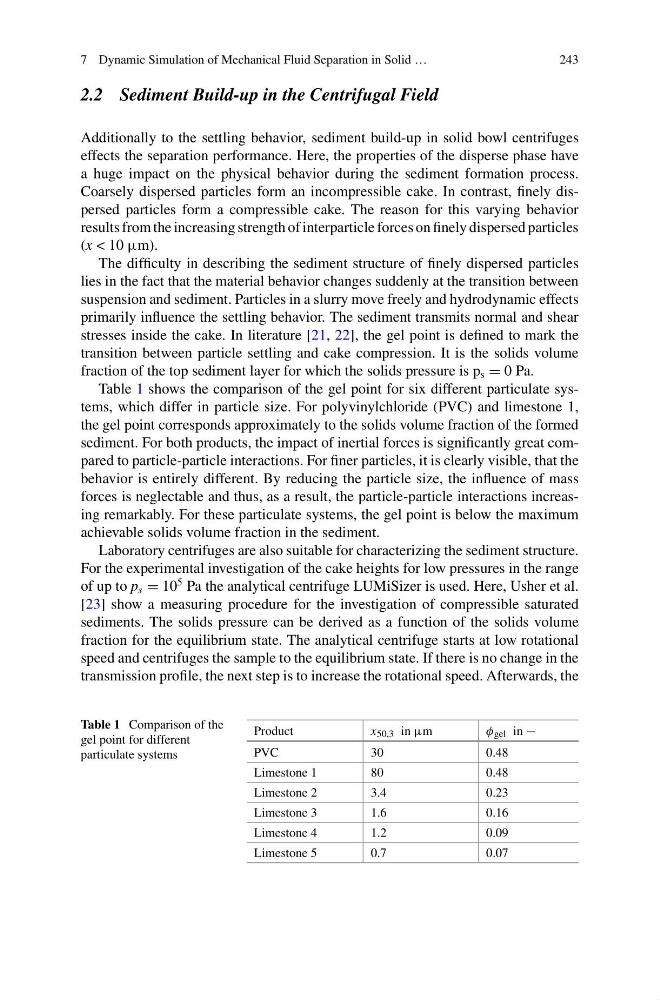
Table 1 shows the comparison of the gel point for six different particulate systems, which differ in particle size. For polyvinylchloride (PVC) and limestone 1,
the gel point corresponds approximately to the solids volume fraction of the formed
sediment. For both products, the impact of inertial forces is significantly great compared to particle-particle interactions. For finer particles, it is clearly visible, that the
behavior is entirely different. By reducing the particle size, the influence of mass
forces is neglectable and thus, as a result, the particle-particle interactions increasing remarkably. For these particulate systems, the gel point is below the maximum
achievable solids volume fraction in the sediment.
Laboratory centrifuges are also suitable for characterizing the sediment structure.
For the experimental investigation of the cake heights for low pressures in the range
of up to p s = 10
5 Pa the analytical centrifuge LUMiSizer is used. Here, Usher et al.
[23] show a measuring procedure for the investigation of compressible saturated
sediments. The solids pressure can be derived as a function of the solids volume
fraction for the equilibrium state. The analytical centrifuge starts at low rotational
speed and centrifuges the sample to the equilibrium state. If there is no change in the
transmission profile, the next step is to increase the rotational speed. Afterwards, the
Table 1 Comparison of the
gel point for different
particulate systems
Product
x 50,3 in µm
φ gel in −
PVC
30
0.48
Limestone 1
80
0.48
Limestone 2
3.4
0.23
Limestone 3
1.6
0.16
Limestone 4
1.2
0.09
Limestone 5
0.7
0.07
243
2.2 Sediment Build-up in the Centrifugal Field
Additionally to the settling behavior, sediment build-up in solid bowl centrifuges
effects the separation performance. Here, the properties of the disperse phase have
a huge impact on the physical behavior during the sediment formation process.
Coarsely dispersed particles form an incompressible cake. In contrast, finely dispersed particles form a compressible cake. The reason for this varying behavior
results from the increasing strength of interparticle forces on finely dispersed particles
(x < 10 µm).
The difficulty in describing the sediment structure of finely dispersed particles
lies in the fact that the material behavior changes suddenly at the transition between
suspension and sediment. Particles in a slurry move freely and hydrodynamic effects
primarily influence the settling behavior. The sediment transmits normal and shear
stresses inside the cake. In literature [21, 22], the gel point is defined to mark the
transition between particle settling and cake compression. It is the solids volume
fraction of the top sediment layer for which the solids pressure is p s = 0 Pa.
Table 1 shows the comparison of the gel point for six different particulate systems, which differ in particle size. For polyvinylchloride (PVC) and limestone 1,
the gel point corresponds approximately to the solids volume fraction of the formed
sediment. For both products, the impact of inertial forces is significantly great compared to particle-particle interactions. For finer particles, it is clearly visible, that the
behavior is entirely different. By reducing the particle size, the influence of mass
forces is neglectable and thus, as a result, the particle-particle interactions increasing remarkably. For these particulate systems, the gel point is below the maximum
achievable solids volume fraction in the sediment.
Laboratory centrifuges are also suitable for characterizing the sediment structure.
For the experimental investigation of the cake heights for low pressures in the range
of up to p s = 10
5 Pa the analytical centrifuge LUMiSizer is used. Here, Usher et al.
[23] show a measuring procedure for the investigation of compressible saturated
sediments. The solids pressure can be derived as a function of the solids volume
fraction for the equilibrium state. The analytical centrifuge starts at low rotational
speed and centrifuges the sample to the equilibrium state. If there is no change in the
transmission profile, the next step is to increase the rotational speed. Afterwards, the
Table 1 Comparison of the
gel point for different
particulate systems
Product
x 50,3 in µm
φ gel in −
PVC
30
0.48
Limestone 1
80
0.48
Limestone 2
3.4
0.23
Limestone 3
1.6
0.16
Limestone 4
1.2
0.09
Limestone 5
0.7
0.07