

242
M. Gleiss and H. Nirschl
Richardson and Zaki [18] postulate a power law based on experimental investigation for the hindered settling
h = (1 − φ)
n RZ ,
(1)
for slurries consisting of monodisperse particles. For creeping flows (Re p < 0.1), the
exponent n RZ is 4.65. The approach of Richardson and Zaki, however, is only valid for
monodisperse particles and therefore represents a simplification of the real behavior
of a polydisperse particle system. To investigate these, it is appropriate to measure the
material function for settling behavior by means of analytical centrifugation. Often
the hindered settling approach
h =
1 −
φ
r 1
r 2
,
(2)
of Michaels and Bolger is applied in this case to adapt to the experimental data
[19]. Here, r 1 and r 2 be adapted to fit the experimental data. Figure 1 Schematic
representation of the measuring principle for the analytical centrifuge LUMiSizer
(a). Temporal change of transmission along the radius of a cuvette for the product
limestone (b).
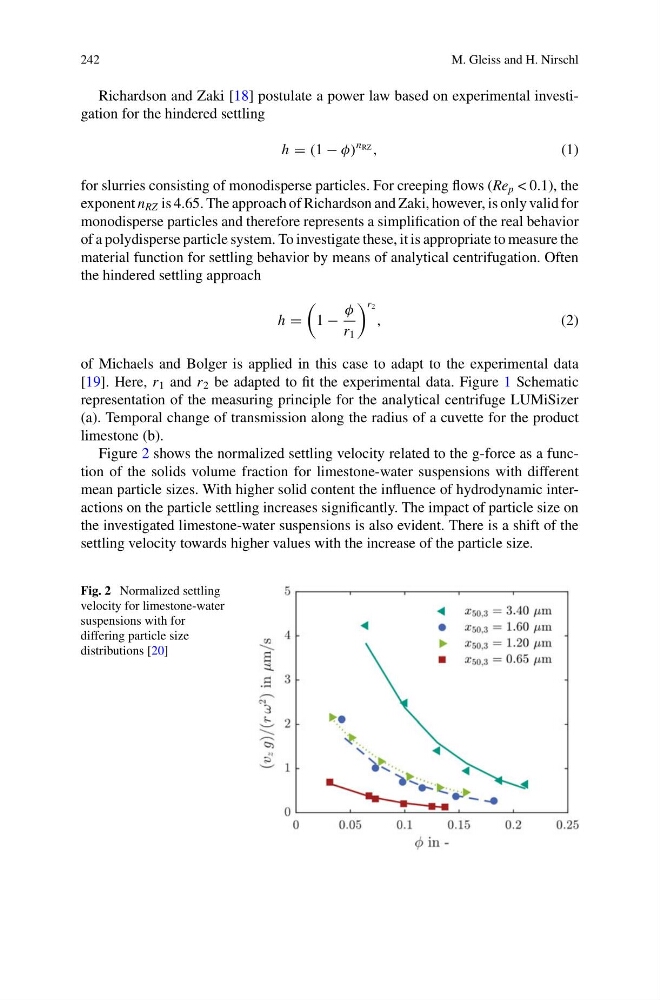
Figure 2 shows the normalized settling velocity related to the g-force as a function of the solids volume fraction for limestone-water suspensions with different
mean particle sizes. With higher solid content the influence of hydrodynamic interactions on the particle settling increases significantly. The impact of particle size on
the investigated limestone-water suspensions is also evident. There is a shift of the
settling velocity towards higher values with the increase of the particle size.
Fig. 2 Normalized settling
velocity for limestone-water
suspensions with for
differing particle size
distributions [20]
M. Gleiss and H. Nirschl
Richardson and Zaki [18] postulate a power law based on experimental investigation for the hindered settling
h = (1 − φ)
n RZ ,
(1)
for slurries consisting of monodisperse particles. For creeping flows (Re p < 0.1), the
exponent n RZ is 4.65. The approach of Richardson and Zaki, however, is only valid for
monodisperse particles and therefore represents a simplification of the real behavior
of a polydisperse particle system. To investigate these, it is appropriate to measure the
material function for settling behavior by means of analytical centrifugation. Often
the hindered settling approach
h =
1 −
φ
r 1
r 2
,
(2)
of Michaels and Bolger is applied in this case to adapt to the experimental data
[19]. Here, r 1 and r 2 be adapted to fit the experimental data. Figure 1 Schematic
representation of the measuring principle for the analytical centrifuge LUMiSizer
(a). Temporal change of transmission along the radius of a cuvette for the product
limestone (b).
Figure 2 shows the normalized settling velocity related to the g-force as a function of the solids volume fraction for limestone-water suspensions with different
mean particle sizes. With higher solid content the influence of hydrodynamic interactions on the particle settling increases significantly. The impact of particle size on
the investigated limestone-water suspensions is also evident. There is a shift of the
settling velocity towards higher values with the increase of the particle size.
Fig. 2 Normalized settling
velocity for limestone-water
suspensions with for
differing particle size
distributions [20]