

7 Dynamic Simulation of Mechanical Fluid Separation in Solid …
241
the process behavior depends on various influencing factors for instance, the settling
behavior, sediment build-up, sediment transport and mechanical dewatering [16, 17].
In the following subsection the experimental investigation of material functions for
finely dispersed materials is presented in more detail.
2.1 Settling Behavior of Finely Dispersed Particles
in the Centrifugal Field
The settling behavior of finely dispersed particles has a decisive influence on the
separation efficiency of solid bowl centrifuges. Especially in the case of a high solid
content, the particles affect each other due to an increasing hydrodynamic interaction
between solid and liquid. As a result, Stokes law for particle settling is no longer valid
and a correction function for hindered settling is necessary. A measuring system for
determining the settling behavior of slurries is the LUMiSizer, which is an analytical
centrifuge for the investigation of small product quantities of a few milliliters [15].
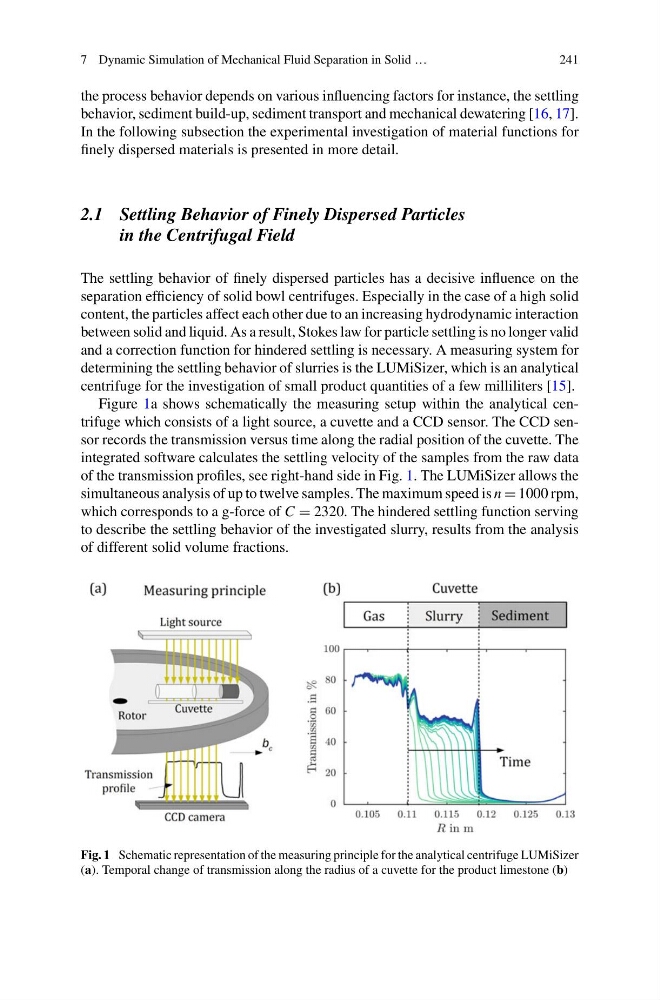
Figure 1a shows schematically the measuring setup within the analytical centrifuge which consists of a light source, a cuvette and a CCD sensor. The CCD sensor records the transmission versus time along the radial position of the cuvette. The
integrated software calculates the settling velocity of the samples from the raw data
of the transmission profiles, see right-hand side in Fig. 1. The LUMiSizer allows the
simultaneous analysis of up to twelve samples. The maximum speed is n = 1000 rpm,
which corresponds to a g-force of C = 2320. The hindered settling function serving
to describe the settling behavior of the investigated slurry, results from the analysis
of different solid volume fractions.
Fig. 1 Schematic representation of the measuring principle for the analytical centrifuge LUMiSizer
(a). Temporal change of transmission along the radius of a cuvette for the product limestone (b)
241
the process behavior depends on various influencing factors for instance, the settling
behavior, sediment build-up, sediment transport and mechanical dewatering [16, 17].
In the following subsection the experimental investigation of material functions for
finely dispersed materials is presented in more detail.
2.1 Settling Behavior of Finely Dispersed Particles
in the Centrifugal Field
The settling behavior of finely dispersed particles has a decisive influence on the
separation efficiency of solid bowl centrifuges. Especially in the case of a high solid
content, the particles affect each other due to an increasing hydrodynamic interaction
between solid and liquid. As a result, Stokes law for particle settling is no longer valid
and a correction function for hindered settling is necessary. A measuring system for
determining the settling behavior of slurries is the LUMiSizer, which is an analytical
centrifuge for the investigation of small product quantities of a few milliliters [15].
Figure 1a shows schematically the measuring setup within the analytical centrifuge which consists of a light source, a cuvette and a CCD sensor. The CCD sensor records the transmission versus time along the radial position of the cuvette. The
integrated software calculates the settling velocity of the samples from the raw data
of the transmission profiles, see right-hand side in Fig. 1. The LUMiSizer allows the
simultaneous analysis of up to twelve samples. The maximum speed is n = 1000 rpm,
which corresponds to a g-force of C = 2320. The hindered settling function serving
to describe the settling behavior of the investigated slurry, results from the analysis
of different solid volume fractions.
Fig. 1 Schematic representation of the measuring principle for the analytical centrifuge LUMiSizer
(a). Temporal change of transmission along the radius of a cuvette for the product limestone (b)