

230
G. Fragnière et al.
It is obvious that there is a close interaction of the parameters affecting the axial
grinding media distribution. Especially the tip speed and the volume flow rate influence the grinding media transport along the x-axis and can easily be adjusted during
the operation of the mill.
7 Flowsheet Model
In the following the application of the dynamic grinding model for a horizontal stirred
media mill is shown. The model is implemented in the dynamic flowsheet simulation software Dyssol [36]. The change of the particle size distribution is calculated
via population balance equations. The milling chamber is simulated as a series of
instantly mixed cells that are connected by mixing streams. The cells allow for a
simplified simulation of the grinding bead filling level and the product transport
through the stirred media mill. Exemplarily, the effect of the solids concentration
and the volume flow on grinding and residence time distribution is investigated. The
dynamic response of the product particle size distribution at the mill outlet after stepwise change of these process parameters is shown. The simulations are compared to
experimental investigations with limestone in a laboratory stirred media mill.
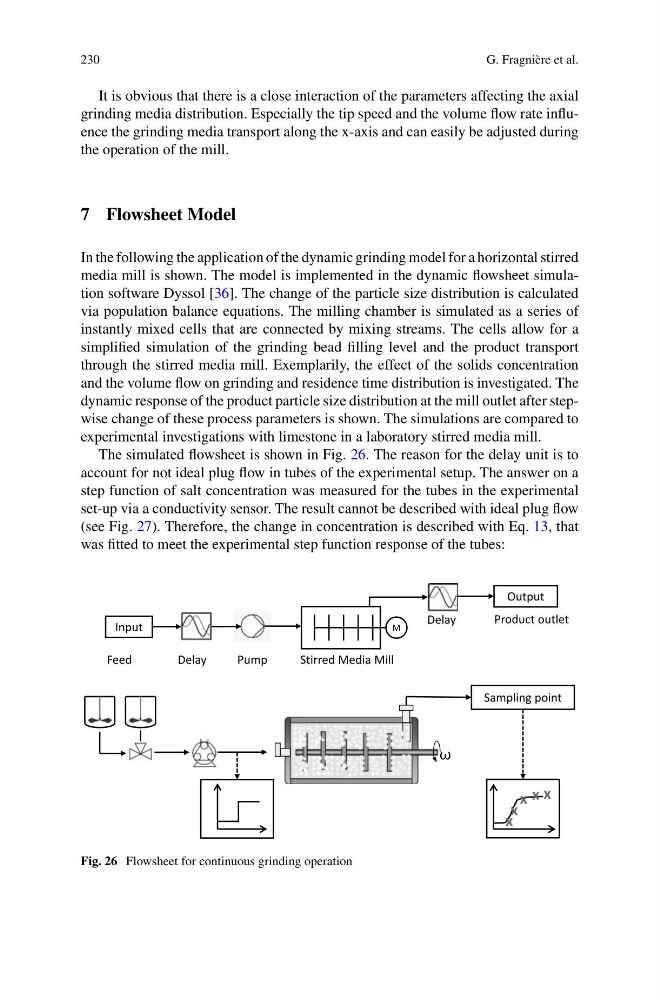
The simulated flowsheet is shown in Fig. 26. The reason for the delay unit is to
account for not ideal plug flow in tubes of the experimental setup. The answer on a
step function of salt concentration was measured for the tubes in the experimental
set-up via a conductivity sensor. The result cannot be described with ideal plug flow
(see Fig. 27). Therefore, the change in concentration is described with Eq. 13, that
was fitted to meet the experimental step function response of the tubes:
Fig. 26 Flowsheet for continuous grinding operation
G. Fragnière et al.
It is obvious that there is a close interaction of the parameters affecting the axial
grinding media distribution. Especially the tip speed and the volume flow rate influence the grinding media transport along the x-axis and can easily be adjusted during
the operation of the mill.
7 Flowsheet Model
In the following the application of the dynamic grinding model for a horizontal stirred
media mill is shown. The model is implemented in the dynamic flowsheet simulation software Dyssol [36]. The change of the particle size distribution is calculated
via population balance equations. The milling chamber is simulated as a series of
instantly mixed cells that are connected by mixing streams. The cells allow for a
simplified simulation of the grinding bead filling level and the product transport
through the stirred media mill. Exemplarily, the effect of the solids concentration
and the volume flow on grinding and residence time distribution is investigated. The
dynamic response of the product particle size distribution at the mill outlet after stepwise change of these process parameters is shown. The simulations are compared to
experimental investigations with limestone in a laboratory stirred media mill.
The simulated flowsheet is shown in Fig. 26. The reason for the delay unit is to
account for not ideal plug flow in tubes of the experimental setup. The answer on a
step function of salt concentration was measured for the tubes in the experimental
set-up via a conductivity sensor. The result cannot be described with ideal plug flow
(see Fig. 27). Therefore, the change in concentration is described with Eq. 13, that
was fitted to meet the experimental step function response of the tubes:
Fig. 26 Flowsheet for continuous grinding operation