

6 Dynamic Process Models for Fine Grinding and Dispersing
229
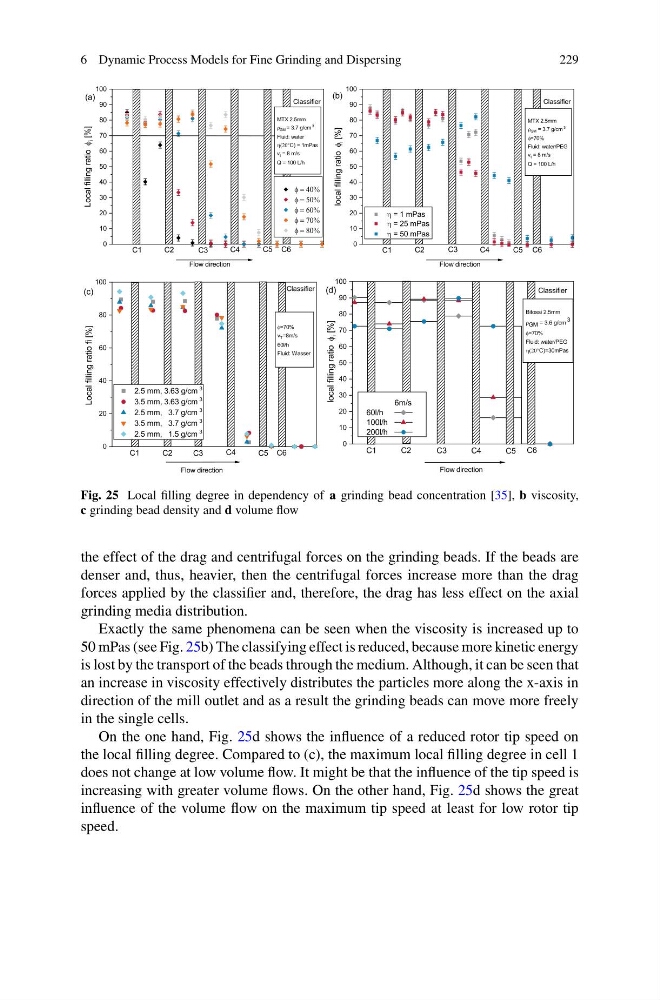
Fig. 25 Local filling degree in dependency of a grinding bead concentration [35], b viscosity,
c grinding bead density and d volume flow
the effect of the drag and centrifugal forces on the grinding beads. If the beads are
denser and, thus, heavier, then the centrifugal forces increase more than the drag
forces applied by the classifier and, therefore, the drag has less effect on the axial
grinding media distribution.
Exactly the same phenomena can be seen when the viscosity is increased up to
50 mPas (see Fig. 25b) The classifying effect is reduced, because more kinetic energy
is lost by the transport of the beads through the medium. Although, it can be seen that
an increase in viscosity effectively distributes the particles more along the x-axis in
direction of the mill outlet and as a result the grinding beads can move more freely
in the single cells.
On the one hand, Fig. 25d shows the influence of a reduced rotor tip speed on
the local filling degree. Compared to (c), the maximum local filling degree in cell 1
does not change at low volume flow. It might be that the influence of the tip speed is
increasing with greater volume flows. On the other hand, Fig. 25d shows the great
influence of the volume flow on the maximum tip speed at least for low rotor tip
speed.
229
Fig. 25 Local filling degree in dependency of a grinding bead concentration [35], b viscosity,
c grinding bead density and d volume flow
the effect of the drag and centrifugal forces on the grinding beads. If the beads are
denser and, thus, heavier, then the centrifugal forces increase more than the drag
forces applied by the classifier and, therefore, the drag has less effect on the axial
grinding media distribution.
Exactly the same phenomena can be seen when the viscosity is increased up to
50 mPas (see Fig. 25b) The classifying effect is reduced, because more kinetic energy
is lost by the transport of the beads through the medium. Although, it can be seen that
an increase in viscosity effectively distributes the particles more along the x-axis in
direction of the mill outlet and as a result the grinding beads can move more freely
in the single cells.
On the one hand, Fig. 25d shows the influence of a reduced rotor tip speed on
the local filling degree. Compared to (c), the maximum local filling degree in cell 1
does not change at low volume flow. It might be that the influence of the tip speed is
increasing with greater volume flows. On the other hand, Fig. 25d shows the great
influence of the volume flow on the maximum tip speed at least for low rotor tip
speed.