

16
S. Sander et al.
where m = 1/270 is the area ratio of a turbulent burst and j is the number of
bursts particles undergo inside the precipitator. A typical mean pathway for a particle
detaching from and then reattaching to the walls is shown in Fig. 8.
Concerning cluster removal by particle impact, an additional hit towards the walls
increases the kinetic energy onto the particle layer and on the particle bounds inside
the layer, respectively. The energy will be dissipated to some extent, e.g. into layer
rearrangements, thermal and mechanical stresses, while the main part of the energy
is used towards the breakage of the bounds inside the layer.
Each bound break down at a singular level. Thus, the maximal energy into the
breakage of the layer is compared to the layer bonds energy. Based on layer properties,
the number of bounds may be estimated, e.g. for highly porous layers. According to
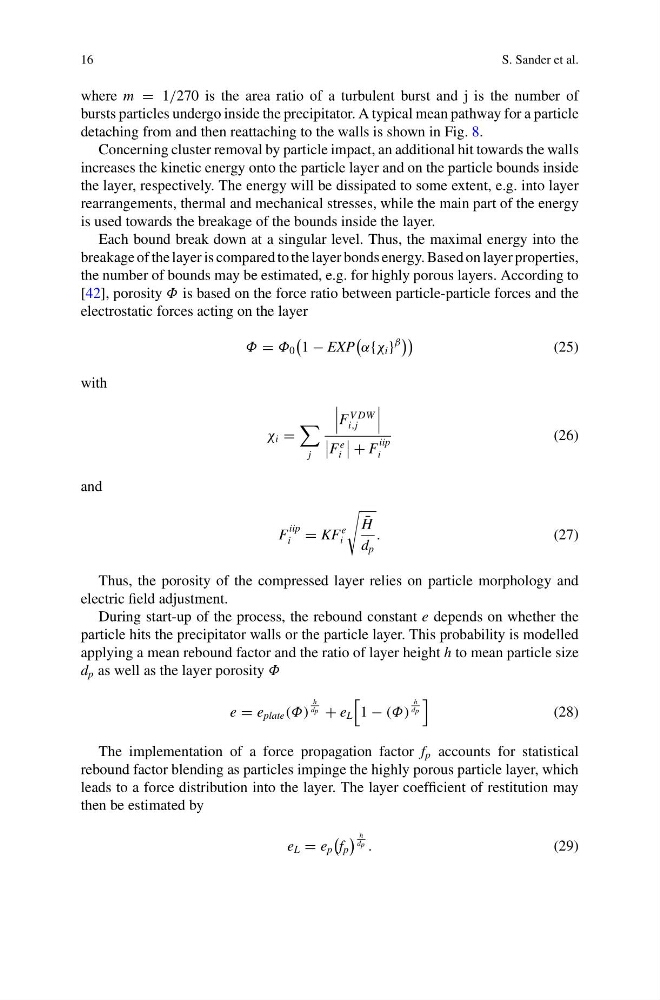
[42], porosity Φ is based on the force ratio between particle-particle forces and the
electrostatic forces acting on the layer
Φ = Φ 0
1 − EXP
α{χ i }
β
(25)
with
χ i =
j
F
V DW
i,j
F
e
i
+ F
iip
i
(26)
and
F
iip
i = KF
e
i
¯
H
d p
.
(27)
Thus, the porosity of the compressed layer relies on particle morphology and
electric field adjustment.
During start-up of the process, the rebound constant e depends on whether the
particle hits the precipitator walls or the particle layer. This probability is modelled
applying a mean rebound factor and the ratio of layer height h to mean particle size
d p as well as the layer porosity Φ
e = e plate (Φ)
h
dp
+ e L
1 − (Φ)
h
dp
(28)
The implementation of a force propagation factor f p accounts for statistical
rebound factor blending as particles impinge the highly porous particle layer, which
leads to a force distribution into the layer. The layer coefficient of restitution may
then be estimated by
e L = e p
f p
h
dp
.
(29)
S. Sander et al.
where m = 1/270 is the area ratio of a turbulent burst and j is the number of
bursts particles undergo inside the precipitator. A typical mean pathway for a particle
detaching from and then reattaching to the walls is shown in Fig. 8.
Concerning cluster removal by particle impact, an additional hit towards the walls
increases the kinetic energy onto the particle layer and on the particle bounds inside
the layer, respectively. The energy will be dissipated to some extent, e.g. into layer
rearrangements, thermal and mechanical stresses, while the main part of the energy
is used towards the breakage of the bounds inside the layer.
Each bound break down at a singular level. Thus, the maximal energy into the
breakage of the layer is compared to the layer bonds energy. Based on layer properties,
the number of bounds may be estimated, e.g. for highly porous layers. According to
[42], porosity Φ is based on the force ratio between particle-particle forces and the
electrostatic forces acting on the layer
Φ = Φ 0
1 − EXP
α{χ i }
β
(25)
with
χ i =
j
F
V DW
i,j
F
e
i
+ F
iip
i
(26)
and
F
iip
i = KF
e
i
¯
H
d p
.
(27)
Thus, the porosity of the compressed layer relies on particle morphology and
electric field adjustment.
During start-up of the process, the rebound constant e depends on whether the
particle hits the precipitator walls or the particle layer. This probability is modelled
applying a mean rebound factor and the ratio of layer height h to mean particle size
d p as well as the layer porosity Φ
e = e plate (Φ)
h
dp
+ e L
1 − (Φ)
h
dp
(28)
The implementation of a force propagation factor f p accounts for statistical
rebound factor blending as particles impinge the highly porous particle layer, which
leads to a force distribution into the layer. The layer coefficient of restitution may
then be estimated by
e L = e p
f p
h
dp
.
(29)