

1 Process Modeling for Dynamic Disperse Particle Separation …
15
been attached to the separation walls back towards the free stream [36, 37]. Both
effects arise mainly for low resistive particles, which keep their electric charge yield
a force towards the wall, preventing detachment from the walls. In high resistive
layers, electric discharges and back-corona ignite similar re-dispersive behavior of
the particulate matter. The derived model is capable of mapping and calculation both
phenomena, however, the analysis will focus on low resistivity particulate matter.
Therefore, two oxide materials are subject to examination, a natural oxide CaCO 3
and a metal oxide Al 2 O 3 . They only slightly differ in terms of separation efficiencies
and discharge quickly as they impact the layer. Yet, the metal oxide has a higher
degree of hardness.
The three main mechanisms which cause redispersion for these oxides are bouncing of the unoccupied wall and the sparse layer, turbulence induced redispersion due
to flow conditions and cluster removal due to particle impacts.
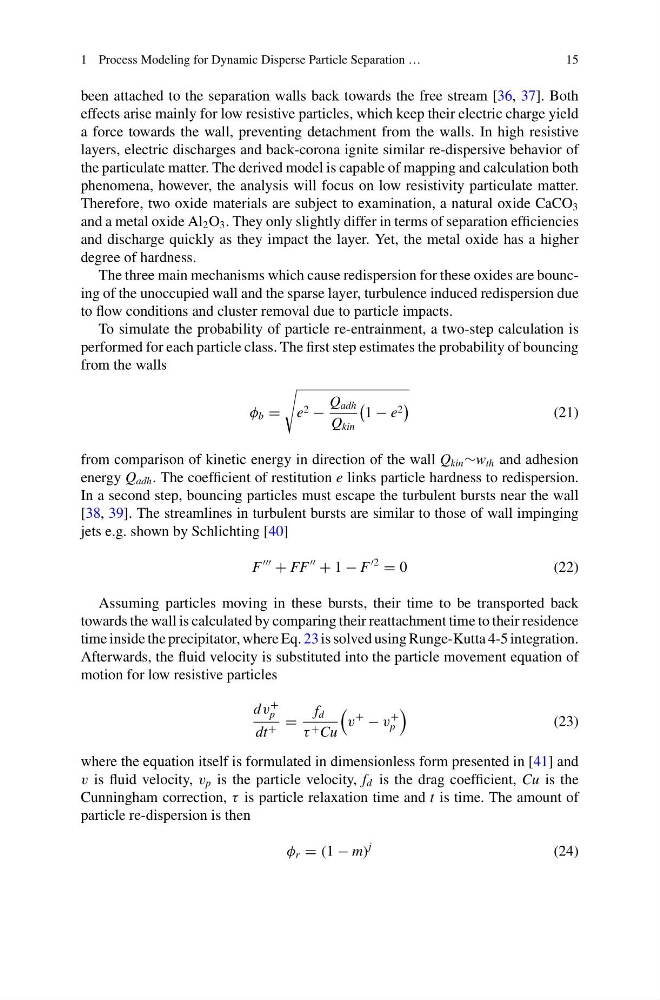
To simulate the probability of particle re-entrainment, a two-step calculation is
performed for each particle class. The first step estimates the probability of bouncing
from the walls
φ b =
e 2 −
Q adh
Q kin
1 − e 2
(21)
from comparison of kinetic energy in direction of the wall Q kin ∼w th and adhesion
energy Q adh . The coefficient of restitution e links particle hardness to redispersion.
In a second step, bouncing particles must escape the turbulent bursts near the wall
[38, 39]. The streamlines in turbulent bursts are similar to those of wall impinging
jets e.g. shown by Schlichting [40]
F
+ FF
+ 1 − F
2
= 0
( 2 2 )
Assuming particles moving in these bursts, their time to be transported back
towards the wall is calculated by comparing their reattachment time to their residence
time inside the precipitator, where Eq. 23 is solved using Runge-Kutta 4-5 integration.
Afterwards, the fluid velocity is substituted into the particle movement equation of
motion for low resistive particles
d v
+
p
dt + =
f d
τ + Cu
v
+
− v
+
p
(23)
where the equation itself is formulated in dimensionless form presented in [41] and
v is fluid velocity, v p is the particle velocity, f d is the drag coefficient, Cu is the
Cunningham correction, τ is particle relaxation time and t is time. The amount of
particle re-dispersion is then
φ r = (1 − m)
j
(24)
15
been attached to the separation walls back towards the free stream [36, 37]. Both
effects arise mainly for low resistive particles, which keep their electric charge yield
a force towards the wall, preventing detachment from the walls. In high resistive
layers, electric discharges and back-corona ignite similar re-dispersive behavior of
the particulate matter. The derived model is capable of mapping and calculation both
phenomena, however, the analysis will focus on low resistivity particulate matter.
Therefore, two oxide materials are subject to examination, a natural oxide CaCO 3
and a metal oxide Al 2 O 3 . They only slightly differ in terms of separation efficiencies
and discharge quickly as they impact the layer. Yet, the metal oxide has a higher
degree of hardness.
The three main mechanisms which cause redispersion for these oxides are bouncing of the unoccupied wall and the sparse layer, turbulence induced redispersion due
to flow conditions and cluster removal due to particle impacts.
To simulate the probability of particle re-entrainment, a two-step calculation is
performed for each particle class. The first step estimates the probability of bouncing
from the walls
φ b =
e 2 −
Q adh
Q kin
1 − e 2
(21)
from comparison of kinetic energy in direction of the wall Q kin ∼w th and adhesion
energy Q adh . The coefficient of restitution e links particle hardness to redispersion.
In a second step, bouncing particles must escape the turbulent bursts near the wall
[38, 39]. The streamlines in turbulent bursts are similar to those of wall impinging
jets e.g. shown by Schlichting [40]
F
+ FF
+ 1 − F
2
= 0
( 2 2 )
Assuming particles moving in these bursts, their time to be transported back
towards the wall is calculated by comparing their reattachment time to their residence
time inside the precipitator, where Eq. 23 is solved using Runge-Kutta 4-5 integration.
Afterwards, the fluid velocity is substituted into the particle movement equation of
motion for low resistive particles
d v
+
p
dt + =
f d
τ + Cu
v
+
− v
+
p
(23)
where the equation itself is formulated in dimensionless form presented in [41] and
v is fluid velocity, v p is the particle velocity, f d is the drag coefficient, Cu is the
Cunningham correction, τ is particle relaxation time and t is time. The amount of
particle re-dispersion is then
φ r = (1 − m)
j
(24)