

14
S. Sander et al.
2.11 Effective Electric Field
The mean electric field applied to the particles comprises of the applied voltage
at the electrodes, the electrode geometry and the particle trajectories through the
precipitator. Thus, a complex interplay of particle acceleration towards the walls
and the charging due to the field arises, which is important as the electrodes do
not generate a constant field throughout the ESP. To avoid immense computational
costs, this coupling is modeled, using an electrode specific effective field parameter
CE = E electrode /E plate , where E plate is the electric field of a plate-to-plate capacitor
with similar dimensions (see [34]).
2.12 Ion Concentration
Besides the electric field, the ion concentration inside ESP is spatially distributed.
Again, the dependency of the particle tracks on charging and vice versa rises a need
to model the mean field by application of an electrode geometry dependent mean
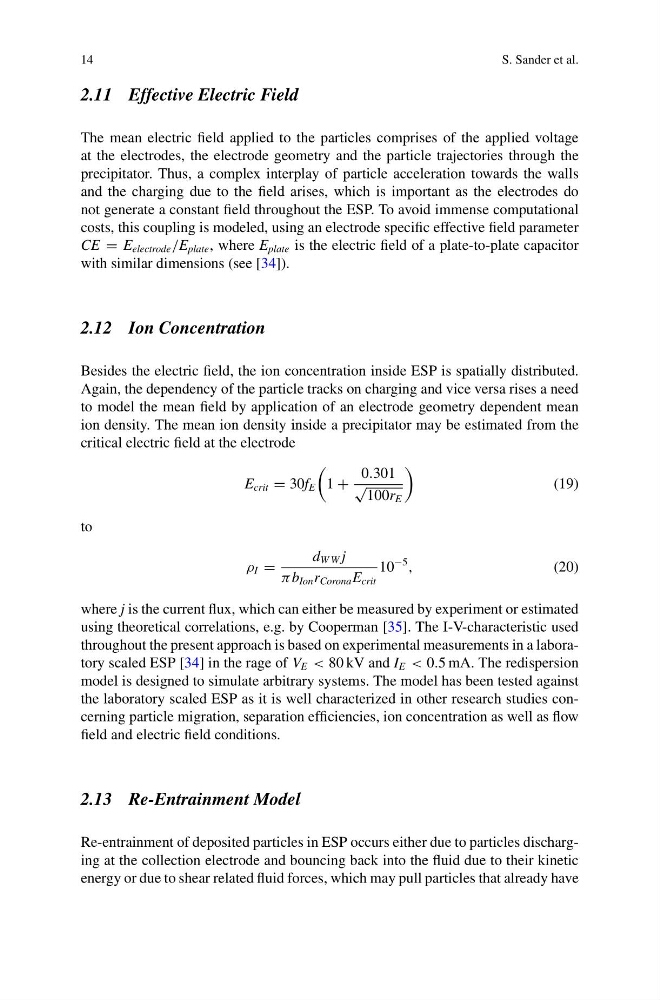
ion density. The mean ion density inside a precipitator may be estimated from the
critical electric field at the electrode
E crit = 30f E
1 +
0.301
√
100r E
(19)
to
ρ I =
d W W j
π b Ion r Corona E crit
10
−5
,
(20)
where j is the current flux, which can either be measured by experiment or estimated
using theoretical correlations, e.g. by Cooperman [35]. The I-V-characteristic used
throughout the present approach is based on experimental measurements in a laboratory scaled ESP [34] in the rage of V E < 80 kV and I E < 0.5 mA. The redispersion
model is designed to simulate arbitrary systems. The model has been tested against
the laboratory scaled ESP as it is well characterized in other research studies concerning particle migration, separation efficiencies, ion concentration as well as flow
field and electric field conditions.
2.13 Re-Entrainment Model
Re-entrainment of deposited particles in ESP occurs either due to particles discharging at the collection electrode and bouncing back into the fluid due to their kinetic
energy or due to shear related fluid forces, which may pull particles that already have
S. Sander et al.
2.11 Effective Electric Field
The mean electric field applied to the particles comprises of the applied voltage
at the electrodes, the electrode geometry and the particle trajectories through the
precipitator. Thus, a complex interplay of particle acceleration towards the walls
and the charging due to the field arises, which is important as the electrodes do
not generate a constant field throughout the ESP. To avoid immense computational
costs, this coupling is modeled, using an electrode specific effective field parameter
CE = E electrode /E plate , where E plate is the electric field of a plate-to-plate capacitor
with similar dimensions (see [34]).
2.12 Ion Concentration
Besides the electric field, the ion concentration inside ESP is spatially distributed.
Again, the dependency of the particle tracks on charging and vice versa rises a need
to model the mean field by application of an electrode geometry dependent mean
ion density. The mean ion density inside a precipitator may be estimated from the
critical electric field at the electrode
E crit = 30f E
1 +
0.301
√
100r E
(19)
to
ρ I =
d W W j
π b Ion r Corona E crit
10
−5
,
(20)
where j is the current flux, which can either be measured by experiment or estimated
using theoretical correlations, e.g. by Cooperman [35]. The I-V-characteristic used
throughout the present approach is based on experimental measurements in a laboratory scaled ESP [34] in the rage of V E < 80 kV and I E < 0.5 mA. The redispersion
model is designed to simulate arbitrary systems. The model has been tested against
the laboratory scaled ESP as it is well characterized in other research studies concerning particle migration, separation efficiencies, ion concentration as well as flow
field and electric field conditions.
2.13 Re-Entrainment Model
Re-entrainment of deposited particles in ESP occurs either due to particles discharging at the collection electrode and bouncing back into the fluid due to their kinetic
energy or due to shear related fluid forces, which may pull particles that already have