

1 Process Modeling for Dynamic Disperse Particle Separation …
13
In the second stage, the possible redispersion of particles from the deposited layer
back into the flow field is characterized on the basis of the particles in the holdup.
A mean characteristic is determined by defining a reentry probability. Particles that
do not reenter the gas stream end up as finally separated at the outlet of the model
while the exhaust gas stream contains all the non-separated and redispersed particles
in the first step.
The dynamic FSS simulation environment “dysSol” of Skorych et al. [33] is
utilized as a simulation frame where a new dynamic model unit “ESP” calculates
the evolving particle sizes and masses at the outlet of the precipitator with time. The
precipitation rate defines the transformation matrix used in the framework.
While the collection area and the flow rate are easily determined and usually
previously known, especially the particle migration velocity inside ESP is to be
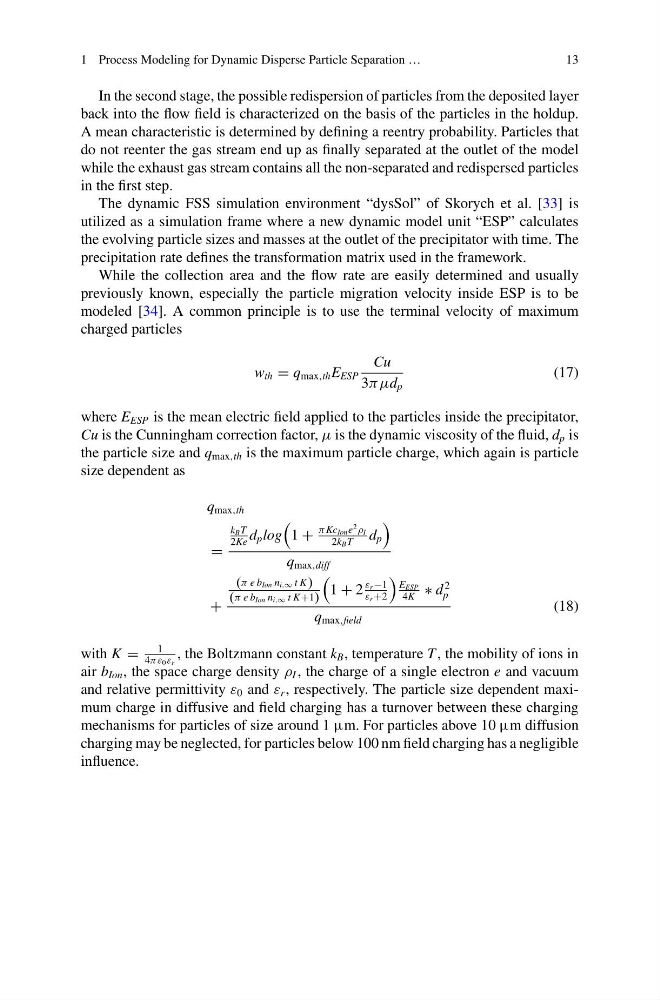
modeled [34]. A common principle is to use the terminal velocity of maximum
charged particles
w th = q max,th E ESP
Cu
3πμd p
(17)
where E ESP is the mean electric field applied to the particles inside the precipitator,
Cu is the Cunningham correction factor, μ is the dynamic viscosity of the fluid, d p is
the particle size and q max,th is the maximum particle charge, which again is particle
size dependent as
q max,th
=
k B T
2Ke
d p log
1 +
πKc Ion e
2 ρ I
2k B T
d p
q max,diff
+
(π e b Ion n i,∞ t K)
(π e b Ion n i,∞ t K+1)
1 + 2
ε r −1
ε r +2
E ESP
4K
∗ d
2
p
q max,field
(18)
with K =
1
4πε 0 ε r
, the Boltzmann constant k B , temperature T , the mobility of ions in
air b Ion , the space charge density ρ I , the charge of a single electron e and vacuum
and relative permittivity ε 0 and ε r , respectively. The particle size dependent maximum charge in diffusive and field charging has a turnover between these charging
mechanisms for particles of size around 1 μm. For particles above 10 μm diffusion
charging may be neglected, for particles below 100 nm field charging has a negligible
influence.
13
In the second stage, the possible redispersion of particles from the deposited layer
back into the flow field is characterized on the basis of the particles in the holdup.
A mean characteristic is determined by defining a reentry probability. Particles that
do not reenter the gas stream end up as finally separated at the outlet of the model
while the exhaust gas stream contains all the non-separated and redispersed particles
in the first step.
The dynamic FSS simulation environment “dysSol” of Skorych et al. [33] is
utilized as a simulation frame where a new dynamic model unit “ESP” calculates
the evolving particle sizes and masses at the outlet of the precipitator with time. The
precipitation rate defines the transformation matrix used in the framework.
While the collection area and the flow rate are easily determined and usually
previously known, especially the particle migration velocity inside ESP is to be
modeled [34]. A common principle is to use the terminal velocity of maximum
charged particles
w th = q max,th E ESP
Cu
3πμd p
(17)
where E ESP is the mean electric field applied to the particles inside the precipitator,
Cu is the Cunningham correction factor, μ is the dynamic viscosity of the fluid, d p is
the particle size and q max,th is the maximum particle charge, which again is particle
size dependent as
q max,th
=
k B T
2Ke
d p log
1 +
πKc Ion e
2 ρ I
2k B T
d p
q max,diff
+
(π e b Ion n i,∞ t K)
(π e b Ion n i,∞ t K+1)
1 + 2
ε r −1
ε r +2
E ESP
4K
∗ d
2
p
q max,field
(18)
with K =
1
4πε 0 ε r
, the Boltzmann constant k B , temperature T , the mobility of ions in
air b Ion , the space charge density ρ I , the charge of a single electron e and vacuum
and relative permittivity ε 0 and ε r , respectively. The particle size dependent maximum charge in diffusive and field charging has a turnover between these charging
mechanisms for particles of size around 1 μm. For particles above 10 μm diffusion
charging may be neglected, for particles below 100 nm field charging has a negligible
influence.