

6 Dynamic Process Models for Fine Grinding and Dispersing
211
the simulation is t = 150 ms. Due to reasons of the mesh refinement the contact of
the grinding beads was not examined.
Through varying the angular velocities of the grinding beads the rotation based
effects of shearing and rolling on the capture probability of product particles were
considered. Due to the approach of the grinding beads the fluid is accelerated out of
the gap between the grinding media resulting in a transport of the product particles
with the fluid out of the resulting gap. Depending on the local flow field, the acceleration of the product particles is less pronounced with increasing angular velocity
of the approaching grinding beads, leading to an increased capture probability. Five
speed combinations are examined, shear and rolling motion are calculated using an
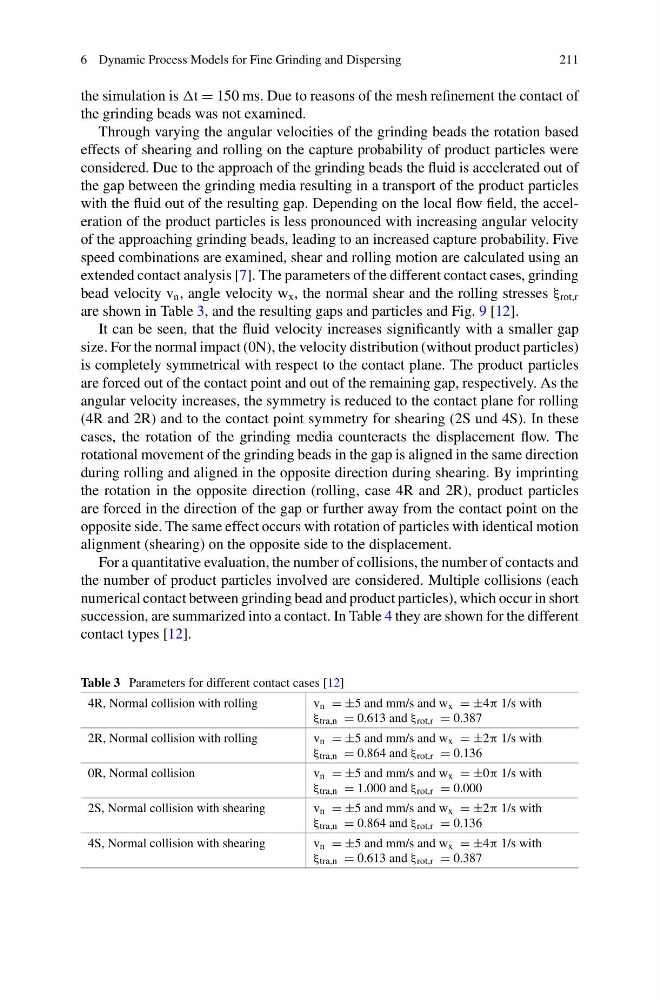
extended contact analysis [7]. The parameters of the different contact cases, grinding
bead velocity v n , angle velocity w x , the normal shear and the rolling stresses ξ rot,r
are shown in Table 3, and the resulting gaps and particles and Fig. 9 [12].
It can be seen, that the fluid velocity increases significantly with a smaller gap
size. For the normal impact (0N), the velocity distribution (without product particles)
is completely symmetrical with respect to the contact plane. The product particles
are forced out of the contact point and out of the remaining gap, respectively. As the
angular velocity increases, the symmetry is reduced to the contact plane for rolling
(4R and 2R) and to the contact point symmetry for shearing (2S und 4S). In these
cases, the rotation of the grinding media counteracts the displacement flow. The
rotational movement of the grinding beads in the gap is aligned in the same direction
during rolling and aligned in the opposite direction during shearing. By imprinting
the rotation in the opposite direction (rolling, case 4R and 2R), product particles
are forced in the direction of the gap or further away from the contact point on the
opposite side. The same effect occurs with rotation of particles with identical motion
alignment (shearing) on the opposite side to the displacement.
For a quantitative evaluation, the number of collisions, the number of contacts and
the number of product particles involved are considered. Multiple collisions (each
numerical contact between grinding bead and product particles), which occur in short
succession, are summarized into a contact. In Table 4 they are shown for the different
contact types [12].
Table 3 Parameters for different contact cases [12]
4R, Normal collision with rolling
v n = ±5 and mm/s and w x = ±4π 1/s with
ξ tra,n = 0.613 and ξ rot,r = 0.387
2R, Normal collision with rolling
v n = ±5 and mm/s and w x = ±2π 1/s with
ξ tra,n = 0.864 and ξ rot,r = 0.136
0R, Normal collision
v n = ±5 and mm/s and w x = ±0π 1/s with
ξ tra,n = 1.000 and ξ rot,r = 0.000
2S, Normal collision with shearing
v n = ±5 and mm/s and w x = ±2π 1/s with
ξ tra,n = 0.864 and ξ rot,r = 0.136
4S, Normal collision with shearing
v n = ±5 and mm/s and w x = ±4π 1/s with
ξ tra,n = 0.613 and ξ rot,r = 0.387
211
the simulation is t = 150 ms. Due to reasons of the mesh refinement the contact of
the grinding beads was not examined.
Through varying the angular velocities of the grinding beads the rotation based
effects of shearing and rolling on the capture probability of product particles were
considered. Due to the approach of the grinding beads the fluid is accelerated out of
the gap between the grinding media resulting in a transport of the product particles
with the fluid out of the resulting gap. Depending on the local flow field, the acceleration of the product particles is less pronounced with increasing angular velocity
of the approaching grinding beads, leading to an increased capture probability. Five
speed combinations are examined, shear and rolling motion are calculated using an
extended contact analysis [7]. The parameters of the different contact cases, grinding
bead velocity v n , angle velocity w x , the normal shear and the rolling stresses ξ rot,r
are shown in Table 3, and the resulting gaps and particles and Fig. 9 [12].
It can be seen, that the fluid velocity increases significantly with a smaller gap
size. For the normal impact (0N), the velocity distribution (without product particles)
is completely symmetrical with respect to the contact plane. The product particles
are forced out of the contact point and out of the remaining gap, respectively. As the
angular velocity increases, the symmetry is reduced to the contact plane for rolling
(4R and 2R) and to the contact point symmetry for shearing (2S und 4S). In these
cases, the rotation of the grinding media counteracts the displacement flow. The
rotational movement of the grinding beads in the gap is aligned in the same direction
during rolling and aligned in the opposite direction during shearing. By imprinting
the rotation in the opposite direction (rolling, case 4R and 2R), product particles
are forced in the direction of the gap or further away from the contact point on the
opposite side. The same effect occurs with rotation of particles with identical motion
alignment (shearing) on the opposite side to the displacement.
For a quantitative evaluation, the number of collisions, the number of contacts and
the number of product particles involved are considered. Multiple collisions (each
numerical contact between grinding bead and product particles), which occur in short
succession, are summarized into a contact. In Table 4 they are shown for the different
contact types [12].
Table 3 Parameters for different contact cases [12]
4R, Normal collision with rolling
v n = ±5 and mm/s and w x = ±4π 1/s with
ξ tra,n = 0.613 and ξ rot,r = 0.387
2R, Normal collision with rolling
v n = ±5 and mm/s and w x = ±2π 1/s with
ξ tra,n = 0.864 and ξ rot,r = 0.136
0R, Normal collision
v n = ±5 and mm/s and w x = ±0π 1/s with
ξ tra,n = 1.000 and ξ rot,r = 0.000
2S, Normal collision with shearing
v n = ±5 and mm/s and w x = ±2π 1/s with
ξ tra,n = 0.864 and ξ rot,r = 0.136
4S, Normal collision with shearing
v n = ±5 and mm/s and w x = ±4π 1/s with
ξ tra,n = 0.613 and ξ rot,r = 0.387