

212
G. Fragnière et al.
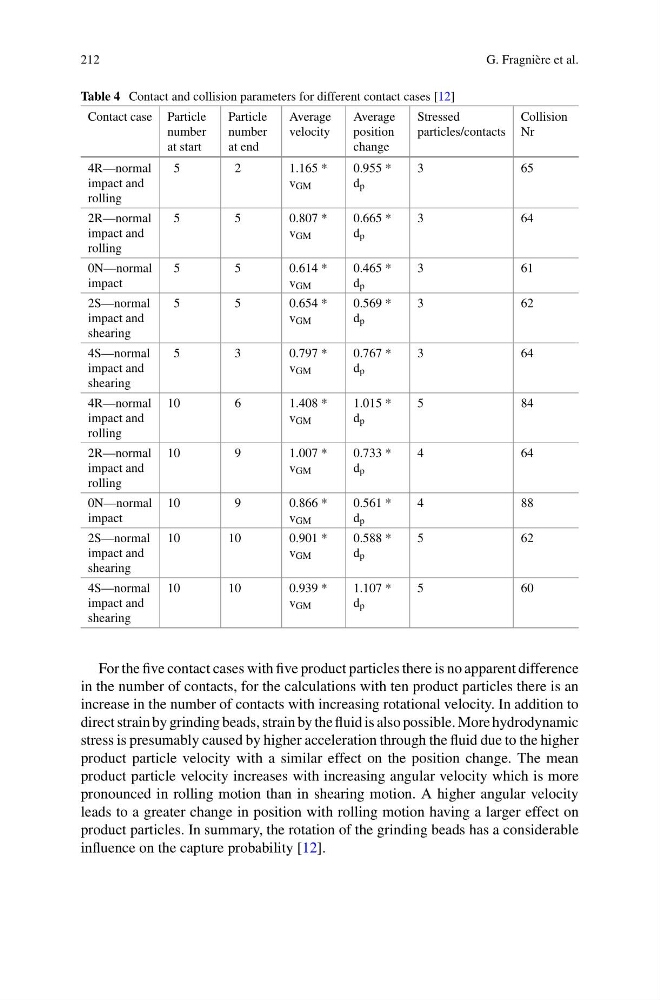
Table 4 Contact and collision parameters for different contact cases [12]
Contact case Particle
number
at start
Particle
number
at end
Average
velocity
Average
position
change
Stressed
particles/contacts
Collision
Nr
4R—normal
impact and
rolling
5
2
1.165 *
v GM
0.955 *
d p
3
65
2R—normal
impact and
rolling
5
5
0.807 *
v GM
0.665 *
d p
3
64
0N—normal
impact
5
5
0.614 *
v GM
0.465 *
d p
3
61
2S—normal
impact and
shearing
5
5
0.654 *
v GM
0.569 *
d p
3
62
4S—normal
impact and
shearing
5
3
0.797 *
v GM
0.767 *
d p
3
64
4R—normal
impact and
rolling
10
6
1.408 *
v GM
1.015 *
d p
5
84
2R—normal
impact and
rolling
10
9
1.007 *
v GM
0.733 *
d p
4
64
0N—normal
impact
10
9
0.866 *
v GM
0.561 *
d p
4
88
2S—normal
impact and
shearing
10
10
0.901 *
v GM
0.588 *
d p
5
62
4S—normal
impact and
shearing
10
10
0.939 *
v GM
1.107 *
d p
5
60
For the five contact cases with five product particles there is no apparent difference
in the number of contacts, for the calculations with ten product particles there is an
increase in the number of contacts with increasing rotational velocity. In addition to
direct strain by grinding beads, strain by the fluid is also possible. More hydrodynamic
stress is presumably caused by higher acceleration through the fluid due to the higher
product particle velocity with a similar effect on the position change. The mean
product particle velocity increases with increasing angular velocity which is more
pronounced in rolling motion than in shearing motion. A higher angular velocity
leads to a greater change in position with rolling motion having a larger effect on
product particles. In summary, the rotation of the grinding beads has a considerable
influence on the capture probability [12].
G. Fragnière et al.
Table 4 Contact and collision parameters for different contact cases [12]
Contact case Particle
number
at start
Particle
number
at end
Average
velocity
Average
position
change
Stressed
particles/contacts
Collision
Nr
4R—normal
impact and
rolling
5
2
1.165 *
v GM
0.955 *
d p
3
65
2R—normal
impact and
rolling
5
5
0.807 *
v GM
0.665 *
d p
3
64
0N—normal
impact
5
5
0.614 *
v GM
0.465 *
d p
3
61
2S—normal
impact and
shearing
5
5
0.654 *
v GM
0.569 *
d p
3
62
4S—normal
impact and
shearing
5
3
0.797 *
v GM
0.767 *
d p
3
64
4R—normal
impact and
rolling
10
6
1.408 *
v GM
1.015 *
d p
5
84
2R—normal
impact and
rolling
10
9
1.007 *
v GM
0.733 *
d p
4
64
0N—normal
impact
10
9
0.866 *
v GM
0.561 *
d p
4
88
2S—normal
impact and
shearing
10
10
0.901 *
v GM
0.588 *
d p
5
62
4S—normal
impact and
shearing
10
10
0.939 *
v GM
1.107 *
d p
5
60
For the five contact cases with five product particles there is no apparent difference
in the number of contacts, for the calculations with ten product particles there is an
increase in the number of contacts with increasing rotational velocity. In addition to
direct strain by grinding beads, strain by the fluid is also possible. More hydrodynamic
stress is presumably caused by higher acceleration through the fluid due to the higher
product particle velocity with a similar effect on the position change. The mean
product particle velocity increases with increasing angular velocity which is more
pronounced in rolling motion than in shearing motion. A higher angular velocity
leads to a greater change in position with rolling motion having a larger effect on
product particles. In summary, the rotation of the grinding beads has a considerable
influence on the capture probability [12].