

158
D. Markauskas and H. Kruggel-Emden
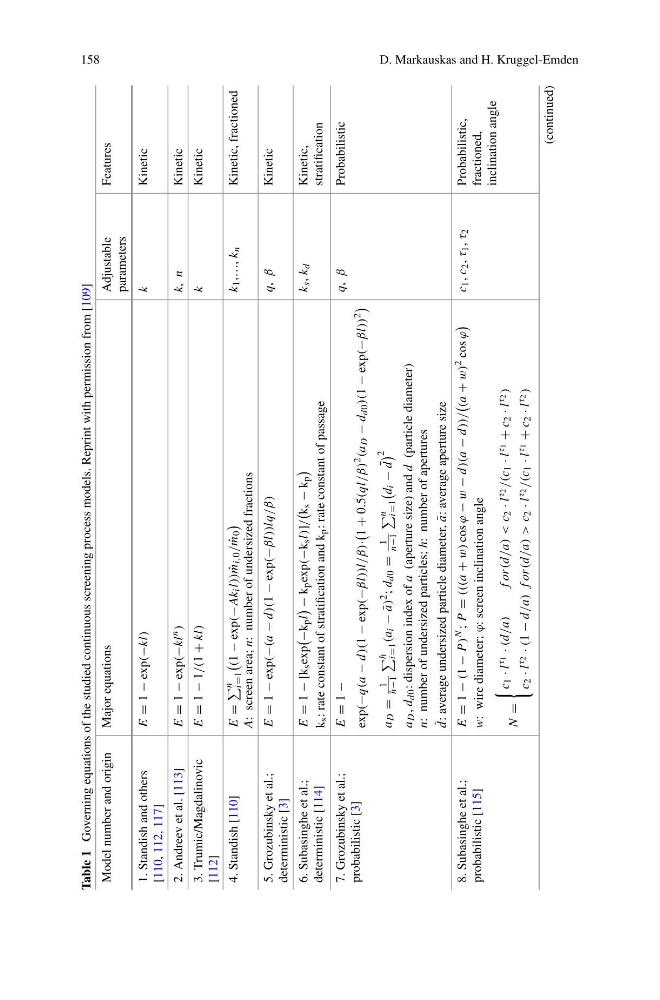
Table 1
Governing equations of the studied continuous screening process models. Reprint with permission from [109]
Model number and origin
Major equations
Adjustable
parameters
Features
1. Standish and others
[110, 112, 117]
E
= 1
− exp(−kl)
k
Kinetic
2. Andreev et al. [113]
E
= 1
− exp(−kl n
)
k, n
Kinetic
3. Trumic/Magdalinovic
[112]
E
= 1
− 1/(1
+ kl)
k
Kinetic
4. Standish [110]
E
=
n
i=1
(1 − exp(−Ak
i l))
˙
m
i,0
/ ˙
m
0
A:
screen area; n:
number of undersized fractions
k
1 ,…, k
n
Kinetic, fractioned
5. Grozubinsky et al.;
deterministic [3]
E
= 1
− exp(−(a
− d)(1
− exp(−βl))lq/β)
q,
β
Kinetic
6. Subasinghe et al.;
deterministic [114]
E
= 1
− [k s exp
−k p l
− k
p exp(−k
s l)]/
k
s
− k
p
k
s : rate constant of stratification and k
p : rate constant of passage
k
s , k
d
Kinetic,
stratification
7. Grozubinsky et al.;
probabilistic [3]
E
= 1
−
exp(−q(a
− d)(1
− exp(−βl))l/β)·
1
+ 0.5(ql/β)
2
(a D
− d
d0
)(1 − exp(−βl))
2
a
D
=
1
h−1
h
i=1 (a i
− ¯
a)
2
; d
d0
=
1
n−1
n
i=1
d
i
− ¯
d
2
a
D
, d
d0 : dispersion index of a
(aperture size) and d
(particle diameter)
n:
number of undersized particles; h:
number of apertures
¯
d:
average undersized particle diameter,
¯
a:
average aperture size
q,
β
Probabilistic
8. Subasinghe et al.;
probabilistic [115]
E
= 1
−
(1 − P)
N
; P
=
(((a + w) cos
ϕ − w − d)(a
− d))/
(a + w)
2
cos
ϕ
w:
wire diameter;
ϕ: screen inclination angle
N
=
c
1
· l τ1
·
(d/a)
f or(d/a)
< c
2
· l τ2
/(c 1
· l τ1
+ c
2
· l τ2
)
c
2
· l τ2
·
(1 − d/a) f or(d/a)
> c
2
· l τ2
/(c 1
· l τ1
+ c
2
· l τ2
)
c
1 , c
2 ,
τ 1 ,
τ 2
Probabilistic,
fractioned,
inclination angle
(continued)
D. Markauskas and H. Kruggel-Emden
Table 1
Governing equations of the studied continuous screening process models. Reprint with permission from [109]
Model number and origin
Major equations
Adjustable
parameters
Features
1. Standish and others
[110, 112, 117]
E
= 1
− exp(−kl)
k
Kinetic
2. Andreev et al. [113]
E
= 1
− exp(−kl n
)
k, n
Kinetic
3. Trumic/Magdalinovic
[112]
E
= 1
− 1/(1
+ kl)
k
Kinetic
4. Standish [110]
E
=
n
i=1
(1 − exp(−Ak
i l))
˙
m
i,0
/ ˙
m
0
A:
screen area; n:
number of undersized fractions
k
1 ,…, k
n
Kinetic, fractioned
5. Grozubinsky et al.;
deterministic [3]
E
= 1
− exp(−(a
− d)(1
− exp(−βl))lq/β)
q,
β
Kinetic
6. Subasinghe et al.;
deterministic [114]
E
= 1
− [k s exp
−k p l
− k
p exp(−k
s l)]/
k
s
− k
p
k
s : rate constant of stratification and k
p : rate constant of passage
k
s , k
d
Kinetic,
stratification
7. Grozubinsky et al.;
probabilistic [3]
E
= 1
−
exp(−q(a
− d)(1
− exp(−βl))l/β)·
1
+ 0.5(ql/β)
2
(a D
− d
d0
)(1 − exp(−βl))
2
a
D
=
1
h−1
h
i=1 (a i
− ¯
a)
2
; d
d0
=
1
n−1
n
i=1
d
i
− ¯
d
2
a
D
, d
d0 : dispersion index of a
(aperture size) and d
(particle diameter)
n:
number of undersized particles; h:
number of apertures
¯
d:
average undersized particle diameter,
¯
a:
average aperture size
q,
β
Probabilistic
8. Subasinghe et al.;
probabilistic [115]
E
= 1
−
(1 − P)
N
; P
=
(((a + w) cos
ϕ − w − d)(a
− d))/
(a + w)
2
cos
ϕ
w:
wire diameter;
ϕ: screen inclination angle
N
=
c
1
· l τ1
·
(d/a)
f or(d/a)
< c
2
· l τ2
/(c 1
· l τ1
+ c
2
· l τ2
)
c
2
· l τ2
·
(1 − d/a) f or(d/a)
> c
2
· l τ2
/(c 1
· l τ1
+ c
2
· l τ2
)
c
1 , c
2 ,
τ 1 ,
τ 2
Probabilistic,
fractioned,
inclination angle
(continued)