

5 Development of a Dynamic-Physical Process Model for Sieving
157
T (d) T rawinski_1 =
1 −
1 +
α S
√
2 − 1
d
d cut
α S ·β S
−α S
· (1 − a S ) + a S ,
(24)
T (d) T rawinski_2 =
⎛
⎜
⎝1 −
⎛
⎝ 1 + 3 ·
d
d cut
d
dcut +α S
·β S
⎞
⎠
−0.5
⎞
⎟
⎠ · (1 − a S ) + a S ,
(25)
T (d) T rawinski_3 =
d
d cut
α S ·
d
dcut +β S
1 +
d
d cut
α S ·
d
dcut +β S
· (1 − a S ) + a S .
(26)
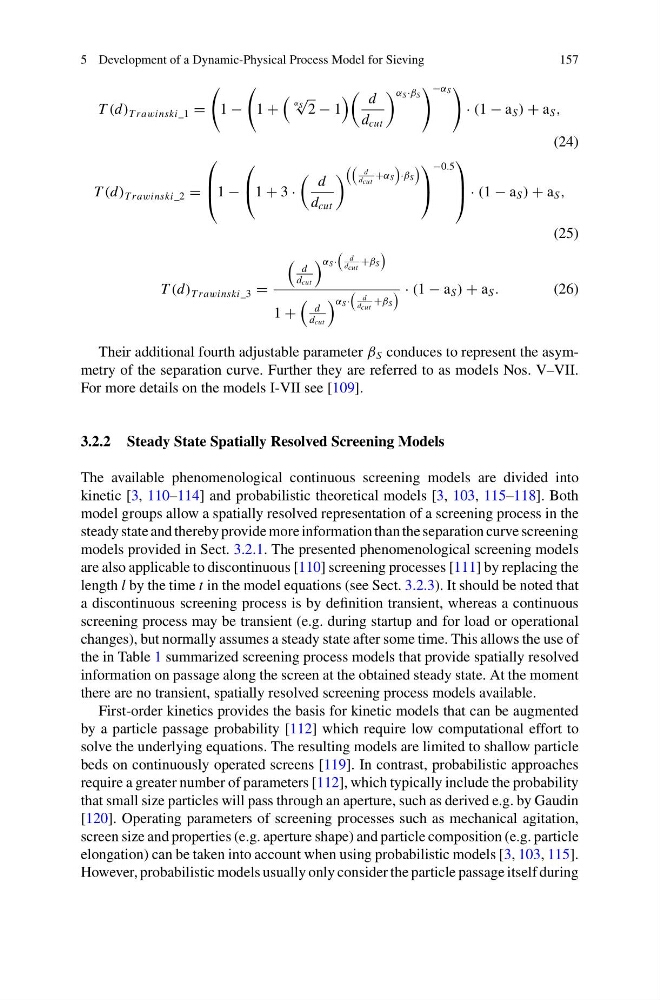
Their additional fourth adjustable parameter β S conduces to represent the asymmetry of the separation curve. Further they are referred to as models Nos. V–VII.
For more details on the models I-VII see [109].
3.2.2 Steady State Spatially Resolved Screening Models
The available phenomenological continuous screening models are divided into
kinetic [3, 110–114] and probabilistic theoretical models [3, 103, 115–118]. Both
model groups allow a spatially resolved representation of a screening process in the
steady state and thereby provide more information than the separation curve screening
models provided in Sect. 3.2.1. The presented phenomenological screening models
are also applicable to discontinuous [110] screening processes [111] by replacing the
length l by the time t in the model equations (see Sect. 3.2.3). It should be noted that
a discontinuous screening process is by definition transient, whereas a continuous
screening process may be transient (e.g. during startup and for load or operational
changes), but normally assumes a steady state after some time. This allows the use of
the in Table 1 summarized screening process models that provide spatially resolved
information on passage along the screen at the obtained steady state. At the moment
there are no transient, spatially resolved screening process models available.
First-order kinetics provides the basis for kinetic models that can be augmented
by a particle passage probability [112] which require low computational effort to
solve the underlying equations. The resulting models are limited to shallow particle
beds on continuously operated screens [119]. In contrast, probabilistic approaches
require a greater number of parameters [112], which typically include the probability
that small size particles will pass through an aperture, such as derived e.g. by Gaudin
[120]. Operating parameters of screening processes such as mechanical agitation,
screen size and properties (e.g. aperture shape) and particle composition (e.g. particle
elongation) can be taken into account when using probabilistic models [3, 103, 115].
However, probabilistic models usually only consider the particle passage itself during
157
T (d) T rawinski_1 =
1 −
1 +
α S
√
2 − 1
d
d cut
α S ·β S
−α S
· (1 − a S ) + a S ,
(24)
T (d) T rawinski_2 =
⎛
⎜
⎝1 −
⎛
⎝ 1 + 3 ·
d
d cut
d
dcut +α S
·β S
⎞
⎠
−0.5
⎞
⎟
⎠ · (1 − a S ) + a S ,
(25)
T (d) T rawinski_3 =
d
d cut
α S ·
d
dcut +β S
1 +
d
d cut
α S ·
d
dcut +β S
· (1 − a S ) + a S .
(26)
Their additional fourth adjustable parameter β S conduces to represent the asymmetry of the separation curve. Further they are referred to as models Nos. V–VII.
For more details on the models I-VII see [109].
3.2.2 Steady State Spatially Resolved Screening Models
The available phenomenological continuous screening models are divided into
kinetic [3, 110–114] and probabilistic theoretical models [3, 103, 115–118]. Both
model groups allow a spatially resolved representation of a screening process in the
steady state and thereby provide more information than the separation curve screening
models provided in Sect. 3.2.1. The presented phenomenological screening models
are also applicable to discontinuous [110] screening processes [111] by replacing the
length l by the time t in the model equations (see Sect. 3.2.3). It should be noted that
a discontinuous screening process is by definition transient, whereas a continuous
screening process may be transient (e.g. during startup and for load or operational
changes), but normally assumes a steady state after some time. This allows the use of
the in Table 1 summarized screening process models that provide spatially resolved
information on passage along the screen at the obtained steady state. At the moment
there are no transient, spatially resolved screening process models available.
First-order kinetics provides the basis for kinetic models that can be augmented
by a particle passage probability [112] which require low computational effort to
solve the underlying equations. The resulting models are limited to shallow particle
beds on continuously operated screens [119]. In contrast, probabilistic approaches
require a greater number of parameters [112], which typically include the probability
that small size particles will pass through an aperture, such as derived e.g. by Gaudin
[120]. Operating parameters of screening processes such as mechanical agitation,
screen size and properties (e.g. aperture shape) and particle composition (e.g. particle
elongation) can be taken into account when using probabilistic models [3, 103, 115].
However, probabilistic models usually only consider the particle passage itself during