

156
D. Markauskas and H. Kruggel-Emden
T i = T (d) =
˙
m i,over f low
˙
m i, f eed
.
(19)
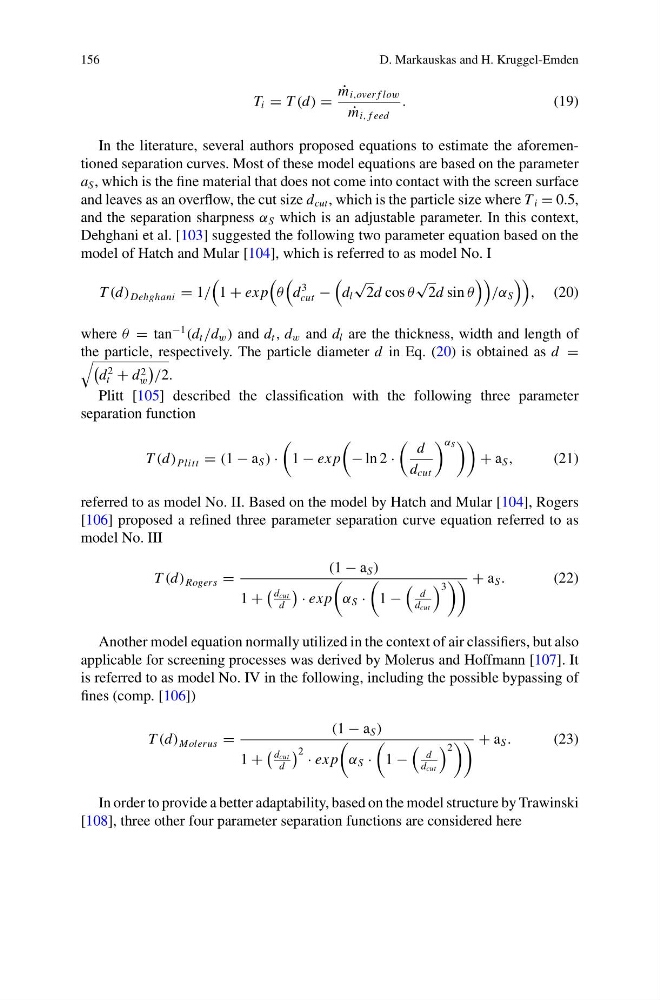
In the literature, several authors proposed equations to estimate the aforementioned separation curves. Most of these model equations are based on the parameter
a S , which is the fine material that does not come into contact with the screen surface
and leaves as an overflow, the cut size d cut , which is the particle size where T i = 0.5,
and the separation sharpness α S which is an adjustable parameter. In this context,
Dehghani et al. [103] suggested the following two parameter equation based on the
model of Hatch and Mular [104], which is referred to as model No. I
T (d) Dehghani = 1/
1 + ex p
θ
d
3
cut −
d l
√
2d cos θ
√
2d sin θ
/α S
, (20)
where θ = tan
−1
(d t /d w ) and d t , d w and d l are the thickness, width and length of
the particle, respectively. The particle diameter d in Eq. (20) is obtained as d =
d
2
t + d 2
w
/2.
Plitt [105] described the classification with the following three parameter
separation function
T (d) Plitt = (1 − a S ) ·
1 − ex p
− ln 2 ·
d
d cut
α S
+ a S ,
(21)
referred to as model No. II. Based on the model by Hatch and Mular [104], Rogers
[106] proposed a refined three parameter separation curve equation referred to as
model No. III
T (d) Rogers =
(1 − a S )
1 +
d cut
d
· ex p
α S ·
1 −
d
d cut
3
+ a S .
(22)
Another model equation normally utilized in the context of air classifiers, but also
applicable for screening processes was derived by Molerus and Hoffmann [107]. It
is referred to as model No. IV in the following, including the possible bypassing of
fines (comp. [106])
T (d) Molerus =
(1 − a S )
1 +
d cut
d
2 · ex p
α S ·
1 −
d
d cut
2
+ a S .
(23)
In order to provide a better adaptability, based on the model structure by Trawinski
[108], three other four parameter separation functions are considered here
D. Markauskas and H. Kruggel-Emden
T i = T (d) =
˙
m i,over f low
˙
m i, f eed
.
(19)
In the literature, several authors proposed equations to estimate the aforementioned separation curves. Most of these model equations are based on the parameter
a S , which is the fine material that does not come into contact with the screen surface
and leaves as an overflow, the cut size d cut , which is the particle size where T i = 0.5,
and the separation sharpness α S which is an adjustable parameter. In this context,
Dehghani et al. [103] suggested the following two parameter equation based on the
model of Hatch and Mular [104], which is referred to as model No. I
T (d) Dehghani = 1/
1 + ex p
θ
d
3
cut −
d l
√
2d cos θ
√
2d sin θ
/α S
, (20)
where θ = tan
−1
(d t /d w ) and d t , d w and d l are the thickness, width and length of
the particle, respectively. The particle diameter d in Eq. (20) is obtained as d =
d
2
t + d 2
w
/2.
Plitt [105] described the classification with the following three parameter
separation function
T (d) Plitt = (1 − a S ) ·
1 − ex p
− ln 2 ·
d
d cut
α S
+ a S ,
(21)
referred to as model No. II. Based on the model by Hatch and Mular [104], Rogers
[106] proposed a refined three parameter separation curve equation referred to as
model No. III
T (d) Rogers =
(1 − a S )
1 +
d cut
d
· ex p
α S ·
1 −
d
d cut
3
+ a S .
(22)
Another model equation normally utilized in the context of air classifiers, but also
applicable for screening processes was derived by Molerus and Hoffmann [107]. It
is referred to as model No. IV in the following, including the possible bypassing of
fines (comp. [106])
T (d) Molerus =
(1 − a S )
1 +
d cut
d
2 · ex p
α S ·
1 −
d
d cut
2
+ a S .
(23)
In order to provide a better adaptability, based on the model structure by Trawinski
[108], three other four parameter separation functions are considered here