

5 Development of a Dynamic-Physical Process Model for Sieving
159
Table 1
(continued)
Model number and origin
Major equations
Adjustable
parameters
Features
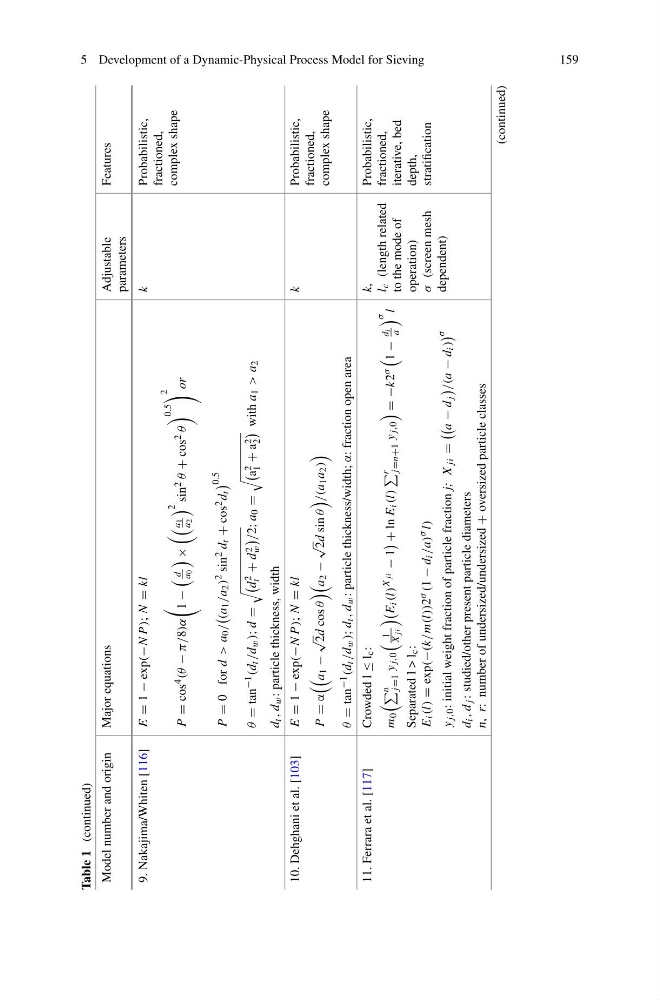
9. Nakajima/Whiten [116]
E
= 1
− exp(−N P); N
= kl
P
= cos 4
(θ − π/8)α
1
−
d
a0
×
a1
a2
2
sin 2
θ + cos 2
θ
0.5
2
or
P
= 0 for d
> a
0
/
(a 1
/a 2
)
2
sin 2
d
t
+ cos 2
d
t
0.5
θ = tan −1
(d t
/d
w ); d
=
d 2
t + d 2
w
/2; a
0
=
a 2
1 + a 2
2
with a
1
> a
2
d
t
, d
w : particle thickness, width
k
Probabilistic,
fractioned,
complex shape
10. Dehghani et al. [103]
E
= 1
− exp(−N P); N
= kl
P
= α
a
1
−
√
2d cos
θ
a
2
−
√
2d sin
θ
/(a 1 a
2
)
θ = tan −1
(d t
/d
w ); d
t
, d
w : particle thickness/width;
α: fraction open area
k
Probabilistic,
fractioned,
complex shape
11. Ferrara et al. [117]
Crowded l
≤ l
c :
m
0
n
j=1 y
j,0
1
X
ji
E
i
(l)
X
ji
− 1
+ ln E
i
(l)
r
j=n+1 y
j,0
= −k2 σ
1
−
d
i
a
σ
l
Separated l > l
c :
E
i
(l) = exp(−(k/m(l))2 σ
(1 − d
i
/a)
σ
l)
y
j,0 : initial weight fraction of particle fraction j; X
ji
=
a
− d
j
/(a − d
i
)
σ
d
i
, d
j : studied/other present particle diameters
n, r:
number of undersized/undersized
+ oversized particle classes
k,
l
c (length related
to the mode of
operation)
σ (screen mesh
dependent)
Probabilistic,
fractioned,
iterative, bed
depth,
stratification
(continued)
159
Table 1
(continued)
Model number and origin
Major equations
Adjustable
parameters
Features
9. Nakajima/Whiten [116]
E
= 1
− exp(−N P); N
= kl
P
= cos 4
(θ − π/8)α
1
−
d
a0
×
a1
a2
2
sin 2
θ + cos 2
θ
0.5
2
or
P
= 0 for d
> a
0
/
(a 1
/a 2
)
2
sin 2
d
t
+ cos 2
d
t
0.5
θ = tan −1
(d t
/d
w ); d
=
d 2
t + d 2
w
/2; a
0
=
a 2
1 + a 2
2
with a
1
> a
2
d
t
, d
w : particle thickness, width
k
Probabilistic,
fractioned,
complex shape
10. Dehghani et al. [103]
E
= 1
− exp(−N P); N
= kl
P
= α
a
1
−
√
2d cos
θ
a
2
−
√
2d sin
θ
/(a 1 a
2
)
θ = tan −1
(d t
/d
w ); d
t
, d
w : particle thickness/width;
α: fraction open area
k
Probabilistic,
fractioned,
complex shape
11. Ferrara et al. [117]
Crowded l
≤ l
c :
m
0
n
j=1 y
j,0
1
X
ji
E
i
(l)
X
ji
− 1
+ ln E
i
(l)
r
j=n+1 y
j,0
= −k2 σ
1
−
d
i
a
σ
l
Separated l > l
c :
E
i
(l) = exp(−(k/m(l))2 σ
(1 − d
i
/a)
σ
l)
y
j,0 : initial weight fraction of particle fraction j; X
ji
=
a
− d
j
/(a − d
i
)
σ
d
i
, d
j : studied/other present particle diameters
n, r:
number of undersized/undersized
+ oversized particle classes
k,
l
c (length related
to the mode of
operation)
σ (screen mesh
dependent)
Probabilistic,
fractioned,
iterative, bed
depth,
stratification
(continued)