

5 Development of a Dynamic-Physical Process Model for Sieving
153
material of the second contact partner. Then the coefficient of restitution for this
particle-particle contact is determined based on H 0 , H 1 and H 2 .
The construction of Fig. 6a may be modified to study particle wall collisions
according to the construction shown in Fig. 6b, in which the second particle is
replaced by a wall of the desired material. Another method for obtaining the coefficient of restitution between a particle and a wall is the common drop test shown in
Fig. 6c (see e.g. [68, 70, 78–81]). The latter approach can be used for spherical and
non-spherical particles, considering the angle of motion and angular velocity [82–
84]. Note that the drop test can also be used to measure the coefficient of restitution
for particle-particle contacts (see e.g. [68, 70, 78–81]).
2.5.2 Determination of DEM Parameters at the Bulk Particle Scale
For the determination of DEM parameters at bulk level, various tests are carried out at
small scale, whereby one or more parameters of the respective DEM simulations are
iteratively adapted to the obtained experimental results. To adjust the bulk density,
simple experiments can be carried out to fill a container of known volume, and the
same particle bed height should be obtained in experiments and simulations (see e.g.
[85–88]).
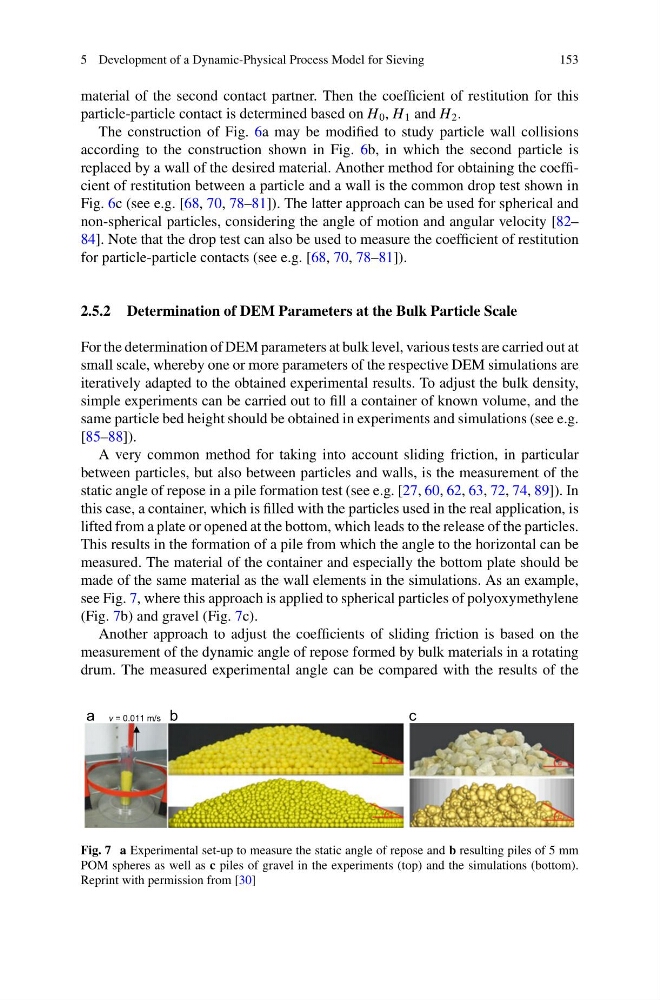
A very common method for taking into account sliding friction, in particular
between particles, but also between particles and walls, is the measurement of the
static angle of repose in a pile formation test (see e.g. [27, 60, 62, 63, 72, 74, 89]). In
this case, a container, which is filled with the particles used in the real application, is
lifted from a plate or opened at the bottom, which leads to the release of the particles.
This results in the formation of a pile from which the angle to the horizontal can be
measured. The material of the container and especially the bottom plate should be
made of the same material as the wall elements in the simulations. As an example,
see Fig. 7, where this approach is applied to spherical particles of polyoxymethylene
(Fig. 7b) and gravel (Fig. 7c).
Another approach to adjust the coefficients of sliding friction is based on the
measurement of the dynamic angle of repose formed by bulk materials in a rotating
drum. The measured experimental angle can be compared with the results of the
a
b
c
v = 0.011 m/s
Fig. 7 a Experimental set-up to measure the static angle of repose and b resulting piles of 5 mm
POM spheres as well as c piles of gravel in the experiments (top) and the simulations (bottom).
Reprint with permission from [30]
153
material of the second contact partner. Then the coefficient of restitution for this
particle-particle contact is determined based on H 0 , H 1 and H 2 .
The construction of Fig. 6a may be modified to study particle wall collisions
according to the construction shown in Fig. 6b, in which the second particle is
replaced by a wall of the desired material. Another method for obtaining the coefficient of restitution between a particle and a wall is the common drop test shown in
Fig. 6c (see e.g. [68, 70, 78–81]). The latter approach can be used for spherical and
non-spherical particles, considering the angle of motion and angular velocity [82–
84]. Note that the drop test can also be used to measure the coefficient of restitution
for particle-particle contacts (see e.g. [68, 70, 78–81]).
2.5.2 Determination of DEM Parameters at the Bulk Particle Scale
For the determination of DEM parameters at bulk level, various tests are carried out at
small scale, whereby one or more parameters of the respective DEM simulations are
iteratively adapted to the obtained experimental results. To adjust the bulk density,
simple experiments can be carried out to fill a container of known volume, and the
same particle bed height should be obtained in experiments and simulations (see e.g.
[85–88]).
A very common method for taking into account sliding friction, in particular
between particles, but also between particles and walls, is the measurement of the
static angle of repose in a pile formation test (see e.g. [27, 60, 62, 63, 72, 74, 89]). In
this case, a container, which is filled with the particles used in the real application, is
lifted from a plate or opened at the bottom, which leads to the release of the particles.
This results in the formation of a pile from which the angle to the horizontal can be
measured. The material of the container and especially the bottom plate should be
made of the same material as the wall elements in the simulations. As an example,
see Fig. 7, where this approach is applied to spherical particles of polyoxymethylene
(Fig. 7b) and gravel (Fig. 7c).
Another approach to adjust the coefficients of sliding friction is based on the
measurement of the dynamic angle of repose formed by bulk materials in a rotating
drum. The measured experimental angle can be compared with the results of the
a
b
c
v = 0.011 m/s
Fig. 7 a Experimental set-up to measure the static angle of repose and b resulting piles of 5 mm
POM spheres as well as c piles of gravel in the experiments (top) and the simulations (bottom).
Reprint with permission from [30]