

152
D. Markauskas and H. Kruggel-Emden
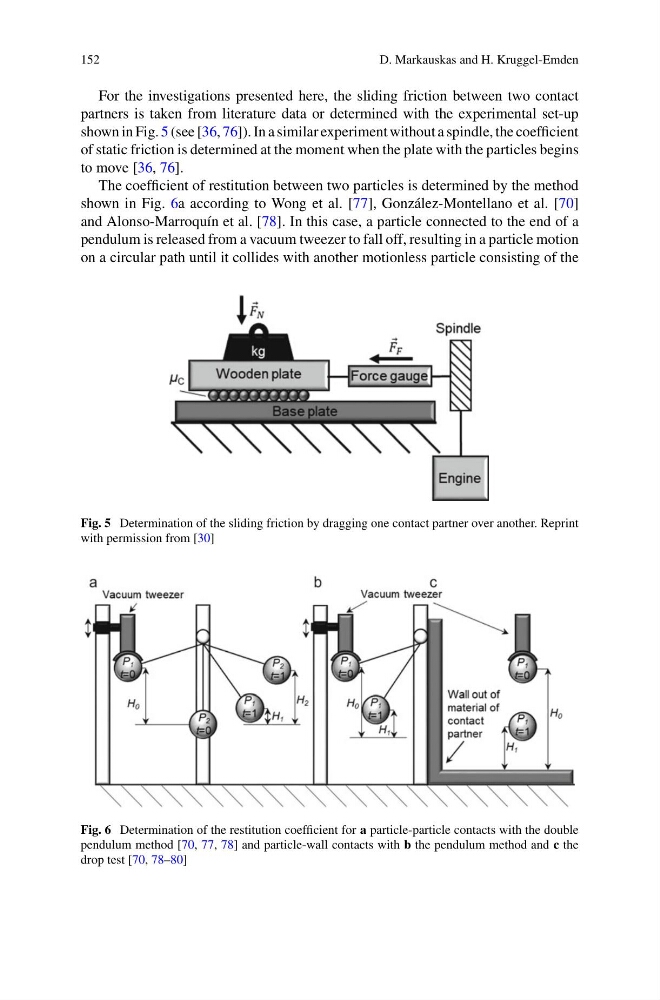
For the investigations presented here, the sliding friction between two contact
partners is taken from literature data or determined with the experimental set-up
shown in Fig. 5 (see [36, 76]). In a similar experiment without a spindle, the coefficient
of static friction is determined at the moment when the plate with the particles begins
to move [36, 76].
The coefficient of restitution between two particles is determined by the method
shown in Fig. 6a according to Wong et al. [77], González-Montellano et al. [70]
and Alonso-Marroquín et al. [78]. In this case, a particle connected to the end of a
pendulum is released from a vacuum tweezer to fall off, resulting in a particle motion
on a circular path until it collides with another motionless particle consisting of the
Fig. 5 Determination of the sliding friction by dragging one contact partner over another. Reprint
with permission from [30]
Fig. 6 Determination of the restitution coefficient for a particle-particle contacts with the double
pendulum method [70, 77, 78] and particle-wall contacts with b the pendulum method and c the
drop test [70, 78–80]
D. Markauskas and H. Kruggel-Emden
For the investigations presented here, the sliding friction between two contact
partners is taken from literature data or determined with the experimental set-up
shown in Fig. 5 (see [36, 76]). In a similar experiment without a spindle, the coefficient
of static friction is determined at the moment when the plate with the particles begins
to move [36, 76].
The coefficient of restitution between two particles is determined by the method
shown in Fig. 6a according to Wong et al. [77], González-Montellano et al. [70]
and Alonso-Marroquín et al. [78]. In this case, a particle connected to the end of a
pendulum is released from a vacuum tweezer to fall off, resulting in a particle motion
on a circular path until it collides with another motionless particle consisting of the
Fig. 5 Determination of the sliding friction by dragging one contact partner over another. Reprint
with permission from [30]
Fig. 6 Determination of the restitution coefficient for a particle-particle contacts with the double
pendulum method [70, 77, 78] and particle-wall contacts with b the pendulum method and c the
drop test [70, 78–80]