

128
H. Rehage and M. Kind
yes
PFR
recalculaƟon
no
Solve PFR
Solve comp.
balance
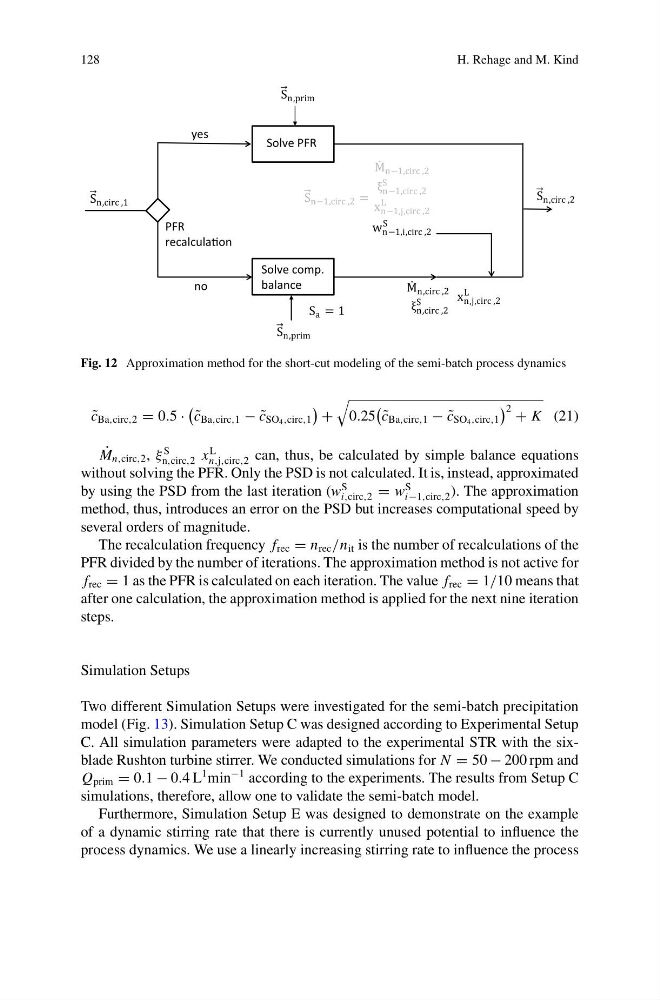
Fig. 12 Approximation method for the short-cut modeling of the semi-batch process dynamics
˜
c Ba,circ,2 = 0.5 ·
˜
c Ba,circ,1 − ˜
c SO 4 ,circ,1
+
0.25
˜
c Ba,circ,1 − ˜
c SO 4 ,circ,1
2 + K (21)
˙
M n,circ,2 , ξ
S
n,circ,2 x
L
n,j,circ,2 can, thus, be calculated by simple balance equations
without solving the PFR. Only the PSD is not calculated. It is, instead, approximated
by using the PSD from the last iteration (w
S
i,circ,2 = w
S
i−1,circ,2 ). The approximation
method, thus, introduces an error on the PSD but increases computational speed by
several orders of magnitude.
The recalculation frequency f rec = n rec /n it is the number of recalculations of the
PFR divided by the number of iterations. The approximation method is not active for
f rec = 1 as the PFR is calculated on each iteration. The value f rec = 1/10 means that
after one calculation, the approximation method is applied for the next nine iteration
steps.
Simulation Setups
Two different Simulation Setups were investigated for the semi-batch precipitation
model (Fig. 13). Simulation Setup C was designed according to Experimental Setup
C. All simulation parameters were adapted to the experimental STR with the sixblade Rushton turbine stirrer. We conducted simulations for N = 50 − 200 rpm and
Q prim = 0.1 − 0.4 L
1 min
−1 according to the experiments. The results from Setup C
simulations, therefore, allow one to validate the semi-batch model.
Furthermore, Simulation Setup E was designed to demonstrate on the example
of a dynamic stirring rate that there is currently unused potential to influence the
process dynamics. We use a linearly increasing stirring rate to influence the process
H. Rehage and M. Kind
yes
PFR
recalculaƟon
no
Solve PFR
Solve comp.
balance
Fig. 12 Approximation method for the short-cut modeling of the semi-batch process dynamics
˜
c Ba,circ,2 = 0.5 ·
˜
c Ba,circ,1 − ˜
c SO 4 ,circ,1
+
0.25
˜
c Ba,circ,1 − ˜
c SO 4 ,circ,1
2 + K (21)
˙
M n,circ,2 , ξ
S
n,circ,2 x
L
n,j,circ,2 can, thus, be calculated by simple balance equations
without solving the PFR. Only the PSD is not calculated. It is, instead, approximated
by using the PSD from the last iteration (w
S
i,circ,2 = w
S
i−1,circ,2 ). The approximation
method, thus, introduces an error on the PSD but increases computational speed by
several orders of magnitude.
The recalculation frequency f rec = n rec /n it is the number of recalculations of the
PFR divided by the number of iterations. The approximation method is not active for
f rec = 1 as the PFR is calculated on each iteration. The value f rec = 1/10 means that
after one calculation, the approximation method is applied for the next nine iteration
steps.
Simulation Setups
Two different Simulation Setups were investigated for the semi-batch precipitation
model (Fig. 13). Simulation Setup C was designed according to Experimental Setup
C. All simulation parameters were adapted to the experimental STR with the sixblade Rushton turbine stirrer. We conducted simulations for N = 50 − 200 rpm and
Q prim = 0.1 − 0.4 L
1 min
−1 according to the experiments. The results from Setup C
simulations, therefore, allow one to validate the semi-batch model.
Furthermore, Simulation Setup E was designed to demonstrate on the example
of a dynamic stirring rate that there is currently unused potential to influence the
process dynamics. We use a linearly increasing stirring rate to influence the process