

4 Dynamic Simulation of Technical Precipitation Processes
121
V
L
k [m
3
] to track the status of mixing (α k = V
L
k /V
L
). V
L
[m
3
] designates the total
volume of liquid phase including all zones. Due to the mixing process, these volume
fractions α k change along the mixer length coordinate z. The balance volume is the
well-mixed reaction volume fraction (M in this example), which will grow along the
mixer length coordinate z by engulfing the unmixed educt fluid A and B.
The PBE is based on the particle density n = dn t /d L [m
−4
] in the reaction zone
M, with n t [m
−3
] as the total number of particles per volume suspension and L [m]
as the particle diameter. As the rising saturation level S a inside the reaction zone will
trigger solids formation, a rising total particle number density can be observed along
z (Fig. 6).
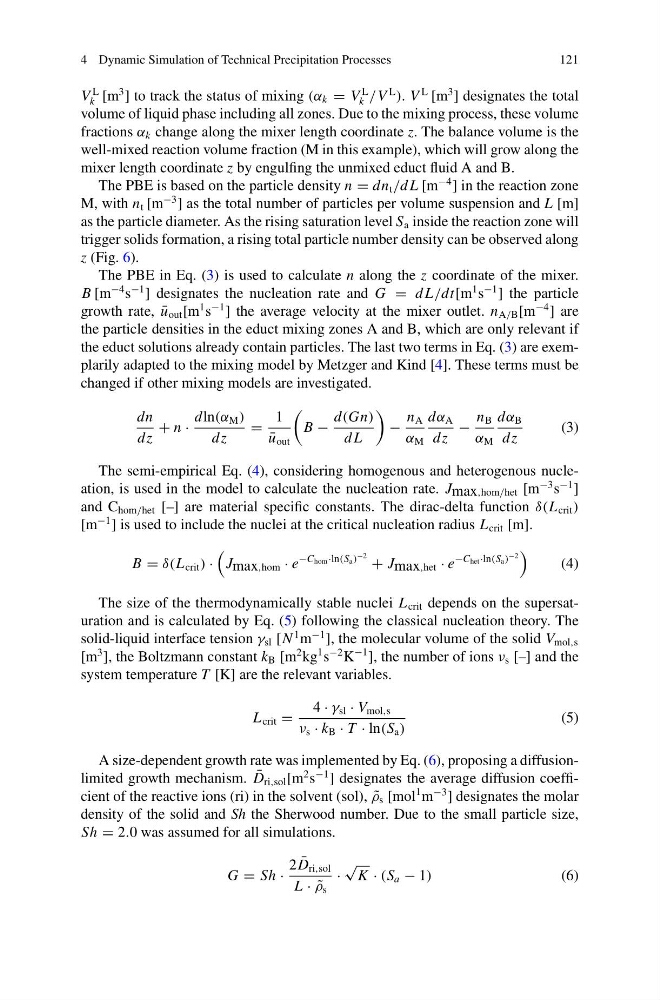
The PBE in Eq. (3) is used to calculate n along the z coordinate of the mixer.
B [m
−4 s
−1
] designates the nucleation rate and G = d L/dt[m
1 s
−1
] the particle
growth rate, ¯
u out [m
1 s
−1
] the average velocity at the mixer outlet. n A/B [m
−4
] are
the particle densities in the educt mixing zones A and B, which are only relevant if
the educt solutions already contain particles. The last two terms in Eq. (3) are exemplarily adapted to the mixing model by Metzger and Kind [4]. These terms must be
changed if other mixing models are investigated.
dn
dz
+ n ·
dln(α M )
dz
=
1
¯
u out
B −
d(Gn)
d L
−
n A
α M
dα A
dz
−
n B
α M
dα B
dz
(3)
The semi-empirical Eq. (4), considering homogenous and heterogenous nucleation, is used in the model to calculate the nucleation rate. J max,hom/het [m
−3 s
−1
]
and C hom/het [–] are material specific constants. The dirac-delta function δ(L crit )
[m
−1
] is used to include the nuclei at the critical nucleation radius L crit [m].
B = δ(L crit ) ·
J max,hom · e
−C hom ·ln(S a )
−2 + J max,het · e
−C het ·ln(S a )
−2
(4)
The size of the thermodynamically stable nuclei L crit depends on the supersaturation and is calculated by Eq. (5) following the classical nucleation theory. The
solid-liquid interface tension γ sl [N
1 m
−1
], the molecular volume of the solid V mol,s
[m
3
], the Boltzmann constant k B [m
2 kg
1 s
−2 K
−1
], the number of ions ν s [–] and the
system temperature T [K] are the relevant variables.
L crit =
4 · γ sl · V mol,s
ν s · k B · T · ln(S a )
(5)
A size-dependent growth rate was implemented by Eq. (6), proposing a diffusionlimited growth mechanism. ¯
D ri,sol [m
2 s
−1
] designates the average diffusion coefficient of the reactive ions (ri) in the solvent (sol), ˜
ρ s [mol
1 m
−3
] designates the molar
density of the solid and Sh the Sherwood number. Due to the small particle size,
Sh = 2.0 was assumed for all simulations.
G = Sh ·
2 ¯
D ri,sol
L · ˜
ρ s
·
√
K · (S a − 1)
(6)
121
V
L
k [m
3
] to track the status of mixing (α k = V
L
k /V
L
). V
L
[m
3
] designates the total
volume of liquid phase including all zones. Due to the mixing process, these volume
fractions α k change along the mixer length coordinate z. The balance volume is the
well-mixed reaction volume fraction (M in this example), which will grow along the
mixer length coordinate z by engulfing the unmixed educt fluid A and B.
The PBE is based on the particle density n = dn t /d L [m
−4
] in the reaction zone
M, with n t [m
−3
] as the total number of particles per volume suspension and L [m]
as the particle diameter. As the rising saturation level S a inside the reaction zone will
trigger solids formation, a rising total particle number density can be observed along
z (Fig. 6).
The PBE in Eq. (3) is used to calculate n along the z coordinate of the mixer.
B [m
−4 s
−1
] designates the nucleation rate and G = d L/dt[m
1 s
−1
] the particle
growth rate, ¯
u out [m
1 s
−1
] the average velocity at the mixer outlet. n A/B [m
−4
] are
the particle densities in the educt mixing zones A and B, which are only relevant if
the educt solutions already contain particles. The last two terms in Eq. (3) are exemplarily adapted to the mixing model by Metzger and Kind [4]. These terms must be
changed if other mixing models are investigated.
dn
dz
+ n ·
dln(α M )
dz
=
1
¯
u out
B −
d(Gn)
d L
−
n A
α M
dα A
dz
−
n B
α M
dα B
dz
(3)
The semi-empirical Eq. (4), considering homogenous and heterogenous nucleation, is used in the model to calculate the nucleation rate. J max,hom/het [m
−3 s
−1
]
and C hom/het [–] are material specific constants. The dirac-delta function δ(L crit )
[m
−1
] is used to include the nuclei at the critical nucleation radius L crit [m].
B = δ(L crit ) ·
J max,hom · e
−C hom ·ln(S a )
−2 + J max,het · e
−C het ·ln(S a )
−2
(4)
The size of the thermodynamically stable nuclei L crit depends on the supersaturation and is calculated by Eq. (5) following the classical nucleation theory. The
solid-liquid interface tension γ sl [N
1 m
−1
], the molecular volume of the solid V mol,s
[m
3
], the Boltzmann constant k B [m
2 kg
1 s
−2 K
−1
], the number of ions ν s [–] and the
system temperature T [K] are the relevant variables.
L crit =
4 · γ sl · V mol,s
ν s · k B · T · ln(S a )
(5)
A size-dependent growth rate was implemented by Eq. (6), proposing a diffusionlimited growth mechanism. ¯
D ri,sol [m
2 s
−1
] designates the average diffusion coefficient of the reactive ions (ri) in the solvent (sol), ˜
ρ s [mol
1 m
−3
] designates the molar
density of the solid and Sh the Sherwood number. Due to the small particle size,
Sh = 2.0 was assumed for all simulations.
G = Sh ·
2 ¯
D ri,sol
L · ˜
ρ s
·
√
K · (S a − 1)
(6)