

120
H. Rehage and M. Kind
2.3 Simulation
Section 2.2.1 introduces the model for steady-state precipitation. Section 2.2.2
presents the dynamic semi-batch model.
2.3.1 Steady-State Precipitation Model
The model equations are given in Sect. 2.3.1.1. The mixing model is presented in
Sect. 2.3.1.2. Section 2.3.1.3 provides information about the Simulation Setups. All
sections only represent the most important equations and information. Consultation
of [5] is recommended for a more detailed view of the steady-state precipitation
model.
Model Equations
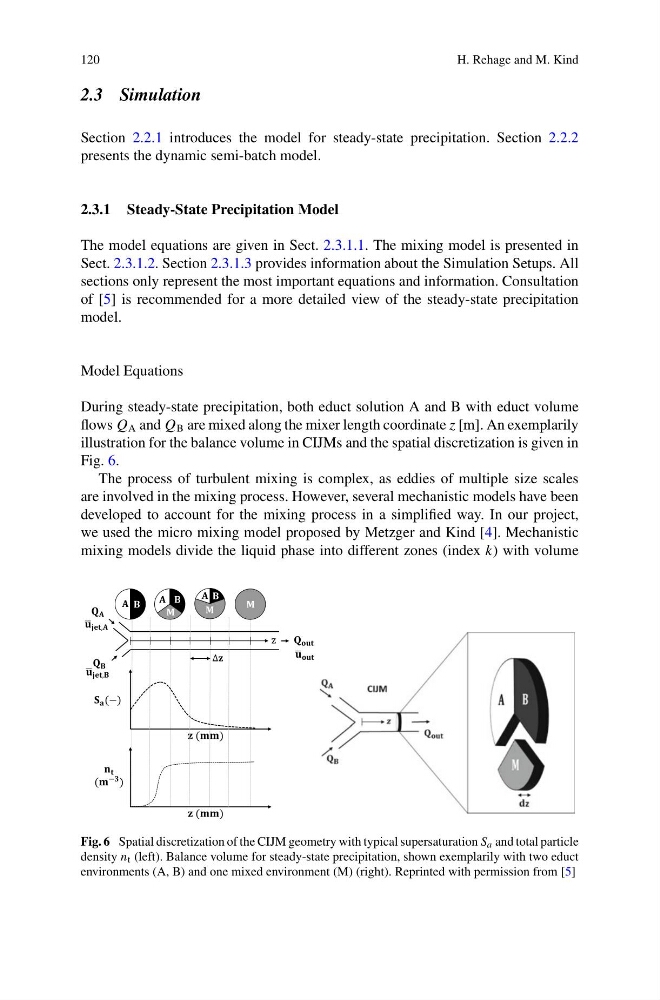
During steady-state precipitation, both educt solution A and B with educt volume
flows Q A and Q B are mixed along the mixer length coordinate z [m]. An exemplarily
illustration for the balance volume in CIJMs and the spatial discretization is given in
Fig. 6.
The process of turbulent mixing is complex, as eddies of multiple size scales
are involved in the mixing process. However, several mechanistic models have been
developed to account for the mixing process in a simplified way. In our project,
we used the micro mixing model proposed by Metzger and Kind [4]. Mechanistic
mixing models divide the liquid phase into different zones (index k) with volume
Fig. 6 Spatial discretization of the CIJM geometry with typical supersaturation S a and total particle
density n t (left). Balance volume for steady-state precipitation, shown exemplarily with two educt
environments (A, B) and one mixed environment (M) (right). Reprinted with permission from [5]
H. Rehage and M. Kind
2.3 Simulation
Section 2.2.1 introduces the model for steady-state precipitation. Section 2.2.2
presents the dynamic semi-batch model.
2.3.1 Steady-State Precipitation Model
The model equations are given in Sect. 2.3.1.1. The mixing model is presented in
Sect. 2.3.1.2. Section 2.3.1.3 provides information about the Simulation Setups. All
sections only represent the most important equations and information. Consultation
of [5] is recommended for a more detailed view of the steady-state precipitation
model.
Model Equations
During steady-state precipitation, both educt solution A and B with educt volume
flows Q A and Q B are mixed along the mixer length coordinate z [m]. An exemplarily
illustration for the balance volume in CIJMs and the spatial discretization is given in
Fig. 6.
The process of turbulent mixing is complex, as eddies of multiple size scales
are involved in the mixing process. However, several mechanistic models have been
developed to account for the mixing process in a simplified way. In our project,
we used the micro mixing model proposed by Metzger and Kind [4]. Mechanistic
mixing models divide the liquid phase into different zones (index k) with volume
Fig. 6 Spatial discretization of the CIJM geometry with typical supersaturation S a and total particle
density n t (left). Balance volume for steady-state precipitation, shown exemplarily with two educt
environments (A, B) and one mixed environment (M) (right). Reprinted with permission from [5]