

1 Process Modeling for Dynamic Disperse Particle Separation …
5
plants [1–4]. In addition, ESP applications to street cleaners have been investigated
[5]. During the past years, new insight into dust separation from exhaust gas by
electrostatic precipitators covered high gas temperatures, discharge electrode design
and quenching (e.g. [6, 7]).
The dynamics in electrostatic precipitators depend on the particle charging and
the field transport. Both parameters vary with local particle position, thus leading to
an effective field particles traverse [4]. A frequently used and industrially applied
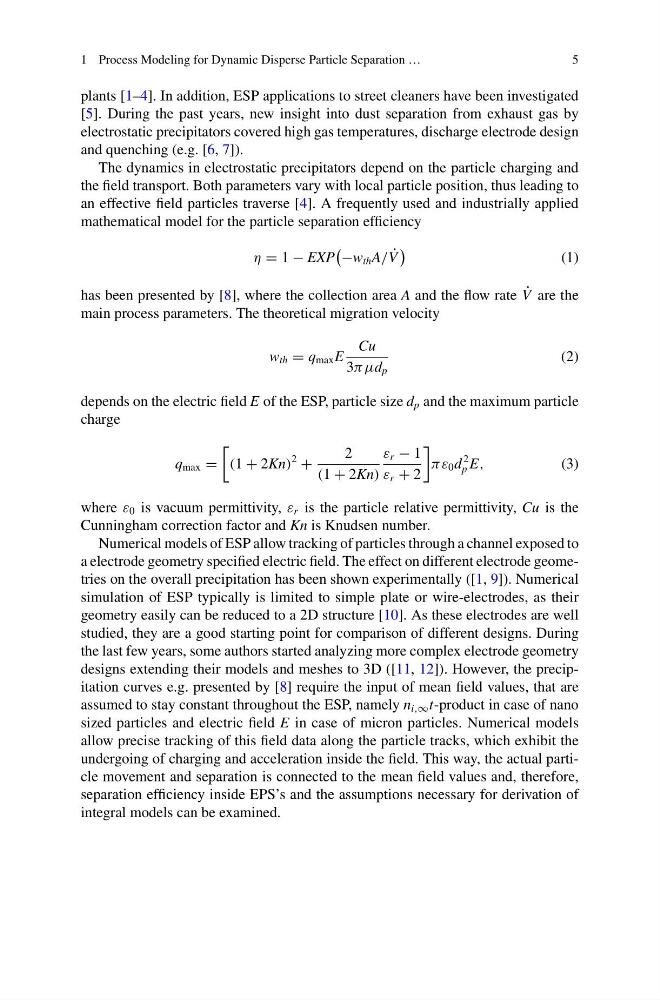
mathematical model for the particle separation efficiency
η = 1 − EXP
−w th A/ ˙
V
(1)
has been presented by [8], where the collection area A and the flow rate ˙
V are the
main process parameters. The theoretical migration velocity
w th = q max E
Cu
3πμd p
(2)
depends on the electric field E of the ESP, particle size d p and the maximum particle
charge
q max =
(1 + 2Kn)
2
+
2
(1 + 2Kn)
ε r − 1
ε r + 2
πε 0 d
2
p E,
(3)
where ε 0 is vacuum permittivity, ε r is the particle relative permittivity, Cu is the
Cunningham correction factor and Kn is Knudsen number.
Numerical models of ESP allow tracking of particles through a channel exposed to
a electrode geometry specified electric field. The effect on different electrode geometries on the overall precipitation has been shown experimentally ([1, 9]). Numerical
simulation of ESP typically is limited to simple plate or wire-electrodes, as their
geometry easily can be reduced to a 2D structure [10]. As these electrodes are well
studied, they are a good starting point for comparison of different designs. During
the last few years, some authors started analyzing more complex electrode geometry
designs extending their models and meshes to 3D ([11, 12]). However, the precipitation curves e.g. presented by [8] require the input of mean field values, that are
assumed to stay constant throughout the ESP, namely n i,∞ t-product in case of nano
sized particles and electric field E in case of micron particles. Numerical models
allow precise tracking of this field data along the particle tracks, which exhibit the
undergoing of charging and acceleration inside the field. This way, the actual particle movement and separation is connected to the mean field values and, therefore,
separation efficiency inside EPS’s and the assumptions necessary for derivation of
integral models can be examined.
5
plants [1–4]. In addition, ESP applications to street cleaners have been investigated
[5]. During the past years, new insight into dust separation from exhaust gas by
electrostatic precipitators covered high gas temperatures, discharge electrode design
and quenching (e.g. [6, 7]).
The dynamics in electrostatic precipitators depend on the particle charging and
the field transport. Both parameters vary with local particle position, thus leading to
an effective field particles traverse [4]. A frequently used and industrially applied
mathematical model for the particle separation efficiency
η = 1 − EXP
−w th A/ ˙
V
(1)
has been presented by [8], where the collection area A and the flow rate ˙
V are the
main process parameters. The theoretical migration velocity
w th = q max E
Cu
3πμd p
(2)
depends on the electric field E of the ESP, particle size d p and the maximum particle
charge
q max =
(1 + 2Kn)
2
+
2
(1 + 2Kn)
ε r − 1
ε r + 2
πε 0 d
2
p E,
(3)
where ε 0 is vacuum permittivity, ε r is the particle relative permittivity, Cu is the
Cunningham correction factor and Kn is Knudsen number.
Numerical models of ESP allow tracking of particles through a channel exposed to
a electrode geometry specified electric field. The effect on different electrode geometries on the overall precipitation has been shown experimentally ([1, 9]). Numerical
simulation of ESP typically is limited to simple plate or wire-electrodes, as their
geometry easily can be reduced to a 2D structure [10]. As these electrodes are well
studied, they are a good starting point for comparison of different designs. During
the last few years, some authors started analyzing more complex electrode geometry
designs extending their models and meshes to 3D ([11, 12]). However, the precipitation curves e.g. presented by [8] require the input of mean field values, that are
assumed to stay constant throughout the ESP, namely n i,∞ t-product in case of nano
sized particles and electric field E in case of micron particles. Numerical models
allow precise tracking of this field data along the particle tracks, which exhibit the
undergoing of charging and acceleration inside the field. This way, the actual particle movement and separation is connected to the mean field values and, therefore,
separation efficiency inside EPS’s and the assumptions necessary for derivation of
integral models can be examined.