

6
S. Sander et al.
2.1 Lab Scale Electrostatic Precipitator Design
The ESP studied in this work is a 0.3 m high and 0.5 m wide rectangular channel with
a length of 1.2 m. The channel walls top and bottom are made of acrylic glass. The
sides consist of grounded copper plates. At the width central plane at a distance of 0.3,
0.6 and 0.9 m from the inlet, three wire spray electrodes are positioned. This design
covers a section of a real size ESP, where multiple channels of the aforementioned
width stringing together to allow higher throughputs of exhaust gas. These parallel
channels are typically 20–60 times higher and their length is varied by a factor of
10–20 to account for nanometer to micrometer sized particle precipitation.
2.2 Numerical Methods for Flow and Electric Field
Numerical models of the electric fields, charge transport and retroactive effects on
the continuous phase, so called electric wind, have been developed and improved
([10, 13, 14]). These models calculate the electrostatic field with respect to Poisson
equation
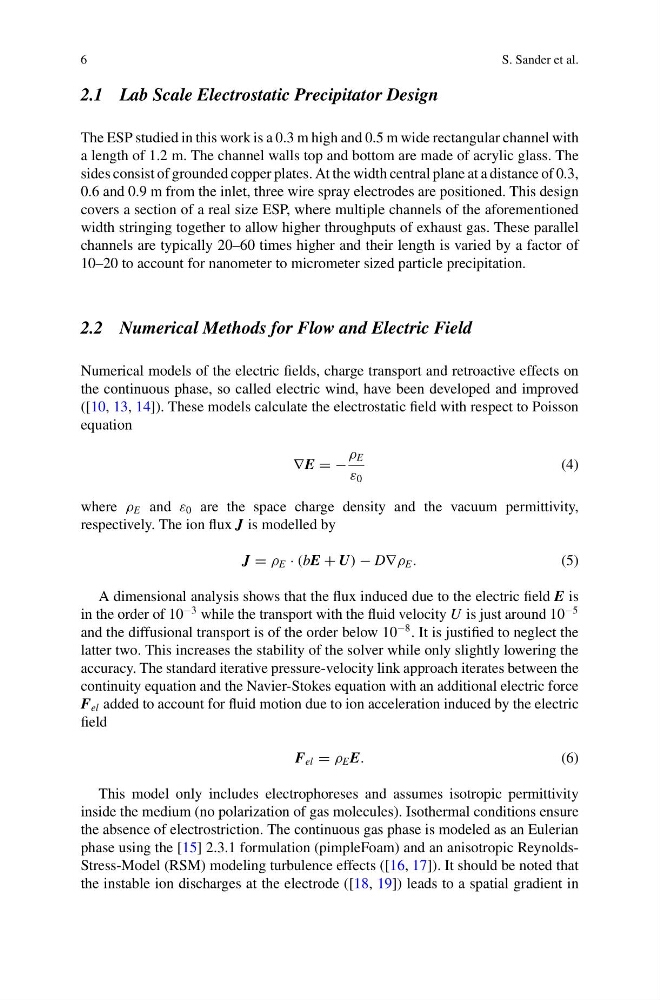
∇E = −
ρ E
ε 0
(4)
where ρ E and ε 0 are the space charge density and the vacuum permittivity,
respectively. The ion flux J is modelled by
J = ρ E · (bE + U) − D∇ρ E .
(5)
A dimensional analysis shows that the flux induced due to the electric field E is
in the order of 10
−3 while the transport with the fluid velocity U is just around 10
−5
and the diffusional transport is of the order below 10
−8 . It is justified to neglect the
latter two. This increases the stability of the solver while only slightly lowering the
accuracy. The standard iterative pressure-velocity link approach iterates between the
continuity equation and the Navier-Stokes equation with an additional electric force
F el added to account for fluid motion due to ion acceleration induced by the electric
field
F el = ρ E E.
(6)
This model only includes electrophoreses and assumes isotropic permittivity
inside the medium (no polarization of gas molecules). Isothermal conditions ensure
the absence of electrostriction. The continuous gas phase is modeled as an Eulerian
phase using the [15] 2.3.1 formulation (pimpleFoam) and an anisotropic ReynoldsStress-Model (RSM) modeling turbulence effects ([16, 17]). It should be noted that
the instable ion discharges at the electrode ([18, 19]) leads to a spatial gradient in
S. Sander et al.
2.1 Lab Scale Electrostatic Precipitator Design
The ESP studied in this work is a 0.3 m high and 0.5 m wide rectangular channel with
a length of 1.2 m. The channel walls top and bottom are made of acrylic glass. The
sides consist of grounded copper plates. At the width central plane at a distance of 0.3,
0.6 and 0.9 m from the inlet, three wire spray electrodes are positioned. This design
covers a section of a real size ESP, where multiple channels of the aforementioned
width stringing together to allow higher throughputs of exhaust gas. These parallel
channels are typically 20–60 times higher and their length is varied by a factor of
10–20 to account for nanometer to micrometer sized particle precipitation.
2.2 Numerical Methods for Flow and Electric Field
Numerical models of the electric fields, charge transport and retroactive effects on
the continuous phase, so called electric wind, have been developed and improved
([10, 13, 14]). These models calculate the electrostatic field with respect to Poisson
equation
∇E = −
ρ E
ε 0
(4)
where ρ E and ε 0 are the space charge density and the vacuum permittivity,
respectively. The ion flux J is modelled by
J = ρ E · (bE + U) − D∇ρ E .
(5)
A dimensional analysis shows that the flux induced due to the electric field E is
in the order of 10
−3 while the transport with the fluid velocity U is just around 10
−5
and the diffusional transport is of the order below 10
−8 . It is justified to neglect the
latter two. This increases the stability of the solver while only slightly lowering the
accuracy. The standard iterative pressure-velocity link approach iterates between the
continuity equation and the Navier-Stokes equation with an additional electric force
F el added to account for fluid motion due to ion acceleration induced by the electric
field
F el = ρ E E.
(6)
This model only includes electrophoreses and assumes isotropic permittivity
inside the medium (no polarization of gas molecules). Isothermal conditions ensure
the absence of electrostriction. The continuous gas phase is modeled as an Eulerian
phase using the [15] 2.3.1 formulation (pimpleFoam) and an anisotropic ReynoldsStress-Model (RSM) modeling turbulence effects ([16, 17]). It should be noted that
the instable ion discharges at the electrode ([18, 19]) leads to a spatial gradient in