

4 Dynamic Simulation of Technical Precipitation Processes
115
2.1 Materials
We used barium sulfate precipitation from aqueous sodium sulfate and barium chloride solution for our studies. Barium sulfate precipitation is well-investigated in
literature and a typical model material for research on mixing influenced precipitation. During contact of both educt solutions, immediate reaction to solid barium
sulfate according to Eq. (1) takes place.
BaCl 2 (aq) + Na 2 SO 4 (aq) → BaSO 4 (s) + 2NaCl (aq)
(1)
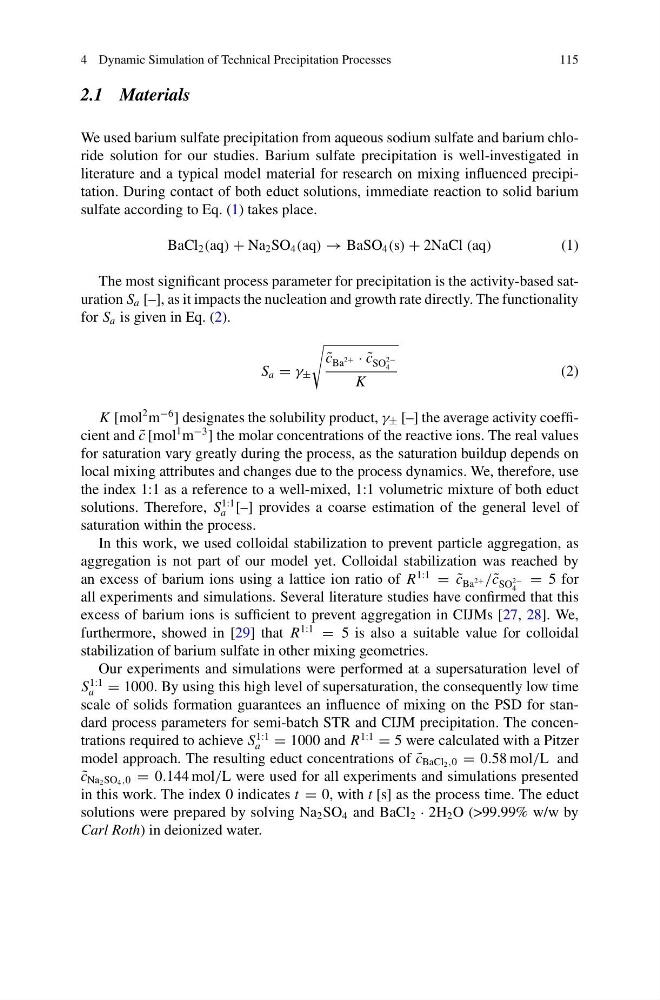
The most significant process parameter for precipitation is the activity-based saturation S a [–], as it impacts the nucleation and growth rate directly. The functionality
for S a is given in Eq. (2).
S a = γ ±
˜
c Ba
2+ · ˜
c SO
2−
4
K
(2)
K [mol
2 m
−6
] designates the solubility product, γ ± [–] the average activity coefficient and ˜
c [mol
1 m
−3
] the molar concentrations of the reactive ions. The real values
for saturation vary greatly during the process, as the saturation buildup depends on
local mixing attributes and changes due to the process dynamics. We, therefore, use
the index 1:1 as a reference to a well-mixed, 1:1 volumetric mixture of both educt
solutions. Therefore, S
1:1
a [–] provides a coarse estimation of the general level of
saturation within the process.
In this work, we used colloidal stabilization to prevent particle aggregation, as
aggregation is not part of our model yet. Colloidal stabilization was reached by
an excess of barium ions using a lattice ion ratio of R
1:1
= ˜
c Ba
2+ / ˜
c SO
2−
4
= 5 for
all experiments and simulations. Several literature studies have confirmed that this
excess of barium ions is sufficient to prevent aggregation in CIJMs [27, 28]. We,
furthermore, showed in [29] that R
1:1
= 5 is also a suitable value for colloidal
stabilization of barium sulfate in other mixing geometries.
Our experiments and simulations were performed at a supersaturation level of
S
1:1
a = 1000. By using this high level of supersaturation, the consequently low time
scale of solids formation guarantees an influence of mixing on the PSD for standard process parameters for semi-batch STR and CIJM precipitation. The concentrations required to achieve S
1:1
a = 1000 and R
1:1
= 5 were calculated with a Pitzer
model approach. The resulting educt concentrations of ˜
c BaCl 2 ,0 = 0.58 mol/L and
˜
c Na 2 SO 4 ,0 = 0.144 mol/L were used for all experiments and simulations presented
in this work. The index 0 indicates t = 0, with t [s] as the process time. The educt
solutions were prepared by solving Na 2 SO 4 and BaCl 2 · 2H 2 O (>99.99% w/w by
Carl Roth) in deionized water.
115
2.1 Materials
We used barium sulfate precipitation from aqueous sodium sulfate and barium chloride solution for our studies. Barium sulfate precipitation is well-investigated in
literature and a typical model material for research on mixing influenced precipitation. During contact of both educt solutions, immediate reaction to solid barium
sulfate according to Eq. (1) takes place.
BaCl 2 (aq) + Na 2 SO 4 (aq) → BaSO 4 (s) + 2NaCl (aq)
(1)
The most significant process parameter for precipitation is the activity-based saturation S a [–], as it impacts the nucleation and growth rate directly. The functionality
for S a is given in Eq. (2).
S a = γ ±
˜
c Ba
2+ · ˜
c SO
2−
4
K
(2)
K [mol
2 m
−6
] designates the solubility product, γ ± [–] the average activity coefficient and ˜
c [mol
1 m
−3
] the molar concentrations of the reactive ions. The real values
for saturation vary greatly during the process, as the saturation buildup depends on
local mixing attributes and changes due to the process dynamics. We, therefore, use
the index 1:1 as a reference to a well-mixed, 1:1 volumetric mixture of both educt
solutions. Therefore, S
1:1
a [–] provides a coarse estimation of the general level of
saturation within the process.
In this work, we used colloidal stabilization to prevent particle aggregation, as
aggregation is not part of our model yet. Colloidal stabilization was reached by
an excess of barium ions using a lattice ion ratio of R
1:1
= ˜
c Ba
2+ / ˜
c SO
2−
4
= 5 for
all experiments and simulations. Several literature studies have confirmed that this
excess of barium ions is sufficient to prevent aggregation in CIJMs [27, 28]. We,
furthermore, showed in [29] that R
1:1
= 5 is also a suitable value for colloidal
stabilization of barium sulfate in other mixing geometries.
Our experiments and simulations were performed at a supersaturation level of
S
1:1
a = 1000. By using this high level of supersaturation, the consequently low time
scale of solids formation guarantees an influence of mixing on the PSD for standard process parameters for semi-batch STR and CIJM precipitation. The concentrations required to achieve S
1:1
a = 1000 and R
1:1
= 5 were calculated with a Pitzer
model approach. The resulting educt concentrations of ˜
c BaCl 2 ,0 = 0.58 mol/L and
˜
c Na 2 SO 4 ,0 = 0.144 mol/L were used for all experiments and simulations presented
in this work. The index 0 indicates t = 0, with t [s] as the process time. The educt
solutions were prepared by solving Na 2 SO 4 and BaCl 2 · 2H 2 O (>99.99% w/w by
Carl Roth) in deionized water.