

114
H. Rehage and M. Kind
Zone models
Large-scale spaƟal
discreƟzaƟon
A
C
E
F
B
D
G
H
CFD models
Small-scale spaƟal
discreƟzaƟon
BF
PFR
MechanisƟc models
SpaƟal discreƟzaƟon limited to PFR
(Lagrangian approach)
Numerical effort
(a)
(b)
(c)
(d)
Flowsheet models
?
MSMPR
No spaƟal
discreƟzaƟon
No mixing
influence
Mixing influence
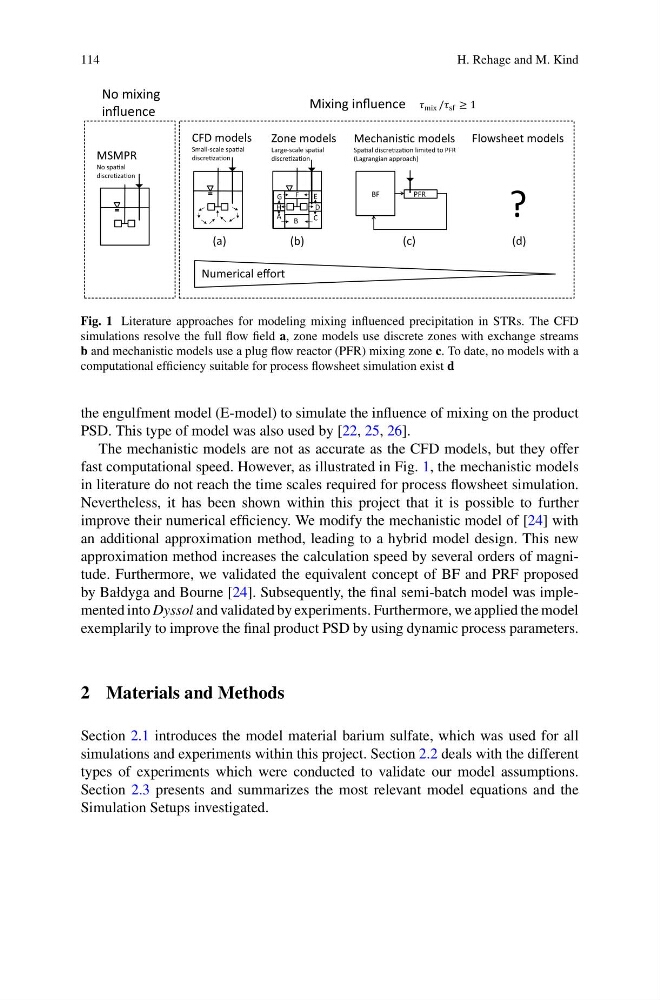
Fig. 1 Literature approaches for modeling mixing influenced precipitation in STRs. The CFD
simulations resolve the full flow field a, zone models use discrete zones with exchange streams
b and mechanistic models use a plug flow reactor (PFR) mixing zone c. To date, no models with a
computational efficiency suitable for process flowsheet simulation exist d
the engulfment model (E-model) to simulate the influence of mixing on the product
PSD. This type of model was also used by [22, 25, 26].
The mechanistic models are not as accurate as the CFD models, but they offer
fast computational speed. However, as illustrated in Fig. 1, the mechanistic models
in literature do not reach the time scales required for process flowsheet simulation.
Nevertheless, it has been shown within this project that it is possible to further
improve their numerical efficiency. We modify the mechanistic model of [24] with
an additional approximation method, leading to a hybrid model design. This new
approximation method increases the calculation speed by several orders of magnitude. Furthermore, we validated the equivalent concept of BF and PRF proposed
by Bałdyga and Bourne [24]. Subsequently, the final semi-batch model was implemented into Dyssol and validated by experiments. Furthermore, we applied the model
exemplarily to improve the final product PSD by using dynamic process parameters.
2 Materials and Methods
Section 2.1 introduces the model material barium sulfate, which was used for all
simulations and experiments within this project. Section 2.2 deals with the different
types of experiments which were conducted to validate our model assumptions.
Section 2.3 presents and summarizes the most relevant model equations and the
Simulation Setups investigated.
H. Rehage and M. Kind
Zone models
Large-scale spaƟal
discreƟzaƟon
A
C
E
F
B
D
G
H
CFD models
Small-scale spaƟal
discreƟzaƟon
BF
PFR
MechanisƟc models
SpaƟal discreƟzaƟon limited to PFR
(Lagrangian approach)
Numerical effort
(a)
(b)
(c)
(d)
Flowsheet models
?
MSMPR
No spaƟal
discreƟzaƟon
No mixing
influence
Mixing influence
Fig. 1 Literature approaches for modeling mixing influenced precipitation in STRs. The CFD
simulations resolve the full flow field a, zone models use discrete zones with exchange streams
b and mechanistic models use a plug flow reactor (PFR) mixing zone c. To date, no models with a
computational efficiency suitable for process flowsheet simulation exist d
the engulfment model (E-model) to simulate the influence of mixing on the product
PSD. This type of model was also used by [22, 25, 26].
The mechanistic models are not as accurate as the CFD models, but they offer
fast computational speed. However, as illustrated in Fig. 1, the mechanistic models
in literature do not reach the time scales required for process flowsheet simulation.
Nevertheless, it has been shown within this project that it is possible to further
improve their numerical efficiency. We modify the mechanistic model of [24] with
an additional approximation method, leading to a hybrid model design. This new
approximation method increases the calculation speed by several orders of magnitude. Furthermore, we validated the equivalent concept of BF and PRF proposed
by Bałdyga and Bourne [24]. Subsequently, the final semi-batch model was implemented into Dyssol and validated by experiments. Furthermore, we applied the model
exemplarily to improve the final product PSD by using dynamic process parameters.
2 Materials and Methods
Section 2.1 introduces the model material barium sulfate, which was used for all
simulations and experiments within this project. Section 2.2 deals with the different
types of experiments which were conducted to validate our model assumptions.
Section 2.3 presents and summarizes the most relevant model equations and the
Simulation Setups investigated.