

3.7 Energy Dissipation by Damping
79
Combining Eqs. (3.44) and (3.45), we get
E e = 2π ζ
ω
p
k A
2
(3.46)
Equations (3.43) and (3.46) reveal that energy dissipation in steady-state vibration
is due to various damping in steady-state vibration.
The graphical representation of energy dissipation in viscous damping is
performed as follows.
The velocity of motion is expressed as
x = ω A cos (ω t− ∈) = ± ω A
1 − sin
2
(ω t − ε ) = ±
A 2 − x 2 (3.47)
The damping force is related to displacement x as follows
F d = c ˙
x = ± cω
A 2 − x 2
(3.48)
Equation (3.48) is rearranged as
F d
cp A
2
+
x
A
2 = 1
(3.49)
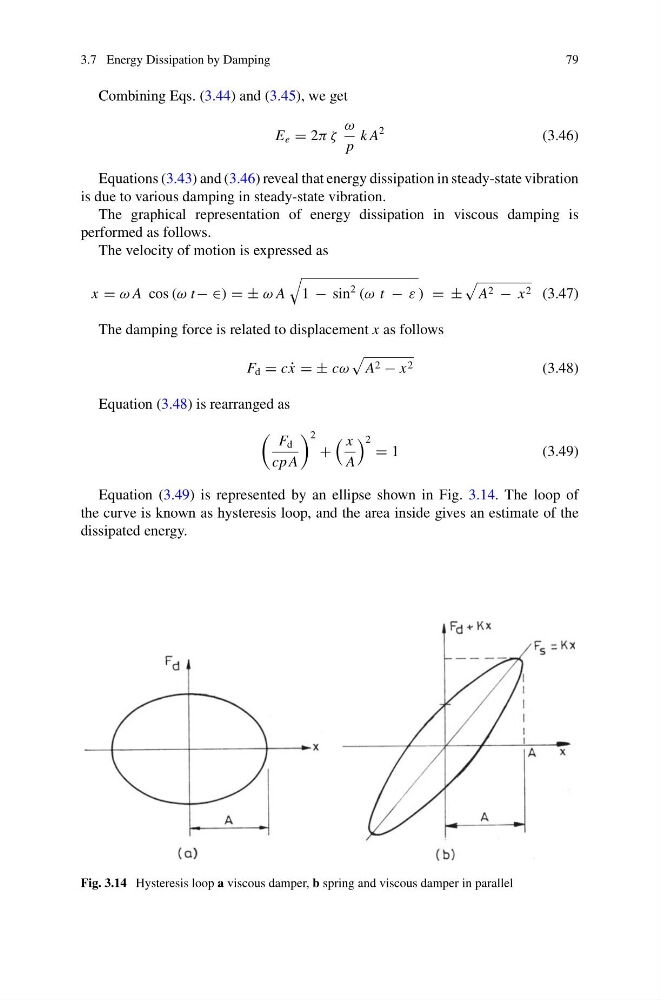
Equation (3.49) is represented by an ellipse shown in Fig. 3.14. The loop of
the curve is known as hysteresis loop, and the area inside gives an estimate of the
dissipated energy.
Fig. 3.14 Hysteresis loop a viscous damper, b spring and viscous damper in parallel
79
Combining Eqs. (3.44) and (3.45), we get
E e = 2π ζ
ω
p
k A
2
(3.46)
Equations (3.43) and (3.46) reveal that energy dissipation in steady-state vibration
is due to various damping in steady-state vibration.
The graphical representation of energy dissipation in viscous damping is
performed as follows.
The velocity of motion is expressed as
x = ω A cos (ω t− ∈) = ± ω A
1 − sin
2
(ω t − ε ) = ±
A 2 − x 2 (3.47)
The damping force is related to displacement x as follows
F d = c ˙
x = ± cω
A 2 − x 2
(3.48)
Equation (3.48) is rearranged as
F d
cp A
2
+
x
A
2 = 1
(3.49)
Equation (3.49) is represented by an ellipse shown in Fig. 3.14. The loop of
the curve is known as hysteresis loop, and the area inside gives an estimate of the
dissipated energy.
Fig. 3.14 Hysteresis loop a viscous damper, b spring and viscous damper in parallel