

78
3 Forced Vibration of Single Degree of Freedom System
=
2 π
p
0
c · (Ap)
2 cos
2
(ω t− ∈) dt
(3.42)
or
E d = π c ω A
2
We know that p =
k
m
and c = 2ζ
√
km. Substituting these values in Eq. (3.42)
yields
E d = 2ζ π k A
2
ω
p
(3.43)
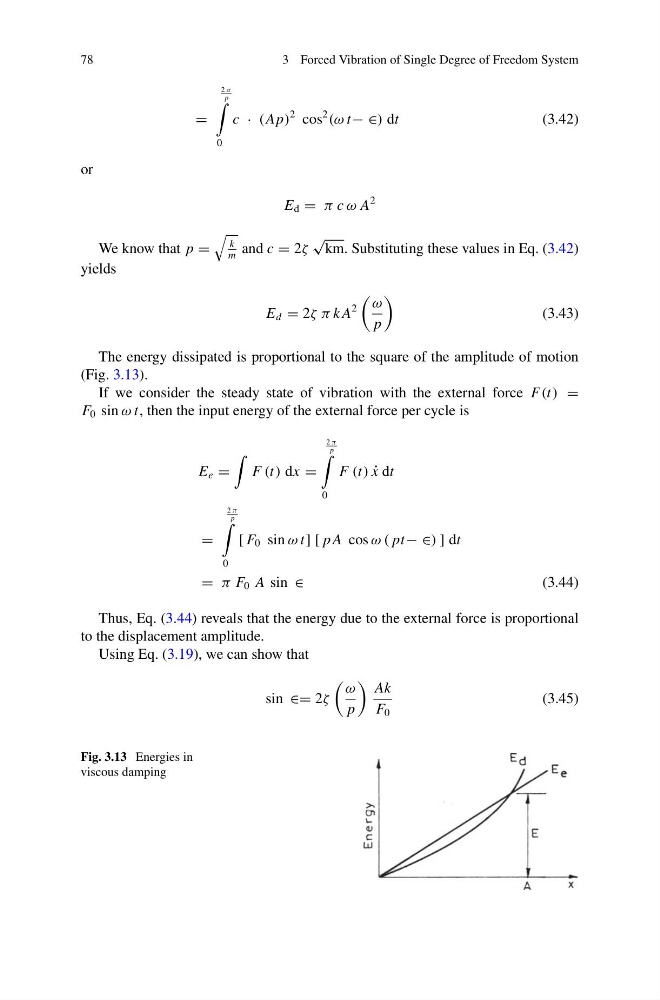
The energy dissipated is proportional to the square of the amplitude of motion
(Fig. 3.13).
If we consider the steady state of vibration with the external force F(t) =
F 0 sin ω t, then the input energy of the external force per cycle is
E e =
F (t) dx =
2 π
p
0
F (t) ˙
x dt
=
2 π
p
0
[ F 0 sin ω t] [ p A cos ω ( pt− ∈) ] dt
= π F 0 A sin ∈
(3.44)
Thus, Eq. (3.44) reveals that the energy due to the external force is proportional
to the displacement amplitude.
Using Eq. (3.19), we can show that
sin ∈= 2ζ
ω
p
Ak
F 0
(3.45)
Fig. 3.13 Energies in
viscous damping
3 Forced Vibration of Single Degree of Freedom System
=
2 π
p
0
c · (Ap)
2 cos
2
(ω t− ∈) dt
(3.42)
or
E d = π c ω A
2
We know that p =
k
m
and c = 2ζ
√
km. Substituting these values in Eq. (3.42)
yields
E d = 2ζ π k A
2
ω
p
(3.43)
The energy dissipated is proportional to the square of the amplitude of motion
(Fig. 3.13).
If we consider the steady state of vibration with the external force F(t) =
F 0 sin ω t, then the input energy of the external force per cycle is
E e =
F (t) dx =
2 π
p
0
F (t) ˙
x dt
=
2 π
p
0
[ F 0 sin ω t] [ p A cos ω ( pt− ∈) ] dt
= π F 0 A sin ∈
(3.44)
Thus, Eq. (3.44) reveals that the energy due to the external force is proportional
to the displacement amplitude.
Using Eq. (3.19), we can show that
sin ∈= 2ζ
ω
p
Ak
F 0
(3.45)
Fig. 3.13 Energies in
viscous damping