

70
3 Forced Vibration of Single Degree of Freedom System
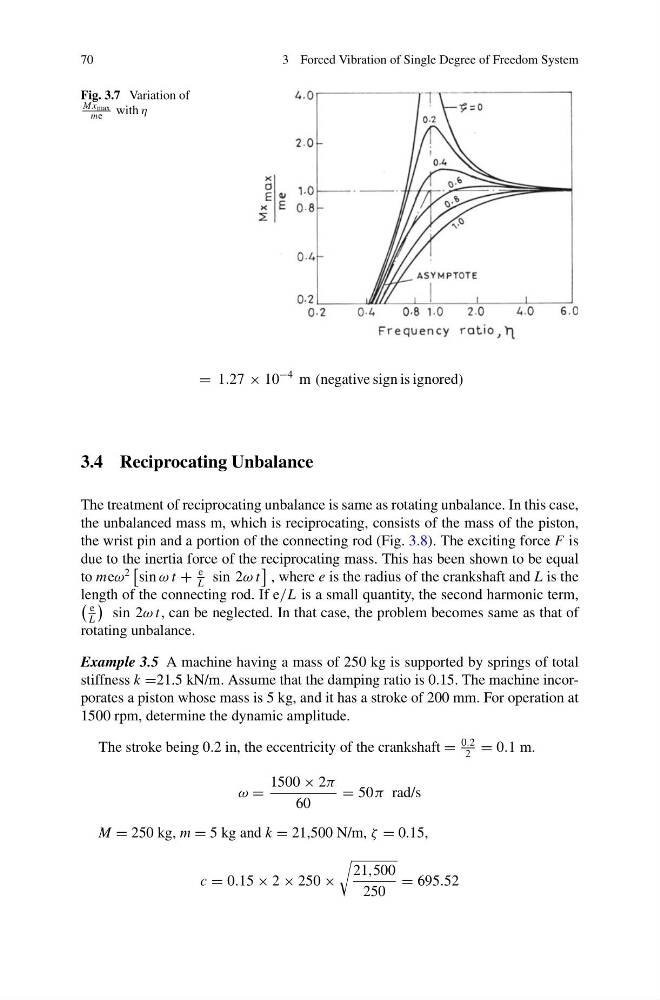
Fig. 3.7 Variation of
Mxmax
me with η
= 1.27 × 10
−4 m (negative sign is ignored)
3.4 Reciprocating Unbalance
The treatment of reciprocating unbalance is same as rotating unbalance. In this case,
the unbalanced mass m, which is reciprocating, consists of the mass of the piston,
the wrist pin and a portion of the connecting rod (Fig. 3.8). The exciting force F is
due to the inertia force of the reciprocating mass. This has been shown to be equal
to meω
2
sin ω t +
e
L
sin 2ω t
, where e is the radius of the crankshaft and L is the
length of the connecting rod. If e/L is a small quantity, the second harmonic term,
e
L
sin 2ω t, can be neglected. In that case, the problem becomes same as that of
rotating unbalance.
Example 3.5 A machine having a mass of 250 kg is supported by springs of total
stiffness k =21.5 kN/m. Assume that the damping ratio is 0.15. The machine incorporates a piston whose mass is 5 kg, and it has a stroke of 200 mm. For operation at
1500 rpm, determine the dynamic amplitude.
The stroke being 0.2 in, the eccentricity of the crankshaft =
0.2
2
= 0.1 m.
ω =
1500 × 2π
60
= 50 π rad/s
M = 250 kg, m = 5 kg and k = 21,500 N/m, ζ = 0.15,
c = 0.15 × 2 × 250 ×
21,500
250
= 695.52
3 Forced Vibration of Single Degree of Freedom System
Fig. 3.7 Variation of
Mxmax
me with η
= 1.27 × 10
−4 m (negative sign is ignored)
3.4 Reciprocating Unbalance
The treatment of reciprocating unbalance is same as rotating unbalance. In this case,
the unbalanced mass m, which is reciprocating, consists of the mass of the piston,
the wrist pin and a portion of the connecting rod (Fig. 3.8). The exciting force F is
due to the inertia force of the reciprocating mass. This has been shown to be equal
to meω
2
sin ω t +
e
L
sin 2ω t
, where e is the radius of the crankshaft and L is the
length of the connecting rod. If e/L is a small quantity, the second harmonic term,
e
L
sin 2ω t, can be neglected. In that case, the problem becomes same as that of
rotating unbalance.
Example 3.5 A machine having a mass of 250 kg is supported by springs of total
stiffness k =21.5 kN/m. Assume that the damping ratio is 0.15. The machine incorporates a piston whose mass is 5 kg, and it has a stroke of 200 mm. For operation at
1500 rpm, determine the dynamic amplitude.
The stroke being 0.2 in, the eccentricity of the crankshaft =
0.2
2
= 0.1 m.
ω =
1500 × 2π
60
= 50 π rad/s
M = 250 kg, m = 5 kg and k = 21,500 N/m, ζ = 0.15,
c = 0.15 × 2 × 250 ×
21,500
250
= 695.52