

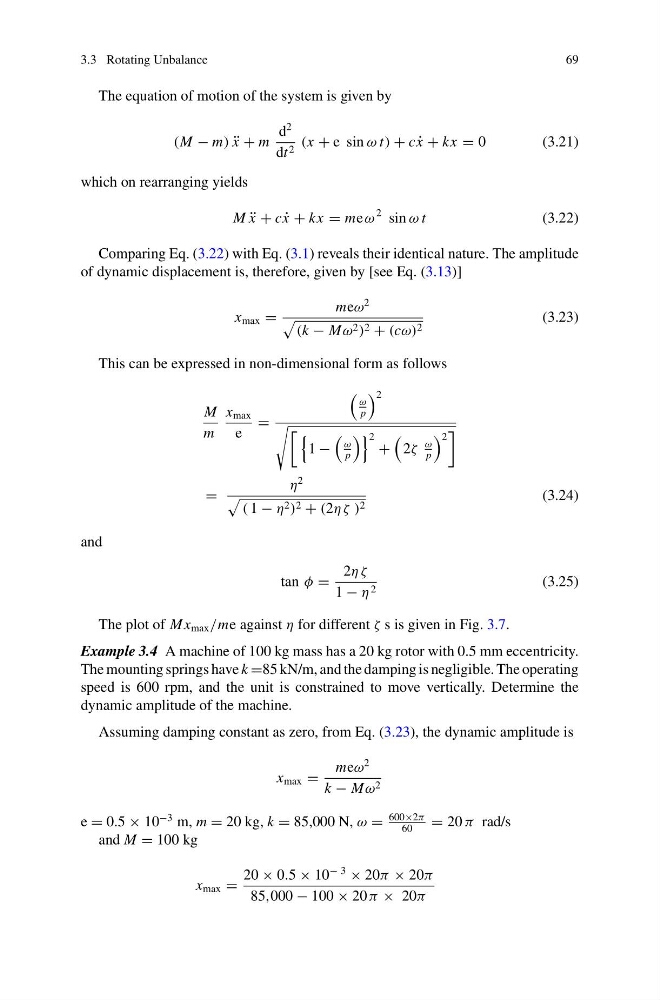
3.3 Rotating Unbalance
69
The equation of motion of the system is given by
(M − m) ¨
x + m
d
2
dt 2 (x + e sin ω t) + c ˙
x + kx = 0
(3.21)
which on rearranging yields
M ¨
x + c ˙
x + kx = meω
2 sin ω t
(3.22)
Comparing Eq. (3.22) with Eq. (3.1) reveals their identical nature. The amplitude
of dynamic displacement is, therefore, given by [see Eq. (3.13)]
x max =
meω
2
(k − Mω 2 ) 2 + (cω) 2
(3.23)
This can be expressed in non-dimensional form as follows
M
m
x max
e
=
ω
p
2
1 −
ω
p
2 +
2ζ
ω
p
2
=
η
2
( 1 − η 2 ) 2 + (2η ζ ) 2
(3.24)
and
tan φ =
2η ζ
1 − η 2
(3.25)
The plot of M x max /me against η for different ζ s is given in Fig. 3.7.
Example 3.4 A machine of 100 kg mass has a 20 kg rotor with 0.5 mm eccentricity.
The mounting springs have k =85 kN/m, and the damping is negligible. The operating
speed is 600 rpm, and the unit is constrained to move vertically. Determine the
dynamic amplitude of the machine.
Assuming damping constant as zero, from Eq. (3.23), the dynamic amplitude is
x max =
meω
2
k − Mω 2
e = 0.5 × 10
−3 m, m = 20 kg, k = 85,000 N, ω =
600×2π
60
= 20 π rad/s
and M = 100 kg
x max =
20 × 0.5 × 10
− 3
× 20π × 20π
85,000 − 100 × 20 π × 20π
69
The equation of motion of the system is given by
(M − m) ¨
x + m
d
2
dt 2 (x + e sin ω t) + c ˙
x + kx = 0
(3.21)
which on rearranging yields
M ¨
x + c ˙
x + kx = meω
2 sin ω t
(3.22)
Comparing Eq. (3.22) with Eq. (3.1) reveals their identical nature. The amplitude
of dynamic displacement is, therefore, given by [see Eq. (3.13)]
x max =
meω
2
(k − Mω 2 ) 2 + (cω) 2
(3.23)
This can be expressed in non-dimensional form as follows
M
m
x max
e
=
ω
p
2
1 −
ω
p
2 +
2ζ
ω
p
2
=
η
2
( 1 − η 2 ) 2 + (2η ζ ) 2
(3.24)
and
tan φ =
2η ζ
1 − η 2
(3.25)
The plot of M x max /me against η for different ζ s is given in Fig. 3.7.
Example 3.4 A machine of 100 kg mass has a 20 kg rotor with 0.5 mm eccentricity.
The mounting springs have k =85 kN/m, and the damping is negligible. The operating
speed is 600 rpm, and the unit is constrained to move vertically. Determine the
dynamic amplitude of the machine.
Assuming damping constant as zero, from Eq. (3.23), the dynamic amplitude is
x max =
meω
2
k − Mω 2
e = 0.5 × 10
−3 m, m = 20 kg, k = 85,000 N, ω =
600×2π
60
= 20 π rad/s
and M = 100 kg
x max =
20 × 0.5 × 10
− 3
× 20π × 20π
85,000 − 100 × 20 π × 20π