

62
3 Forced Vibration of Single Degree of Freedom System
The initial part of the motion involving the first few cycles is known as the transient
state.
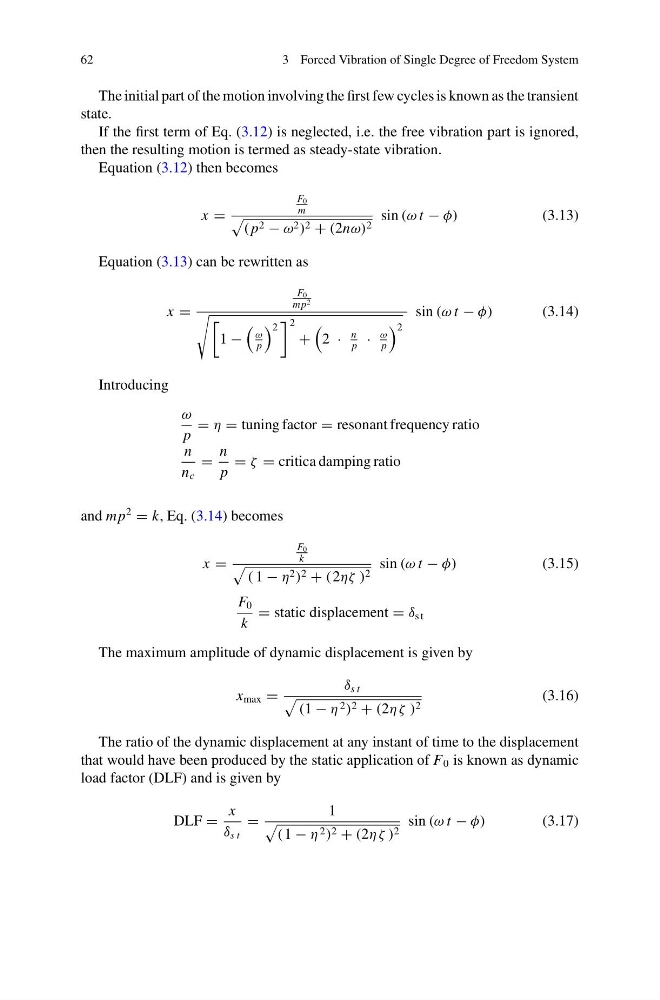
If the first term of Eq. (3.12) is neglected, i.e. the free vibration part is ignored,
then the resulting motion is termed as steady-state vibration.
Equation (3.12) then becomes
x =
F 0
m
( p 2 − ω 2 ) 2 + (2nω) 2
sin (ω t − φ)
(3.13)
Equation (3.13) can be rewritten as
x =
F 0
mp 2
1 −
ω
p
2
2
+
2 ·
n
p
·
ω
p
2
sin (ω t − φ)
(3.14)
Introducing
ω
p
= η = tuning factor = resonant frequency ratio
n
n c
=
n
p
= ζ = critica damping ratio
and mp
2
= k, Eq. (3.14) becomes
x =
F 0
k
( 1 − η 2 ) 2 + ( 2ηζ ) 2
sin (ω t − φ)
(3.15)
F 0
k
= static displacement = δ s t
The maximum amplitude of dynamic displacement is given by
x max =
δ s t
(1 − η 2 ) 2 + (2η ζ ) 2
(3.16)
The ratio of the dynamic displacement at any instant of time to the displacement
that would have been produced by the static application of F 0 is known as dynamic
load factor (DLF) and is given by
DLF =
x
δ s t
=
1
( 1 − η 2 ) 2 + (2η ζ ) 2
sin (ω t − φ)
(3.17)
3 Forced Vibration of Single Degree of Freedom System
The initial part of the motion involving the first few cycles is known as the transient
state.
If the first term of Eq. (3.12) is neglected, i.e. the free vibration part is ignored,
then the resulting motion is termed as steady-state vibration.
Equation (3.12) then becomes
x =
F 0
m
( p 2 − ω 2 ) 2 + (2nω) 2
sin (ω t − φ)
(3.13)
Equation (3.13) can be rewritten as
x =
F 0
mp 2
1 −
ω
p
2
2
+
2 ·
n
p
·
ω
p
2
sin (ω t − φ)
(3.14)
Introducing
ω
p
= η = tuning factor = resonant frequency ratio
n
n c
=
n
p
= ζ = critica damping ratio
and mp
2
= k, Eq. (3.14) becomes
x =
F 0
k
( 1 − η 2 ) 2 + ( 2ηζ ) 2
sin (ω t − φ)
(3.15)
F 0
k
= static displacement = δ s t
The maximum amplitude of dynamic displacement is given by
x max =
δ s t
(1 − η 2 ) 2 + (2η ζ ) 2
(3.16)
The ratio of the dynamic displacement at any instant of time to the displacement
that would have been produced by the static application of F 0 is known as dynamic
load factor (DLF) and is given by
DLF =
x
δ s t
=
1
( 1 − η 2 ) 2 + (2η ζ ) 2
sin (ω t − φ)
(3.17)