

15.11 Finite Element Random Response of Plates
555
The procedure above for jth mode is applied to all degrees of freedom in
succession, and the resulting equations are arranged in matrix form as
[X (ω)] = []]H (ω)[]
T
(15.87)
The matrix H (ω) is a diagonal matrix. [X (ω)] in Eq. (15.87) is defined as the
complex admittance matrix for the whole system and is given a new notation
[H (ω)] = [][H (ω)][]
T
(15.88)
15.11.1 Cross-Spectral Density Matrix for Generalised
Forces
We consider transverse loading on the plate only. The overall generalised nodal force
vectors at an instant t for a distributed pressure is expressed as
{F(t)} =
N E
i=1
¨
[N ] i { p(x, y, t)}dxdy
(15.89)
where NE indicates the number of elements. The correlation matrix for the
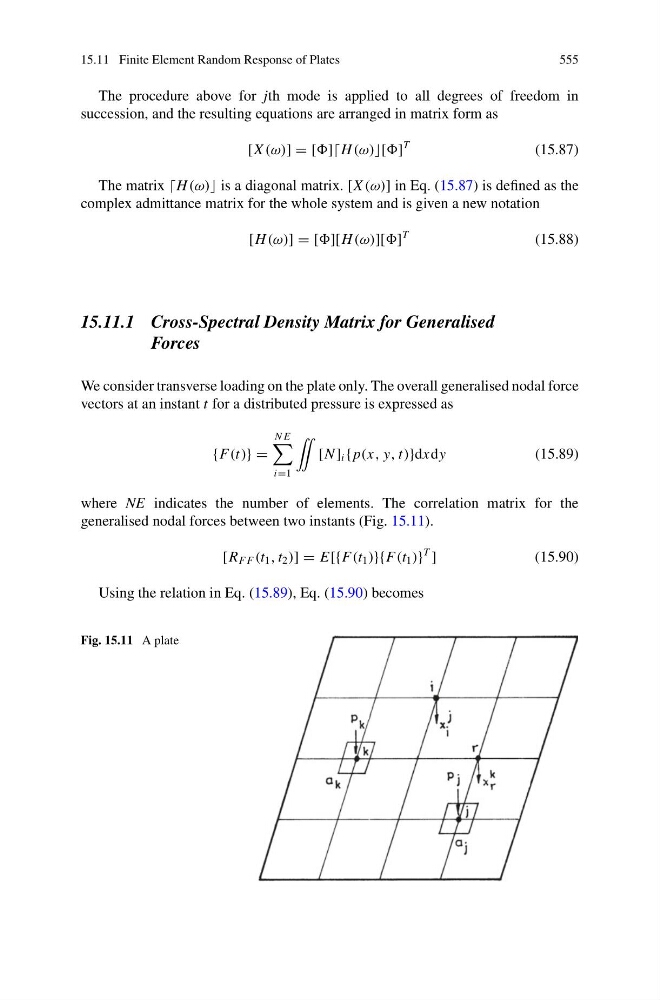
generalised nodal forces between two instants (Fig. 15.11).
[R F F (t 1 , t 2 )] = E[{F(t 1 )}{F(t 1 )}
T
]
(15.90)
Using the relation in Eq. (15.89), Eq. (15.90) becomes
Fig. 15.11 A plate
555
The procedure above for jth mode is applied to all degrees of freedom in
succession, and the resulting equations are arranged in matrix form as
[X (ω)] = []]H (ω)[]
T
(15.87)
The matrix H (ω) is a diagonal matrix. [X (ω)] in Eq. (15.87) is defined as the
complex admittance matrix for the whole system and is given a new notation
[H (ω)] = [][H (ω)][]
T
(15.88)
15.11.1 Cross-Spectral Density Matrix for Generalised
Forces
We consider transverse loading on the plate only. The overall generalised nodal force
vectors at an instant t for a distributed pressure is expressed as
{F(t)} =
N E
i=1
¨
[N ] i { p(x, y, t)}dxdy
(15.89)
where NE indicates the number of elements. The correlation matrix for the
generalised nodal forces between two instants (Fig. 15.11).
[R F F (t 1 , t 2 )] = E[{F(t 1 )}{F(t 1 )}
T
]
(15.90)
Using the relation in Eq. (15.89), Eq. (15.90) becomes
Fig. 15.11 A plate