

556
15 Random Vibrations
[R F F (t 1 , t 2 )] =
N E
i=1
¨
[N ] i
N E
j=1
¨
[N ] j E[ p i {x 1 , y 1 , t 1 }
× p j {x 2 , y 2 , t 2 }]dxdydxdy
(15.91)
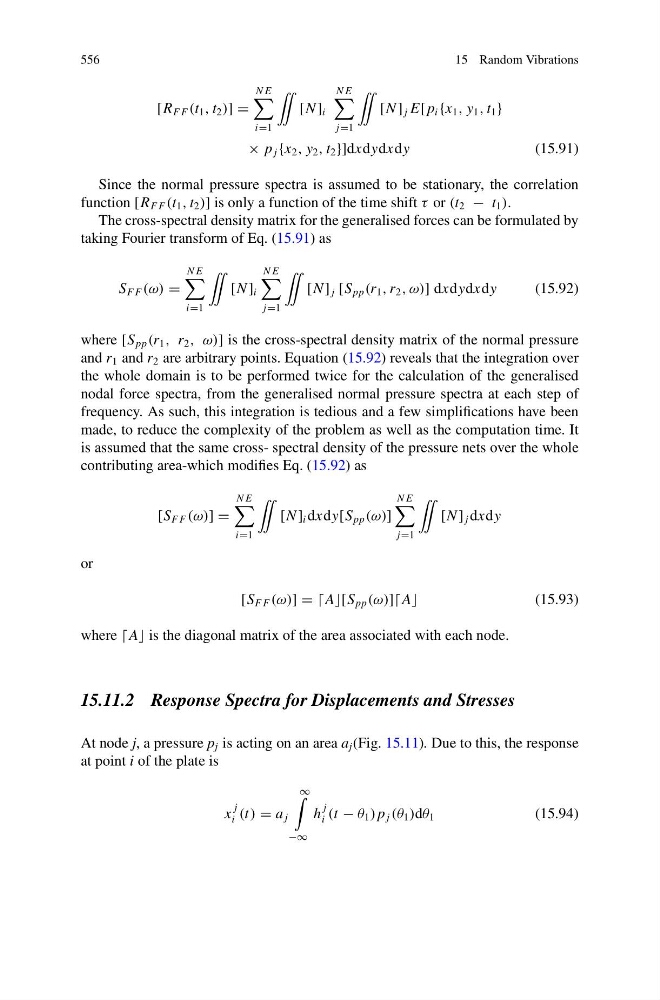
Since the normal pressure spectra is assumed to be stationary, the correlation
function [R F F (t 1 , t 2 )] is only a function of the time shift τ or (t 2 − t 1 ).
The cross-spectral density matrix for the generalised forces can be formulated by
taking Fourier transform of Eq. (15.91) as
S F F (ω) =
N E
i=1
¨
[N ] i
N E
j=1
¨
[N ] j [S pp (r 1 , r 2 , ω)] dxdydxdy
(15.92)
where [S pp (r 1 , r 2 , ω)] is the cross-spectral density matrix of the normal pressure
and r 1 and r 2 are arbitrary points. Equation (15.92) reveals that the integration over
the whole domain is to be performed twice for the calculation of the generalised
nodal force spectra, from the generalised normal pressure spectra at each step of
frequency. As such, this integration is tedious and a few simplifications have been
made, to reduce the complexity of the problem as well as the computation time. It
is assumed that the same cross- spectral density of the pressure nets over the whole
contributing area-which modifies Eq. (15.92) as
[S F F (ω)] =
N E
i=1
¨
[N ] i dxdy[S pp (ω)]
N E
j=1
¨
[N ] j dxdy
or
[S F F (ω)] = =A[S pp (ω)]]A
(15.93)
where A is the diagonal matrix of the area associated with each node.
15.11.2 Response Spectra for Displacements and Stresses
At node j, a pressure p j is acting on an area a j (Fig. 15.11). Due to this, the response
at point i of the plate is
x
j
i (t) = a j
∞
−∞
h
j
i (t − θ 1 ) p j (θ 1 )dθ 1
(15.94)
15 Random Vibrations
[R F F (t 1 , t 2 )] =
N E
i=1
¨
[N ] i
N E
j=1
¨
[N ] j E[ p i {x 1 , y 1 , t 1 }
× p j {x 2 , y 2 , t 2 }]dxdydxdy
(15.91)
Since the normal pressure spectra is assumed to be stationary, the correlation
function [R F F (t 1 , t 2 )] is only a function of the time shift τ or (t 2 − t 1 ).
The cross-spectral density matrix for the generalised forces can be formulated by
taking Fourier transform of Eq. (15.91) as
S F F (ω) =
N E
i=1
¨
[N ] i
N E
j=1
¨
[N ] j [S pp (r 1 , r 2 , ω)] dxdydxdy
(15.92)
where [S pp (r 1 , r 2 , ω)] is the cross-spectral density matrix of the normal pressure
and r 1 and r 2 are arbitrary points. Equation (15.92) reveals that the integration over
the whole domain is to be performed twice for the calculation of the generalised
nodal force spectra, from the generalised normal pressure spectra at each step of
frequency. As such, this integration is tedious and a few simplifications have been
made, to reduce the complexity of the problem as well as the computation time. It
is assumed that the same cross- spectral density of the pressure nets over the whole
contributing area-which modifies Eq. (15.92) as
[S F F (ω)] =
N E
i=1
¨
[N ] i dxdy[S pp (ω)]
N E
j=1
¨
[N ] j dxdy
or
[S F F (ω)] = =A[S pp (ω)]]A
(15.93)
where A is the diagonal matrix of the area associated with each node.
15.11.2 Response Spectra for Displacements and Stresses
At node j, a pressure p j is acting on an area a j (Fig. 15.11). Due to this, the response
at point i of the plate is
x
j
i (t) = a j
∞
−∞
h
j
i (t − θ 1 ) p j (θ 1 )dθ 1
(15.94)