

15.10 Response of Flexural Beams Under Random Loading
553
where R g = autocorrelation of the ground acceleration
= E[ ¨
y g (t − θ 1 ) ¨
y g (t + τ − θ 2 )]
In the frequency domain analysis, the spectral density function for relative
displacement z(x 1 , t) is defined by Eq. (15.38)
S zz (x, ω) =
1
2π
∞
−∞
R zz (x, τ )e
−iωτ dτ
(15.76)
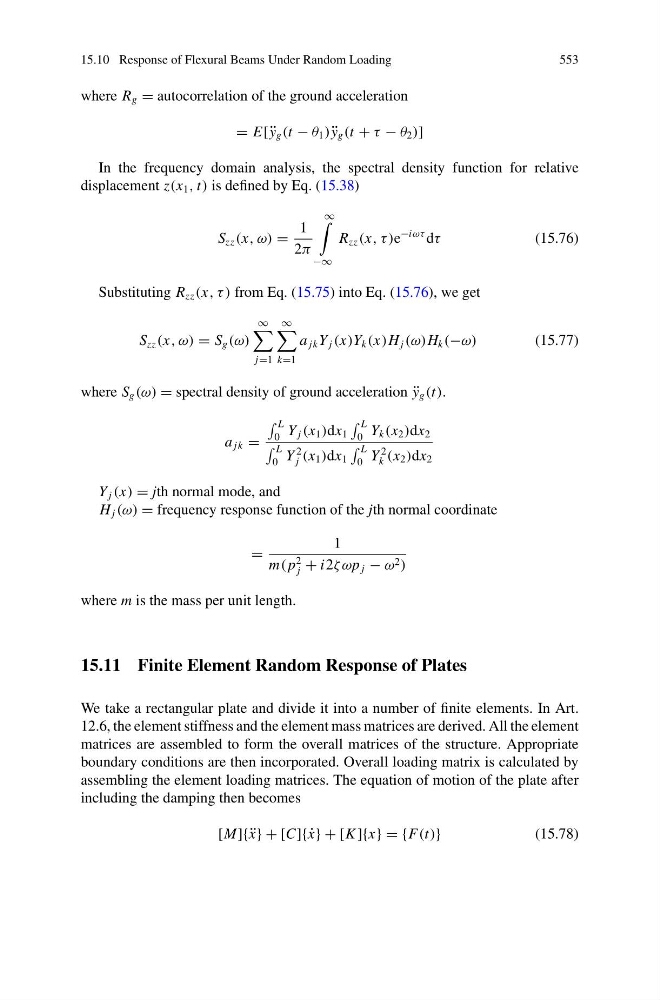
Substituting R zz (x, τ ) from Eq. (15.75) into Eq. (15.76), we get
S zz (x, ω) = S g (ω)
∞
j=1
∞
k=1
a jk Y j (x)Y k (x)H j (ω)H k (−ω)
(15.77)
where S g (ω) = spectral density of ground acceleration ¨
y g (t).
a jk =
L
0 Y j (x 1 )dx 1
L
0 Y k (x 2 )dx 2
L
0 Y
2
j (x 1 )dx 1
L
0 Y
2
k (x 2 )dx 2
Y j (x) = jth normal mode, and
H j (ω) = frequency response function of the jth normal coordinate
=
1
m( p
2
j + i2ζ ωp j − ω 2 )
where m is the mass per unit length.
15.11 Finite Element Random Response of Plates
We take a rectangular plate and divide it into a number of finite elements. In Art.
12.6, the element stiffness and the element mass matrices are derived. All the element
matrices are assembled to form the overall matrices of the structure. Appropriate
boundary conditions are then incorporated. Overall loading matrix is calculated by
assembling the element loading matrices. The equation of motion of the plate after
including the damping then becomes
[M]{ ¨
x} + [C]{ ˙
x} + [K ]{x} = {F(t)}
(15.78)
553
where R g = autocorrelation of the ground acceleration
= E[ ¨
y g (t − θ 1 ) ¨
y g (t + τ − θ 2 )]
In the frequency domain analysis, the spectral density function for relative
displacement z(x 1 , t) is defined by Eq. (15.38)
S zz (x, ω) =
1
2π
∞
−∞
R zz (x, τ )e
−iωτ dτ
(15.76)
Substituting R zz (x, τ ) from Eq. (15.75) into Eq. (15.76), we get
S zz (x, ω) = S g (ω)
∞
j=1
∞
k=1
a jk Y j (x)Y k (x)H j (ω)H k (−ω)
(15.77)
where S g (ω) = spectral density of ground acceleration ¨
y g (t).
a jk =
L
0 Y j (x 1 )dx 1
L
0 Y k (x 2 )dx 2
L
0 Y
2
j (x 1 )dx 1
L
0 Y
2
k (x 2 )dx 2
Y j (x) = jth normal mode, and
H j (ω) = frequency response function of the jth normal coordinate
=
1
m( p
2
j + i2ζ ωp j − ω 2 )
where m is the mass per unit length.
15.11 Finite Element Random Response of Plates
We take a rectangular plate and divide it into a number of finite elements. In Art.
12.6, the element stiffness and the element mass matrices are derived. All the element
matrices are assembled to form the overall matrices of the structure. Appropriate
boundary conditions are then incorporated. Overall loading matrix is calculated by
assembling the element loading matrices. The equation of motion of the plate after
including the damping then becomes
[M]{ ¨
x} + [C]{ ˙
x} + [K ]{x} = {F(t)}
(15.78)