

15.9 Random Response of MDF Systems
551
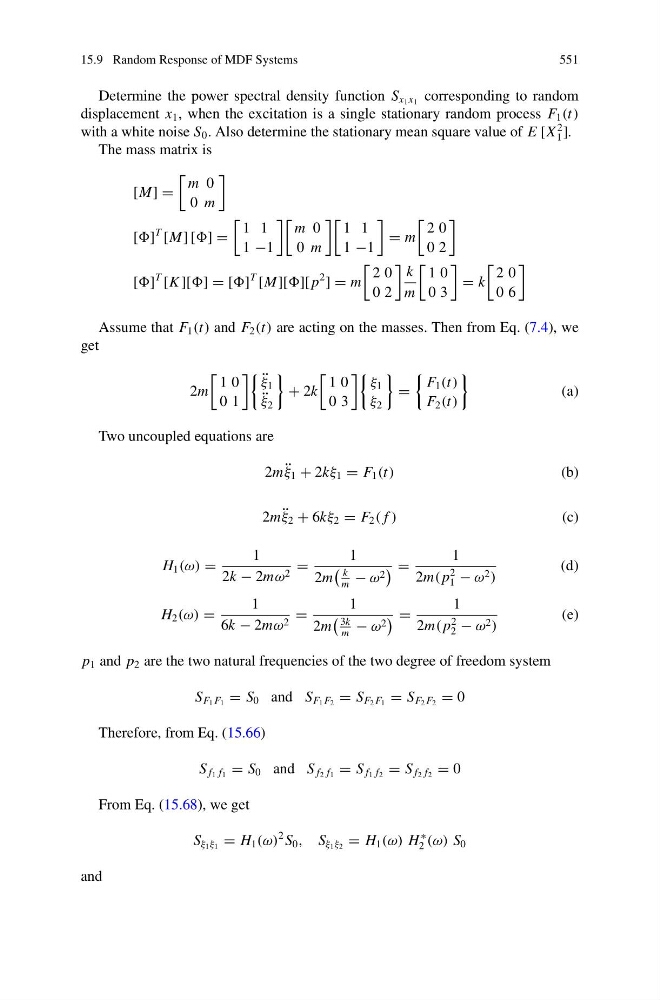
Determine the power spectral density function S x 1 x 1 corresponding to random
displacement x 1 , when the excitation is a single stationary random process F 1 (t)
with a white noise S 0 . Also determine the stationary mean square value of E [X
2
1 ].
The mass matrix is
[M] =
m 0
0 m
[]
T
[M] [] =
1 1
1 −1
m 0
0 m
1 1
1 −1
= m
2 0
0 2
[]
T
[K ][] = []
T
[M][][ p
2
] = m
2 0
0 2
k
m
1 0
0 3
= k
2 0
0 6
Assume that F 1 (t) and F 2 (t) are acting on the masses. Then from Eq. (7.4), we
get
2m
1 0
0 1
¨
ξ 1
¨
ξ 2
+ 2k
1 0
0 3
ξ 1
ξ 2
=
F 1 (t)
F 2 (t)
(a)
Two uncoupled equations are
2m ¨
ξ 1 + 2kξ 1 = F 1 (t)
(b)
2m ¨
ξ 2 + 6kξ 2 = F 2 ( f )
(c)
H 1 (ω) =
1
2k − 2mω 2 =
1
2m
k
m
− ω 2
=
1
2m( p
2
1 − ω 2 )
(d)
H 2 (ω) =
1
6k − 2mω 2 =
1
2m
3k
m
− ω 2
=
1
2m( p
2
2 − ω 2 )
(e)
p 1 and p 2 are the two natural frequencies of the two degree of freedom system
S F 1 F 1 = S 0 and S F 1 F 2 = S F 2 F 1 = S F 2 F 2 = 0
Therefore, from Eq. (15.66)
S f 1 f 1 = S 0 and S f 2 f 1 = S f 1 f 2 = S f 2 f 2 = 0
From Eq. (15.68), we get
S ξ 1 ξ 1 = H 1 (ω)
2 S 0 , S ξ 1 ξ 2 = H 1 (ω) H
∗
2 (ω) S 0
and
551
Determine the power spectral density function S x 1 x 1 corresponding to random
displacement x 1 , when the excitation is a single stationary random process F 1 (t)
with a white noise S 0 . Also determine the stationary mean square value of E [X
2
1 ].
The mass matrix is
[M] =
m 0
0 m
[]
T
[M] [] =
1 1
1 −1
m 0
0 m
1 1
1 −1
= m
2 0
0 2
[]
T
[K ][] = []
T
[M][][ p
2
] = m
2 0
0 2
k
m
1 0
0 3
= k
2 0
0 6
Assume that F 1 (t) and F 2 (t) are acting on the masses. Then from Eq. (7.4), we
get
2m
1 0
0 1
¨
ξ 1
¨
ξ 2
+ 2k
1 0
0 3
ξ 1
ξ 2
=
F 1 (t)
F 2 (t)
(a)
Two uncoupled equations are
2m ¨
ξ 1 + 2kξ 1 = F 1 (t)
(b)
2m ¨
ξ 2 + 6kξ 2 = F 2 ( f )
(c)
H 1 (ω) =
1
2k − 2mω 2 =
1
2m
k
m
− ω 2
=
1
2m( p
2
1 − ω 2 )
(d)
H 2 (ω) =
1
6k − 2mω 2 =
1
2m
3k
m
− ω 2
=
1
2m( p
2
2 − ω 2 )
(e)
p 1 and p 2 are the two natural frequencies of the two degree of freedom system
S F 1 F 1 = S 0 and S F 1 F 2 = S F 2 F 1 = S F 2 F 2 = 0
Therefore, from Eq. (15.66)
S f 1 f 1 = S 0 and S f 2 f 1 = S f 1 f 2 = S f 2 f 2 = 0
From Eq. (15.68), we get
S ξ 1 ξ 1 = H 1 (ω)
2 S 0 , S ξ 1 ξ 2 = H 1 (ω) H
∗
2 (ω) S 0
and