

548
15 Random Vibrations
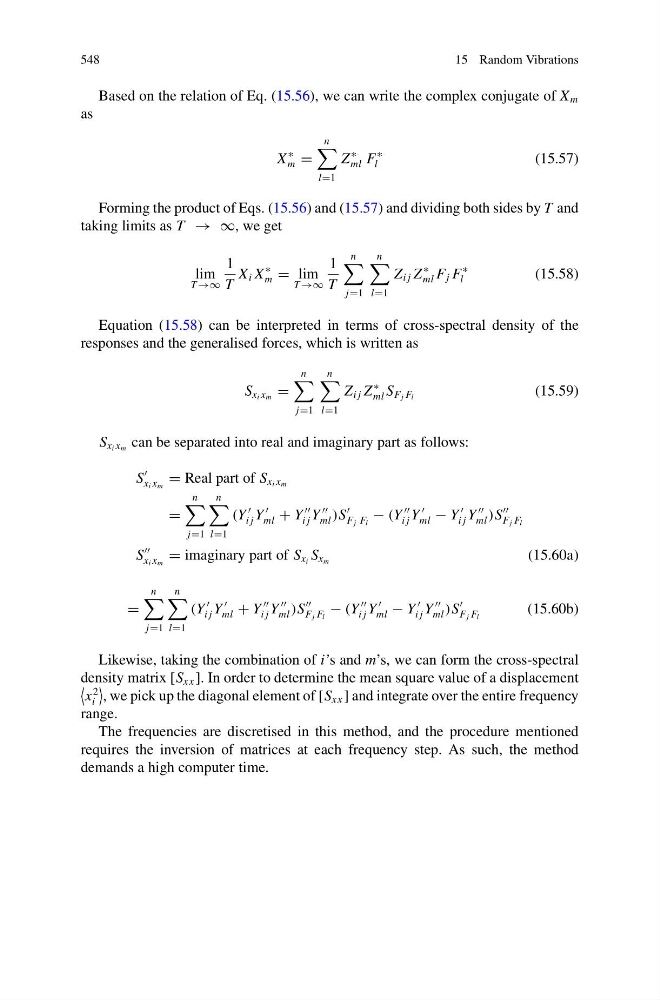
Based on the relation of Eq. (15.56), we can write the complex conjugate of X m
as
X
∗
m =
n
l=1
Z
∗
ml F
∗
l
(15.57)
Forming the product of Eqs. (15.56) and (15.57) and dividing both sides by T and
taking limits as T → ∞, we get
lim
T →∞
1
T
X i X
∗
m = lim
T →∞
1
T
n
j=1
n
l=1
Z i j Z
∗
ml F j F
∗
l
(15.58)
Equation (15.58) can be interpreted in terms of cross-spectral density of the
responses and the generalised forces, which is written as
S x i x m =
n
j=1
n
l=1
Z i j Z
∗
ml S F j F l
(15.59)
S x i x m can be separated into real and imaginary part as follows:
S
x i x m
= Real part of S x i x m
=
n
j=1
n
l=1
(Y
i j Y
ml + Y
i j Y
ml )S
F j F l
− (Y
i j Y
ml − Y
i j Y
ml )S
F j F l
S
x i x m
= imaginary part of S x i S x m
(15.60a)
=
n
j=1
n
l=1
(Y
i j Y
ml + Y
i j Y
ml )S
F j F l
− (Y
i j Y
ml − Y
i j Y
ml )S
F j F l
(15.60b)
Likewise, taking the combination of i’s and m’s, we can form the cross-spectral
density matrix [S xx ]. In order to determine the mean square value of a displacement
x
2
i
, we pick up the diagonal element of [S xx ] and integrate over the entire frequency
range.
The frequencies are discretised in this method, and the procedure mentioned
requires the inversion of matrices at each frequency step. As such, the method
demands a high computer time.
15 Random Vibrations
Based on the relation of Eq. (15.56), we can write the complex conjugate of X m
as
X
∗
m =
n
l=1
Z
∗
ml F
∗
l
(15.57)
Forming the product of Eqs. (15.56) and (15.57) and dividing both sides by T and
taking limits as T → ∞, we get
lim
T →∞
1
T
X i X
∗
m = lim
T →∞
1
T
n
j=1
n
l=1
Z i j Z
∗
ml F j F
∗
l
(15.58)
Equation (15.58) can be interpreted in terms of cross-spectral density of the
responses and the generalised forces, which is written as
S x i x m =
n
j=1
n
l=1
Z i j Z
∗
ml S F j F l
(15.59)
S x i x m can be separated into real and imaginary part as follows:
S
x i x m
= Real part of S x i x m
=
n
j=1
n
l=1
(Y
i j Y
ml + Y
i j Y
ml )S
F j F l
− (Y
i j Y
ml − Y
i j Y
ml )S
F j F l
S
x i x m
= imaginary part of S x i S x m
(15.60a)
=
n
j=1
n
l=1
(Y
i j Y
ml + Y
i j Y
ml )S
F j F l
− (Y
i j Y
ml − Y
i j Y
ml )S
F j F l
(15.60b)
Likewise, taking the combination of i’s and m’s, we can form the cross-spectral
density matrix [S xx ]. In order to determine the mean square value of a displacement
x
2
i
, we pick up the diagonal element of [S xx ] and integrate over the entire frequency
range.
The frequencies are discretised in this method, and the procedure mentioned
requires the inversion of matrices at each frequency step. As such, the method
demands a high computer time.