

15.9 Random Response of MDF Systems
547
15.9.1 Complex Matrix Inversion Method
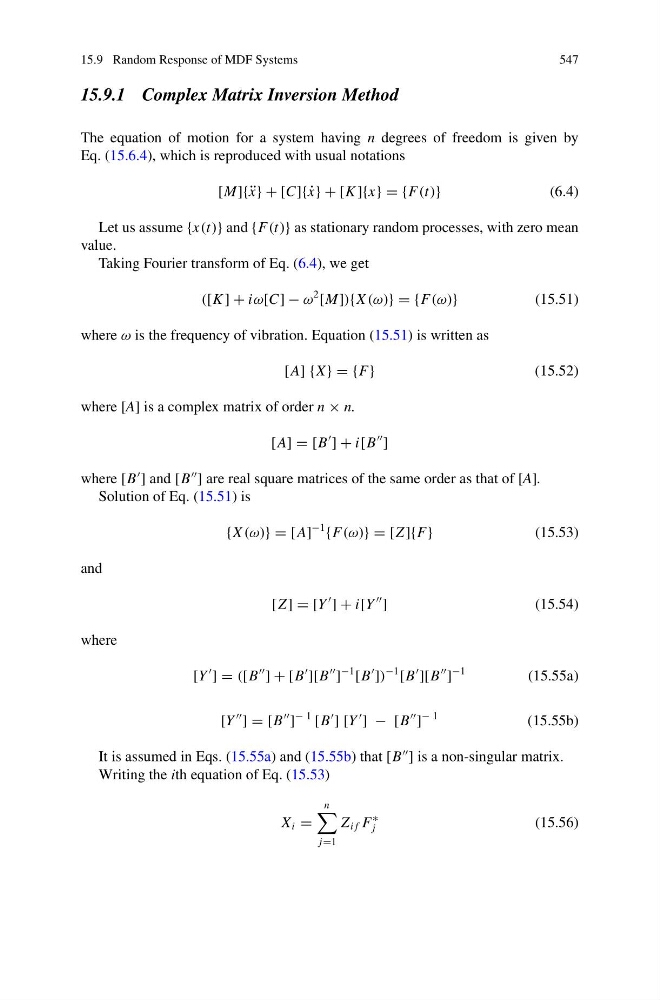
The equation of motion for a system having n degrees of freedom is given by
Eq. (15.6.4), which is reproduced with usual notations
[M]{ ¨
x} + [C]{ ˙
x} + [K ]{x} = {F(t)}
(6.4)
Let us assume {x(t)} and {F(t)} as stationary random processes, with zero mean
value.
Taking Fourier transform of Eq. (6.4), we get
([K ] + iω[C] − ω
2
[M]){X (ω)} = {F(ω)}
(15.51)
where ω is the frequency of vibration. Equation (15.51) is written as
[A] {X } = {F}
(15.52)
where [A] is a complex matrix of order n × n.
[A] = [B
] + i[B
]
where [B
] and [B
] are real square matrices of the same order as that of [A].
Solution of Eq. (15.51) is
{X (ω)} = [A]
−1
{F(ω)} = [Z ]{F}
(15.53)
and
[Z ] = [Y
] + i[Y
]
(15.54)
where
[Y
] = ([B
] + [B
][B
]
−1
[B
])
−1
[B
][B
]
−1
(15.55a)
[Y
] = [B
]
− 1
[B
] [Y
] − [B
]
− 1
(15.55b)
It is assumed in Eqs. (15.55a) and (15.55b) that [B
] is a non-singular matrix.
Writing the ith equation of Eq. (15.53)
X i =
n
j=1
Z i f F
∗
j
(15.56)
547
15.9.1 Complex Matrix Inversion Method
The equation of motion for a system having n degrees of freedom is given by
Eq. (15.6.4), which is reproduced with usual notations
[M]{ ¨
x} + [C]{ ˙
x} + [K ]{x} = {F(t)}
(6.4)
Let us assume {x(t)} and {F(t)} as stationary random processes, with zero mean
value.
Taking Fourier transform of Eq. (6.4), we get
([K ] + iω[C] − ω
2
[M]){X (ω)} = {F(ω)}
(15.51)
where ω is the frequency of vibration. Equation (15.51) is written as
[A] {X } = {F}
(15.52)
where [A] is a complex matrix of order n × n.
[A] = [B
] + i[B
]
where [B
] and [B
] are real square matrices of the same order as that of [A].
Solution of Eq. (15.51) is
{X (ω)} = [A]
−1
{F(ω)} = [Z ]{F}
(15.53)
and
[Z ] = [Y
] + i[Y
]
(15.54)
where
[Y
] = ([B
] + [B
][B
]
−1
[B
])
−1
[B
][B
]
−1
(15.55a)
[Y
] = [B
]
− 1
[B
] [Y
] − [B
]
− 1
(15.55b)
It is assumed in Eqs. (15.55a) and (15.55b) that [B
] is a non-singular matrix.
Writing the ith equation of Eq. (15.53)
X i =
n
j=1
Z i f F
∗
j
(15.56)