

15.4 Ensemble Averages, Mean and Autocorrelation
533
E[ f (X )] =
∞
− ∞
f (x) p(x)dx
(15.10)
This ensemble average is called the mathematical expectation of f (x) , and the
operator E is used to denote this kind of average.
When f (x) = X , then
E(X ) =
∞
−∞
x p(x)dx = mean of ensemble average
= expected value of X.
(15.11)
When f (x) = x
2 , then Eq. (15.10) becomes
E[X
2
] =
∞
−∞
x
2 p(x)dx
= mean square of the random variable x.
(15.12)
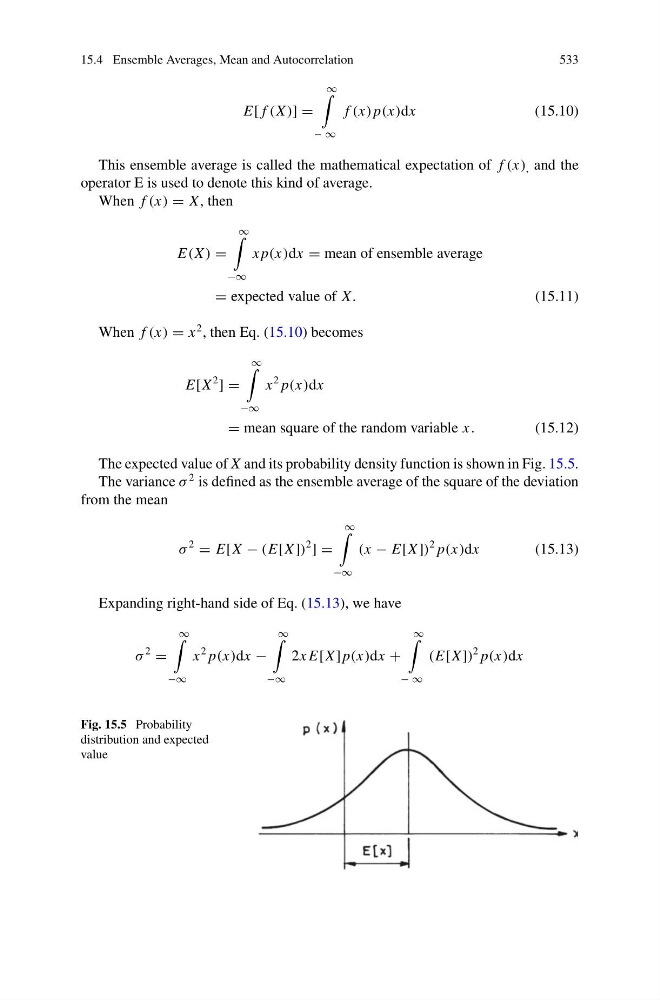
The expected value of X and its probability density function is shown in Fig. 15.5.
The variance σ
2 is defined as the ensemble average of the square of the deviation
from the mean
σ
2
= E[X − (E[X ])
2
] =
∞
−∞
(x − E[X ])
2 p(x)dx
(15.13)
Expanding right-hand side of Eq. (15.13), we have
σ
2
=
∞
−∞
x
2 p(x)dx −
∞
−∞
2x E[X ] p(x)dx +
∞
− ∞
(E[X ])
2 p(x)dx
Fig. 15.5 Probability
distribution and expected
value
533
E[ f (X )] =
∞
− ∞
f (x) p(x)dx
(15.10)
This ensemble average is called the mathematical expectation of f (x) , and the
operator E is used to denote this kind of average.
When f (x) = X , then
E(X ) =
∞
−∞
x p(x)dx = mean of ensemble average
= expected value of X.
(15.11)
When f (x) = x
2 , then Eq. (15.10) becomes
E[X
2
] =
∞
−∞
x
2 p(x)dx
= mean square of the random variable x.
(15.12)
The expected value of X and its probability density function is shown in Fig. 15.5.
The variance σ
2 is defined as the ensemble average of the square of the deviation
from the mean
σ
2
= E[X − (E[X ])
2
] =
∞
−∞
(x − E[X ])
2 p(x)dx
(15.13)
Expanding right-hand side of Eq. (15.13), we have
σ
2
=
∞
−∞
x
2 p(x)dx −
∞
−∞
2x E[X ] p(x)dx +
∞
− ∞
(E[X ])
2 p(x)dx
Fig. 15.5 Probability
distribution and expected
value