

534
15 Random Vibrations
= E[X
2
] − 2(E[X ])
2
(E[X ])
2
or
σ
2
= E[X
2
] − (E[X ])
2
(15.14)
Standard deviation of the random variable X is given by
σ =
√ σ 2 =
√
variance of X
(15.15)
It indicates the spread of the random variable about the mean.
From single random variable, we pass on to two random variables. The measure of
simultaneous variation of X 1 and X 2 is to be obtained. If f (x 1 ) and g(x 2 ) are functions
of x 1 and x 2, respectively, then the mathematical expectation of their product is
E[ f (x 1 )g(x 2 )] =
∞
−∞
∞
−∞
f (x 1 )g(x 2 ) p(x 1 , x 2 )dx 1 dx 2
(15.16)
when
f (x 1 ) = X 1 and g(x 2 ) = X 2
then
E[X 1 X 2 ] =
∞
−∞
∞
−∞
x 1 x 2 p(x 1 , x 2 )dx 1 dx 2
= average across the ensemble of all products X 1 X 2 .
(15.17)
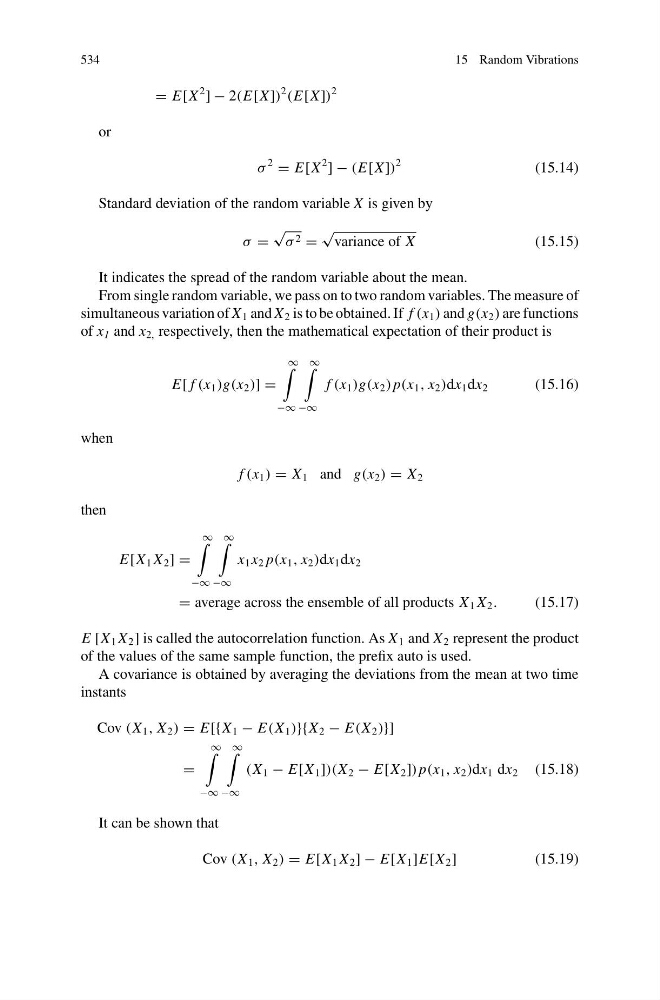
E [X 1 X 2 ] is called the autocorrelation function. As X 1 and X 2 represent the product
of the values of the same sample function, the prefix auto is used.
A covariance is obtained by averaging the deviations from the mean at two time
instants
Cov (X 1 , X 2 ) = E[{X 1 − E(X 1 )}{X 2 − E(X 2 )}]
=
∞
−∞
∞
−∞
(X 1 − E[X 1 ])(X 2 − E[X 2 ]) p(x 1 , x 2 )dx 1 dx 2 (15.18)
It can be shown that
Cov (X 1 , X 2 ) = E[X 1 X 2 ] − E[X 1 ]E[X 2 ]
(15.19)
15 Random Vibrations
= E[X
2
] − 2(E[X ])
2
(E[X ])
2
or
σ
2
= E[X
2
] − (E[X ])
2
(15.14)
Standard deviation of the random variable X is given by
σ =
√ σ 2 =
√
variance of X
(15.15)
It indicates the spread of the random variable about the mean.
From single random variable, we pass on to two random variables. The measure of
simultaneous variation of X 1 and X 2 is to be obtained. If f (x 1 ) and g(x 2 ) are functions
of x 1 and x 2, respectively, then the mathematical expectation of their product is
E[ f (x 1 )g(x 2 )] =
∞
−∞
∞
−∞
f (x 1 )g(x 2 ) p(x 1 , x 2 )dx 1 dx 2
(15.16)
when
f (x 1 ) = X 1 and g(x 2 ) = X 2
then
E[X 1 X 2 ] =
∞
−∞
∞
−∞
x 1 x 2 p(x 1 , x 2 )dx 1 dx 2
= average across the ensemble of all products X 1 X 2 .
(15.17)
E [X 1 X 2 ] is called the autocorrelation function. As X 1 and X 2 represent the product
of the values of the same sample function, the prefix auto is used.
A covariance is obtained by averaging the deviations from the mean at two time
instants
Cov (X 1 , X 2 ) = E[{X 1 − E(X 1 )}{X 2 − E(X 2 )}]
=
∞
−∞
∞
−∞
(X 1 − E[X 1 ])(X 2 − E[X 2 ]) p(x 1 , x 2 )dx 1 dx 2 (15.18)
It can be shown that
Cov (X 1 , X 2 ) = E[X 1 X 2 ] − E[X 1 ]E[X 2 ]
(15.19)