

15.3 Probability Distributions
531
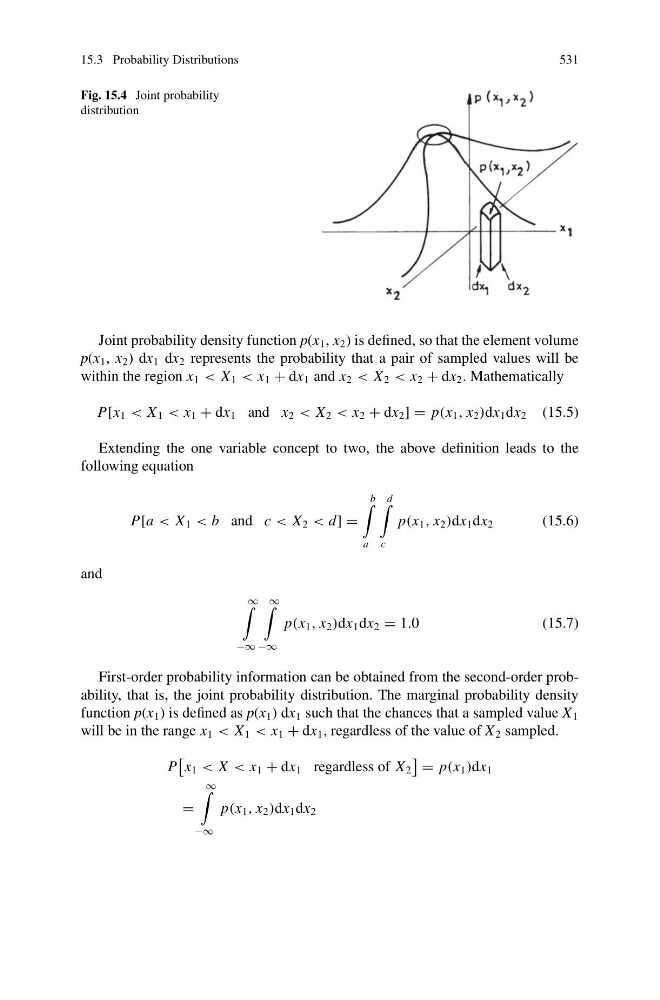
Fig. 15.4 Joint probability
distribution
Joint probability density function p(x 1 , x 2 ) is defined, so that the element volume
p(x 1 , x 2 ) dx 1 dx 2 represents the probability that a pair of sampled values will be
within the region x 1 < X 1 < x 1 + dx 1 and x 2 < X 2 < x 2 + dx 2 . Mathematically
P[x 1 < X 1 < x 1 + dx 1 and x 2 < X 2 < x 2 + dx 2 ] = p(x 1 , x 2 )dx 1 dx 2 (15.5)
Extending the one variable concept to two, the above definition leads to the
following equation
P[a < X 1 < b and c < X 2 < d] =
b
a
d
c
p(x 1 , x 2 )dx 1 dx 2
(15.6)
and
∞
−∞
∞
−∞
p(x 1 , x 2 )dx 1 dx 2 = 1.0
(15.7)
First-order probability information can be obtained from the second-order probability, that is, the joint probability distribution. The marginal probability density
function p(x 1 ) is defined as p(x 1 ) dx 1 such that the chances that a sampled value X 1
will be in the range x 1 < X 1 < x 1 + dx 1 , regardless of the value of X 2 sampled.
P
x 1 < X < x 1 + dx 1 regardless of X 2
= p(x 1 )dx 1
=
∞
−∞
p(x 1 , x 2 )dx 1 dx 2
531
Fig. 15.4 Joint probability
distribution
Joint probability density function p(x 1 , x 2 ) is defined, so that the element volume
p(x 1 , x 2 ) dx 1 dx 2 represents the probability that a pair of sampled values will be
within the region x 1 < X 1 < x 1 + dx 1 and x 2 < X 2 < x 2 + dx 2 . Mathematically
P[x 1 < X 1 < x 1 + dx 1 and x 2 < X 2 < x 2 + dx 2 ] = p(x 1 , x 2 )dx 1 dx 2 (15.5)
Extending the one variable concept to two, the above definition leads to the
following equation
P[a < X 1 < b and c < X 2 < d] =
b
a
d
c
p(x 1 , x 2 )dx 1 dx 2
(15.6)
and
∞
−∞
∞
−∞
p(x 1 , x 2 )dx 1 dx 2 = 1.0
(15.7)
First-order probability information can be obtained from the second-order probability, that is, the joint probability distribution. The marginal probability density
function p(x 1 ) is defined as p(x 1 ) dx 1 such that the chances that a sampled value X 1
will be in the range x 1 < X 1 < x 1 + dx 1 , regardless of the value of X 2 sampled.
P
x 1 < X < x 1 + dx 1 regardless of X 2
= p(x 1 )dx 1
=
∞
−∞
p(x 1 , x 2 )dx 1 dx 2