

504
13 Finite Difference Method for the Vibration Analysis …
been presented earlier in this chapter on semi-analytic finite difference method. The
commonality of both these methods lies in the choice of the displacement function satisfying boundary conditions along two opposite edges in one direction, thus
reducing a two-dimensional plate problem to one dimension. In the semi-analytic
finite difference method, the other direction is discretised by the finite difference
equations. But in the semi-analytic finite method, it is the finite element method
which is applied to the other direction. It has been extensively used for various types
of regular-shaped plates.
But the semi-analytic finite strip method suffers from a number of drawbacks. It
fails for plates having mixed boundary conditions, internal cutouts, for continuous
span, having discrete supports at strip ends. As the method uses characteristic beam
function in one direction which is continuously differentiable, it imposes limitations on the plate problems involving abrupt changes of properties, concentrated and
plate loads, internal supports, etc. To overcome the difficulties mentioned above and
to retain the advantage of the finite strip method, the spline finite strip method is
developed [14–17].
13.7.1 The Spline Functions
Spline is originally the name of a small flexible wooden strip employed by
draughtsman as a tool for drawing a continuous smooth curve segment by segment. It
has now been used as a mathematical tool for the solution of engineering problems.
A variety of spline functions are available. The spline function adopted here to
represent displacement is the B 3 spline of equal section length.
y =
m+1
r =1
α i φ i
(13.42)
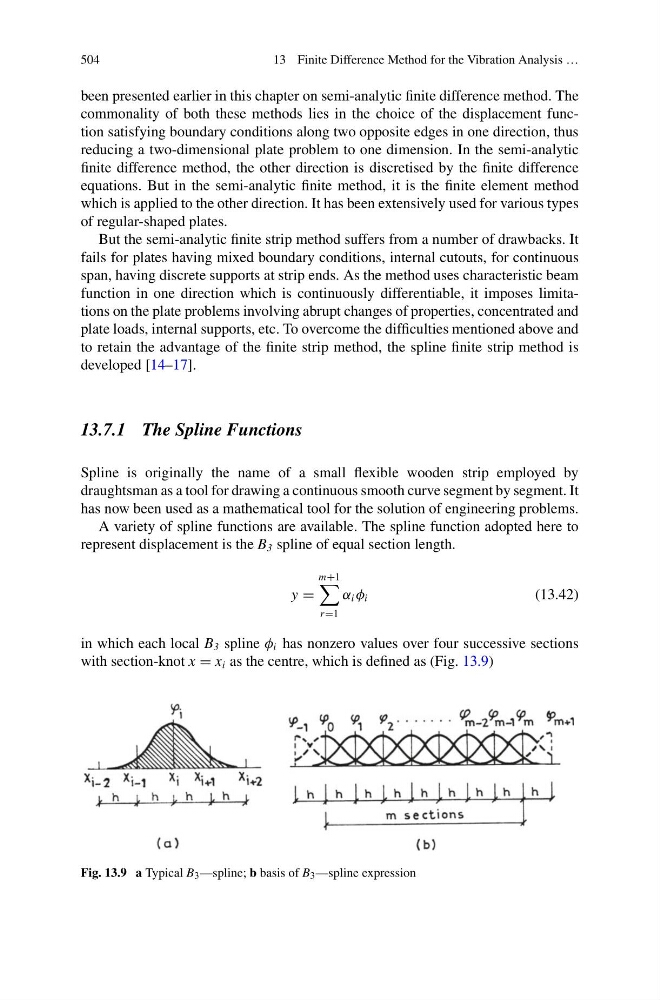
in which each local B 3 spline φ i has nonzero values over four successive sections
with section-knot x = x i as the centre, which is defined as (Fig. 13.9)
Fig. 13.9 a Typical B 3 —spline; b basis of B 3 —spline expression
13 Finite Difference Method for the Vibration Analysis …
been presented earlier in this chapter on semi-analytic finite difference method. The
commonality of both these methods lies in the choice of the displacement function satisfying boundary conditions along two opposite edges in one direction, thus
reducing a two-dimensional plate problem to one dimension. In the semi-analytic
finite difference method, the other direction is discretised by the finite difference
equations. But in the semi-analytic finite method, it is the finite element method
which is applied to the other direction. It has been extensively used for various types
of regular-shaped plates.
But the semi-analytic finite strip method suffers from a number of drawbacks. It
fails for plates having mixed boundary conditions, internal cutouts, for continuous
span, having discrete supports at strip ends. As the method uses characteristic beam
function in one direction which is continuously differentiable, it imposes limitations on the plate problems involving abrupt changes of properties, concentrated and
plate loads, internal supports, etc. To overcome the difficulties mentioned above and
to retain the advantage of the finite strip method, the spline finite strip method is
developed [14–17].
13.7.1 The Spline Functions
Spline is originally the name of a small flexible wooden strip employed by
draughtsman as a tool for drawing a continuous smooth curve segment by segment. It
has now been used as a mathematical tool for the solution of engineering problems.
A variety of spline functions are available. The spline function adopted here to
represent displacement is the B 3 spline of equal section length.
y =
m+1
r =1
α i φ i
(13.42)
in which each local B 3 spline φ i has nonzero values over four successive sections
with section-knot x = x i as the centre, which is defined as (Fig. 13.9)
Fig. 13.9 a Typical B 3 —spline; b basis of B 3 —spline expression