

13.6 Semi-analytic Finite Difference Method for Forced …
503
a nn =
b
0
Y
2
n dy, c mn =
b
0
Y
m Y n dy, e nn =
b
0
Y
iv
n Y n dy
(13.37)
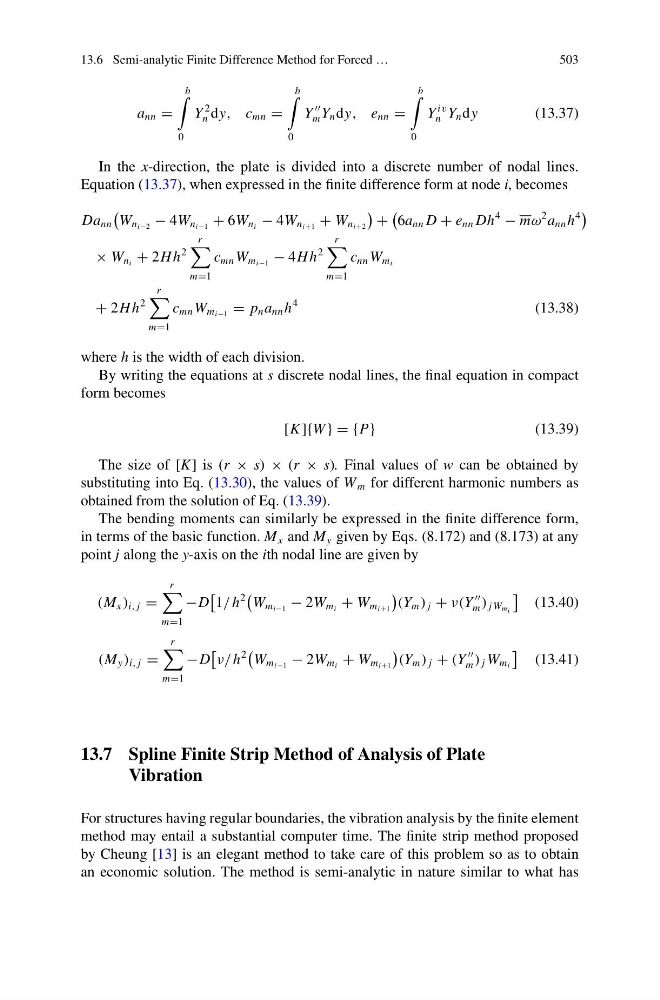
In the x-direction, the plate is divided into a discrete number of nodal lines.
Equation (13.37), when expressed in the finite difference form at node i, becomes
Da nn
W n i−2 − 4W n i−1 + 6W n i − 4W n i+1 + W n i+2
+
6a nn D + e nn Dh
4
− mω
2 a nn h
4
× W n i + 2H h
2
r
m=1
c mn W m i−1 − 4H h
2
r
m=1
c nn W m i
+ 2H h
2
r
m=1
c mn W m i−1 = p n a nn h
4
(13.38)
where h is the width of each division.
By writing the equations at s discrete nodal lines, the final equation in compact
form becomes
[K ]{W } = {P}
(13.39)
The size of [K] is (r × s) × (r × s). Final values of w can be obtained by
substituting into Eq. (13.30), the values of W m for different harmonic numbers as
obtained from the solution of Eq. (13.39).
The bending moments can similarly be expressed in the finite difference form,
in terms of the basic function. M x and M y given by Eqs. (8.172) and (8.173) at any
point j along the y-axis on the ith nodal line are given by
(M x ) i, j =
r
m=1
−D
1/ h
2
W m i−1 − 2W m i + W m i+1
(Y m ) j + ν(Y
m ) j W m i
(13.40)
(M y ) i, j =
r
m=1
−D
ν/ h
2
W m i−1 − 2W m i + W m i+1
(Y m ) j + (Y
m ) j W m i
(13.41)
13.7 Spline Finite Strip Method of Analysis of Plate
Vibration
For structures having regular boundaries, the vibration analysis by the finite element
method may entail a substantial computer time. The finite strip method proposed
by Cheung [13] is an elegant method to take care of this problem so as to obtain
an economic solution. The method is semi-analytic in nature similar to what has
503
a nn =
b
0
Y
2
n dy, c mn =
b
0
Y
m Y n dy, e nn =
b
0
Y
iv
n Y n dy
(13.37)
In the x-direction, the plate is divided into a discrete number of nodal lines.
Equation (13.37), when expressed in the finite difference form at node i, becomes
Da nn
W n i−2 − 4W n i−1 + 6W n i − 4W n i+1 + W n i+2
+
6a nn D + e nn Dh
4
− mω
2 a nn h
4
× W n i + 2H h
2
r
m=1
c mn W m i−1 − 4H h
2
r
m=1
c nn W m i
+ 2H h
2
r
m=1
c mn W m i−1 = p n a nn h
4
(13.38)
where h is the width of each division.
By writing the equations at s discrete nodal lines, the final equation in compact
form becomes
[K ]{W } = {P}
(13.39)
The size of [K] is (r × s) × (r × s). Final values of w can be obtained by
substituting into Eq. (13.30), the values of W m for different harmonic numbers as
obtained from the solution of Eq. (13.39).
The bending moments can similarly be expressed in the finite difference form,
in terms of the basic function. M x and M y given by Eqs. (8.172) and (8.173) at any
point j along the y-axis on the ith nodal line are given by
(M x ) i, j =
r
m=1
−D
1/ h
2
W m i−1 − 2W m i + W m i+1
(Y m ) j + ν(Y
m ) j W m i
(13.40)
(M y ) i, j =
r
m=1
−D
ν/ h
2
W m i−1 − 2W m i + W m i+1
(Y m ) j + (Y
m ) j W m i
(13.41)
13.7 Spline Finite Strip Method of Analysis of Plate
Vibration
For structures having regular boundaries, the vibration analysis by the finite element
method may entail a substantial computer time. The finite strip method proposed
by Cheung [13] is an elegant method to take care of this problem so as to obtain
an economic solution. The method is semi-analytic in nature similar to what has