

502
13 Finite Difference Method for the Vibration Analysis …
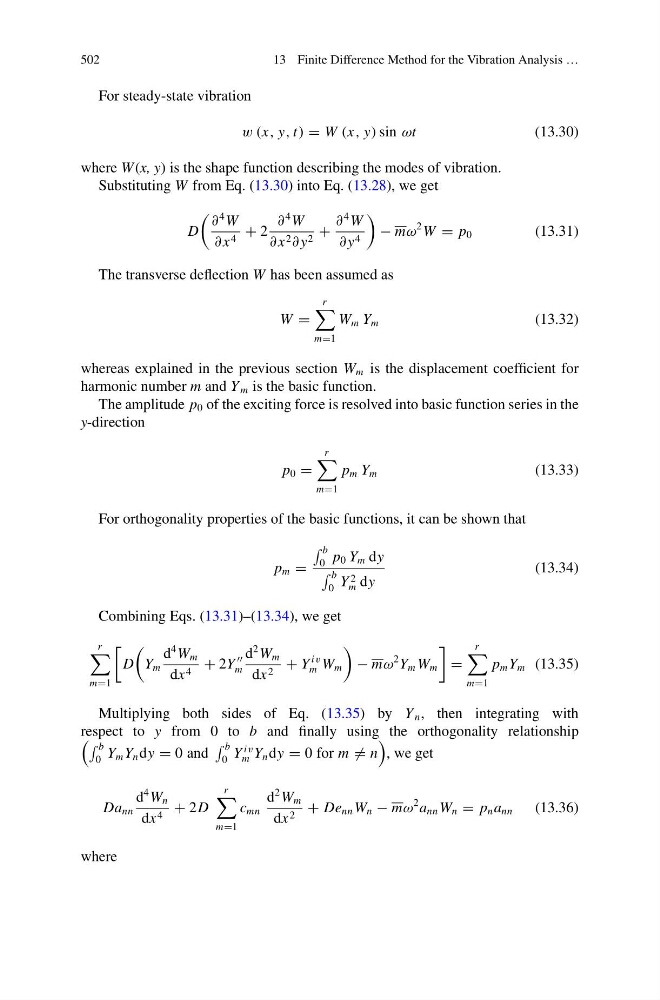
For steady-state vibration
w (x, y, t) = W (x, y) sin ωt
(13.30)
where W (x, y) is the shape function describing the modes of vibration.
Substituting W from Eq. (13.30) into Eq. (13.28), we get
D
∂
4 W
∂ x 4 + 2
∂
4 W
∂ x 2 ∂ y 2 +
∂
4 W
∂ y 4
− mω
2 W = p 0
(13.31)
The transverse deflection W has been assumed as
W =
r
m=1
W m Y m
(13.32)
whereas explained in the previous section W m is the displacement coefficient for
harmonic number m and Y m is the basic function.
The amplitude p 0 of the exciting force is resolved into basic function series in the
y-direction
p 0 =
r
m=1
p m Y m
(13.33)
For orthogonality properties of the basic functions, it can be shown that
p m =
b
0 p 0 Y m dy
b
0 Y 2
m dy
(13.34)
Combining Eqs. (13.31)–(13.34), we get
r
m=1
D
Y m
d
4 W m
dx 4 + 2Y
m
d
2 W m
dx 2 + Y
iv
m W m
− mω
2 Y m W m
=
r
m=1
p m Y m (13.35)
Multiplying both sides of Eq. (13.35) by Y n , then integrating with
respect to y from 0 to b and finally using the orthogonality relationship
b
0 Y m Y n dy = 0 and
b
0 Y
iv
m Y n dy = 0 for m = n
, we get
Da nn
d
4 W n
dx 4 + 2D
r
m=1
c mn
d
2 W m
dx 2 + De nn W n − mω
2 a nn W n = p n a nn
(13.36)
where
13 Finite Difference Method for the Vibration Analysis …
For steady-state vibration
w (x, y, t) = W (x, y) sin ωt
(13.30)
where W (x, y) is the shape function describing the modes of vibration.
Substituting W from Eq. (13.30) into Eq. (13.28), we get
D
∂
4 W
∂ x 4 + 2
∂
4 W
∂ x 2 ∂ y 2 +
∂
4 W
∂ y 4
− mω
2 W = p 0
(13.31)
The transverse deflection W has been assumed as
W =
r
m=1
W m Y m
(13.32)
whereas explained in the previous section W m is the displacement coefficient for
harmonic number m and Y m is the basic function.
The amplitude p 0 of the exciting force is resolved into basic function series in the
y-direction
p 0 =
r
m=1
p m Y m
(13.33)
For orthogonality properties of the basic functions, it can be shown that
p m =
b
0 p 0 Y m dy
b
0 Y 2
m dy
(13.34)
Combining Eqs. (13.31)–(13.34), we get
r
m=1
D
Y m
d
4 W m
dx 4 + 2Y
m
d
2 W m
dx 2 + Y
iv
m W m
− mω
2 Y m W m
=
r
m=1
p m Y m (13.35)
Multiplying both sides of Eq. (13.35) by Y n , then integrating with
respect to y from 0 to b and finally using the orthogonality relationship
b
0 Y m Y n dy = 0 and
b
0 Y
iv
m Y n dy = 0 for m = n
, we get
Da nn
d
4 W n
dx 4 + 2D
r
m=1
c mn
d
2 W m
dx 2 + De nn W n − mω
2 a nn W n = p n a nn
(13.36)
where