

13.5 Semi-analytic Finite Difference Method for Free Vibration …
501
Table 13.1 Frequency parameter λ = pa 2
ρt
D
a/b
0.4
20 divisions
r = 2
1.0
10 divisions
r = 3
2.5
10 divisions
r = 5
SFDM
Ref.*
SFDM
Ref. a
SFDM
Ref. a
23.333
23.648
31.532
31.829
105.40
107.07
26.970
27.817
61.594
63.347
131.63
139.66
34.427
35.446
71.102
71.084
193.36
194.41
44.498
46.702
100.11
100.83
264.57
270.48
58.109
61.554
109.70
116.40
310.34
322.55
63.146
63.100
130.56
130.37
334.06
353.43
SFDM Semi-analytic finite difference method. Divisions refer to that along the x-direction
a Ref. [12]
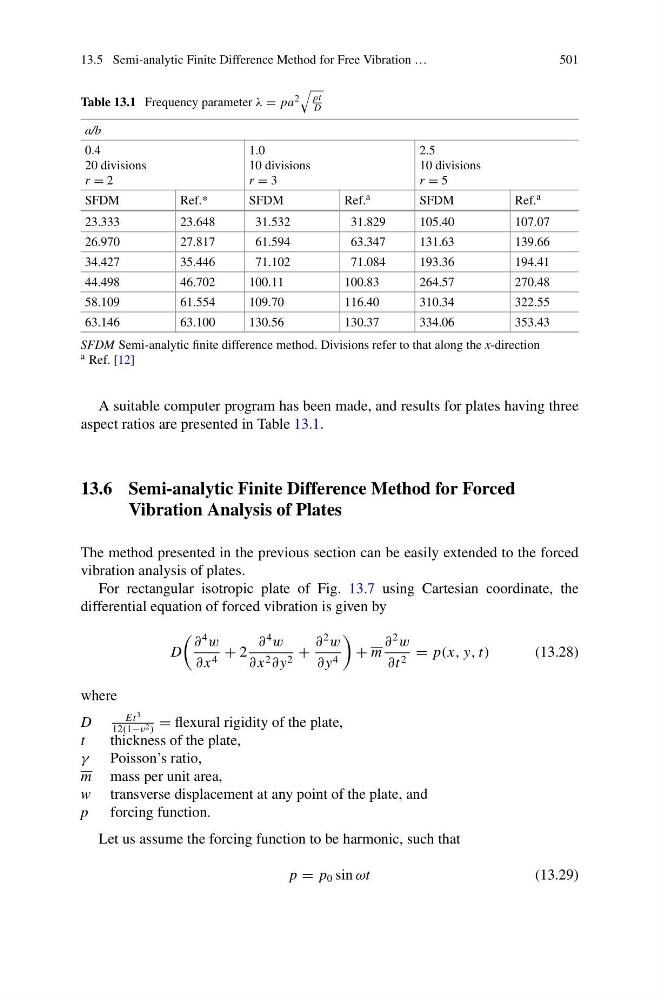
A suitable computer program has been made, and results for plates having three
aspect ratios are presented in Table 13.1.
13.6 Semi-analytic Finite Difference Method for Forced
Vibration Analysis of Plates
The method presented in the previous section can be easily extended to the forced
vibration analysis of plates.
For rectangular isotropic plate of Fig. 13.7 using Cartesian coordinate, the
differential equation of forced vibration is given by
D
∂
4
w
∂ x 4 + 2
∂
4
w
∂ x 2 ∂ y 2 +
∂
2
w
∂ y 4
+ m
∂
2
w
∂t 2 = p(x, y, t)
(13.28)
where
D
Et
3
12(1−ν 2 )
= flexural rigidity of the plate,
t
thickness of the plate,
γ Poisson’s ratio,
m mass per unit area,
w transverse displacement at any point of the plate, and
p forcing function.
Let us assume the forcing function to be harmonic, such that
p = p 0 sin ωt
(13.29)
501
Table 13.1 Frequency parameter λ = pa 2
ρt
D
a/b
0.4
20 divisions
r = 2
1.0
10 divisions
r = 3
2.5
10 divisions
r = 5
SFDM
Ref.*
SFDM
Ref. a
SFDM
Ref. a
23.333
23.648
31.532
31.829
105.40
107.07
26.970
27.817
61.594
63.347
131.63
139.66
34.427
35.446
71.102
71.084
193.36
194.41
44.498
46.702
100.11
100.83
264.57
270.48
58.109
61.554
109.70
116.40
310.34
322.55
63.146
63.100
130.56
130.37
334.06
353.43
SFDM Semi-analytic finite difference method. Divisions refer to that along the x-direction
a Ref. [12]
A suitable computer program has been made, and results for plates having three
aspect ratios are presented in Table 13.1.
13.6 Semi-analytic Finite Difference Method for Forced
Vibration Analysis of Plates
The method presented in the previous section can be easily extended to the forced
vibration analysis of plates.
For rectangular isotropic plate of Fig. 13.7 using Cartesian coordinate, the
differential equation of forced vibration is given by
D
∂
4
w
∂ x 4 + 2
∂
4
w
∂ x 2 ∂ y 2 +
∂
2
w
∂ y 4
+ m
∂
2
w
∂t 2 = p(x, y, t)
(13.28)
where
D
Et
3
12(1−ν 2 )
= flexural rigidity of the plate,
t
thickness of the plate,
γ Poisson’s ratio,
m mass per unit area,
w transverse displacement at any point of the plate, and
p forcing function.
Let us assume the forcing function to be harmonic, such that
p = p 0 sin ωt
(13.29)