

500
13 Finite Difference Method for the Vibration Analysis …
= p
2
⎡
⎢
⎢
⎢
⎢
⎢
⎢
⎢
⎢
⎢
⎣
[M] 1
0
[M] 2
. . .
0
[M] n
. . .
[M] r
⎤
⎥
⎥
⎥
⎥
⎥
⎥
⎥
⎥
⎥
⎦
⎧
⎪ ⎪ ⎪ ⎪ ⎪ ⎪ ⎪ ⎪ ⎪ ⎨
⎪ ⎪ ⎪ ⎪ ⎪ ⎪ ⎪ ⎪ ⎪ ⎩
{W } 1
{W } 2
. . .
{W } n
. . .
{W } r
⎫
⎪ ⎪ ⎪ ⎪ ⎪ ⎪ ⎪ ⎪ ⎪ ⎬
⎪ ⎪ ⎪ ⎪ ⎪ ⎪ ⎪ ⎪ ⎪ ⎭
(13.25)
Each submatrix will have a size s by s. In compact form, Eq. (13.25) becomes
[K ]{W } = p
2
[M]{W }
(13.26)
or
λ[K ]{W } = [M]{W }
(13.27)
Equation (13.26) is a typical eigenvalue problem. It can be solved by the methods
described in Chap. 6.
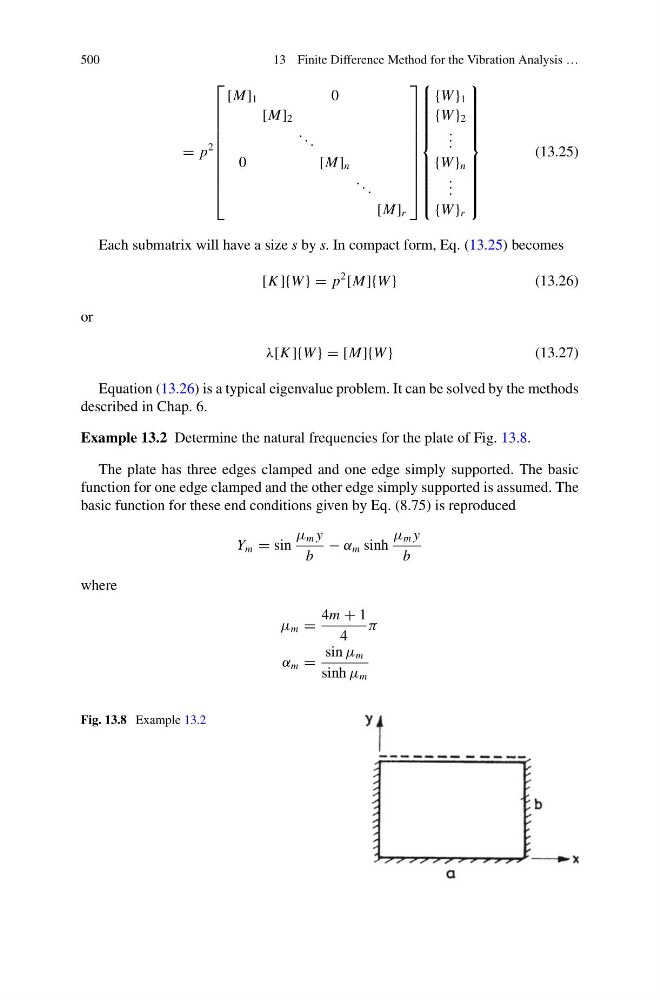
Example 13.2 Determine the natural frequencies for the plate of Fig. 13.8.
The plate has three edges clamped and one edge simply supported. The basic
function for one edge clamped and the other edge simply supported is assumed. The
basic function for these end conditions given by Eq. (8.75) is reproduced
Y m = sin
μ m y
b
− α m sinh
μ m y
b
where
μ m =
4m + 1
4
π
α m =
sin μ m
sinh μ m
Fig. 13.8 Example 13.2
13 Finite Difference Method for the Vibration Analysis …
= p
2
⎡
⎢
⎢
⎢
⎢
⎢
⎢
⎢
⎢
⎢
⎣
[M] 1
0
[M] 2
. . .
0
[M] n
. . .
[M] r
⎤
⎥
⎥
⎥
⎥
⎥
⎥
⎥
⎥
⎥
⎦
⎧
⎪ ⎪ ⎪ ⎪ ⎪ ⎪ ⎪ ⎪ ⎪ ⎨
⎪ ⎪ ⎪ ⎪ ⎪ ⎪ ⎪ ⎪ ⎪ ⎩
{W } 1
{W } 2
. . .
{W } n
. . .
{W } r
⎫
⎪ ⎪ ⎪ ⎪ ⎪ ⎪ ⎪ ⎪ ⎪ ⎬
⎪ ⎪ ⎪ ⎪ ⎪ ⎪ ⎪ ⎪ ⎪ ⎭
(13.25)
Each submatrix will have a size s by s. In compact form, Eq. (13.25) becomes
[K ]{W } = p
2
[M]{W }
(13.26)
or
λ[K ]{W } = [M]{W }
(13.27)
Equation (13.26) is a typical eigenvalue problem. It can be solved by the methods
described in Chap. 6.
Example 13.2 Determine the natural frequencies for the plate of Fig. 13.8.
The plate has three edges clamped and one edge simply supported. The basic
function for one edge clamped and the other edge simply supported is assumed. The
basic function for these end conditions given by Eq. (8.75) is reproduced
Y m = sin
μ m y
b
− α m sinh
μ m y
b
where
μ m =
4m + 1
4
π
α m =
sin μ m
sinh μ m
Fig. 13.8 Example 13.2