

498
13 Finite Difference Method for the Vibration Analysis …
D x
∂
4
w
∂ x 4 + 2H
∂
4
w
∂ x 2 ∂ y 2 + D y
∂
4
w
∂ y 4 + m
∂
2
w
∂t 2 = 0
(13.16)
where D x , H and D y are dependent on the geometric and material properties of the
plate and m is the mass per unit area. w, the transverse displacement at any point of
the plate is a function of x, y and time t. For harmonic vibration
w(x, y, t) = W (x, y) sin pt
(13.17)
where W (x, y) is the shape function describing the modes of vibration, and p is the
natural frequency of the plate.
Substitution of w from Eq. (13.17) into Eq. (13.16) yields
D x
∂
4 W
∂ x 4 + 2H
∂
4 W
∂ x 2 ∂ y 2 + D y
∂
4 W
∂ y 4 = m p
2 W
(13.18)
The transverse deflection W can be assumed to be of the form
W (x, y) =
r
m=1
W m (x)Y m (y)
(13.19)
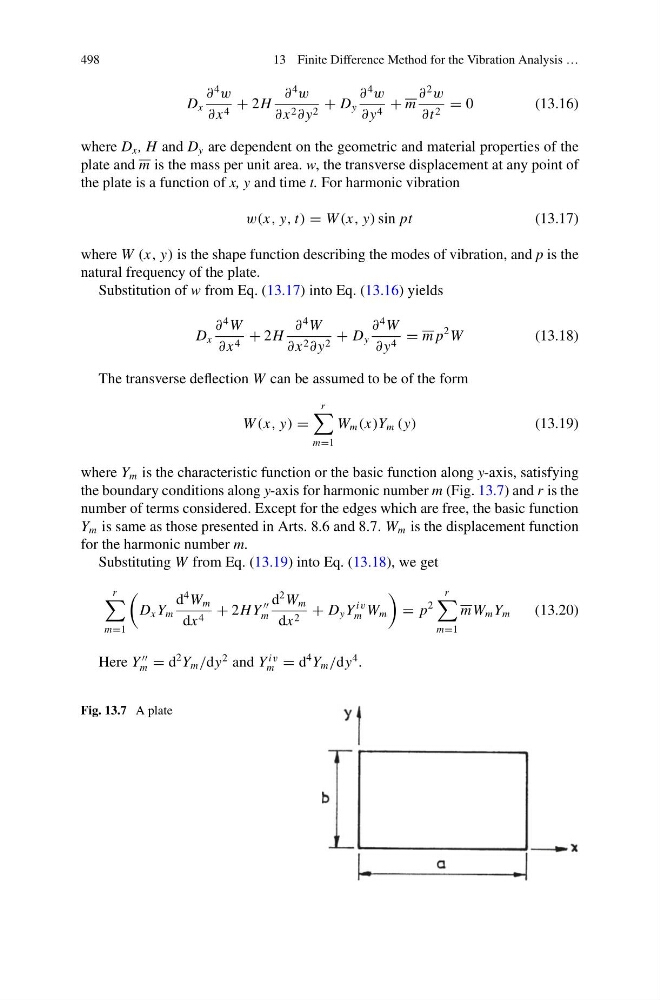
where Y m is the characteristic function or the basic function along y-axis, satisfying
the boundary conditions along y-axis for harmonic number m (Fig. 13.7) and r is the
number of terms considered. Except for the edges which are free, the basic function
Y m is same as those presented in Arts. 8.6 and 8.7. W m is the displacement function
for the harmonic number m.
Substituting W from Eq. (13.19) into Eq. (13.18), we get
r
m=1
D x Y m
d
4 W m
dx 4 + 2HY
m
d
2 W m
dx 2 + D y Y
iv
m W m
= p
2
r
m=1
mW m Y m
(13.20)
Here Y
m = d
2 Y m /dy
2 and Y
iv
m = d
4 Y m /dy
4 .
Fig. 13.7 A plate
13 Finite Difference Method for the Vibration Analysis …
D x
∂
4
w
∂ x 4 + 2H
∂
4
w
∂ x 2 ∂ y 2 + D y
∂
4
w
∂ y 4 + m
∂
2
w
∂t 2 = 0
(13.16)
where D x , H and D y are dependent on the geometric and material properties of the
plate and m is the mass per unit area. w, the transverse displacement at any point of
the plate is a function of x, y and time t. For harmonic vibration
w(x, y, t) = W (x, y) sin pt
(13.17)
where W (x, y) is the shape function describing the modes of vibration, and p is the
natural frequency of the plate.
Substitution of w from Eq. (13.17) into Eq. (13.16) yields
D x
∂
4 W
∂ x 4 + 2H
∂
4 W
∂ x 2 ∂ y 2 + D y
∂
4 W
∂ y 4 = m p
2 W
(13.18)
The transverse deflection W can be assumed to be of the form
W (x, y) =
r
m=1
W m (x)Y m (y)
(13.19)
where Y m is the characteristic function or the basic function along y-axis, satisfying
the boundary conditions along y-axis for harmonic number m (Fig. 13.7) and r is the
number of terms considered. Except for the edges which are free, the basic function
Y m is same as those presented in Arts. 8.6 and 8.7. W m is the displacement function
for the harmonic number m.
Substituting W from Eq. (13.19) into Eq. (13.18), we get
r
m=1
D x Y m
d
4 W m
dx 4 + 2HY
m
d
2 W m
dx 2 + D y Y
iv
m W m
= p
2
r
m=1
mW m Y m
(13.20)
Here Y
m = d
2 Y m /dy
2 and Y
iv
m = d
4 Y m /dy
4 .
Fig. 13.7 A plate