

13.4 Free Vibration of Rectangular Plates
497
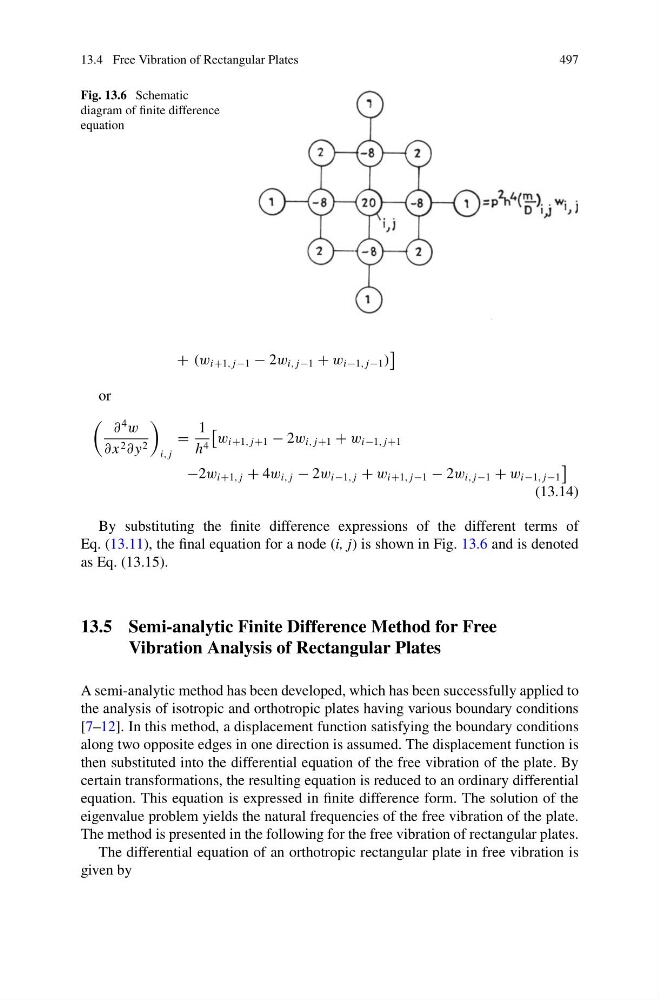
Fig. 13.6 Schematic
diagram of finite difference
equation
+ (w i+1, j−1 − 2w i, j−1 + w i−1, j−1 )
or
∂
4
w
∂ x 2 ∂ y 2
i, j
=
1
h 4
w i+1, j+1 − 2w i, j+1 + w i−1, j+1
−2w i+1, j + 4w i, j − 2w i−1, j + w i+1, j−1 − 2w i, j−1 + w i−1, j−1
(13.14)
By substituting the finite difference expressions of the different terms of
Eq. (13.11), the final equation for a node (i, j) is shown in Fig. 13.6 and is denoted
as Eq. (13.15).
13.5 Semi-analytic Finite Difference Method for Free
Vibration Analysis of Rectangular Plates
A semi-analytic method has been developed, which has been successfully applied to
the analysis of isotropic and orthotropic plates having various boundary conditions
[7–12]. In this method, a displacement function satisfying the boundary conditions
along two opposite edges in one direction is assumed. The displacement function is
then substituted into the differential equation of the free vibration of the plate. By
certain transformations, the resulting equation is reduced to an ordinary differential
equation. This equation is expressed in finite difference form. The solution of the
eigenvalue problem yields the natural frequencies of the free vibration of the plate.
The method is presented in the following for the free vibration of rectangular plates.
The differential equation of an orthotropic rectangular plate in free vibration is
given by
497
Fig. 13.6 Schematic
diagram of finite difference
equation
+ (w i+1, j−1 − 2w i, j−1 + w i−1, j−1 )
or
∂
4
w
∂ x 2 ∂ y 2
i, j
=
1
h 4
w i+1, j+1 − 2w i, j+1 + w i−1, j+1
−2w i+1, j + 4w i, j − 2w i−1, j + w i+1, j−1 − 2w i, j−1 + w i−1, j−1
(13.14)
By substituting the finite difference expressions of the different terms of
Eq. (13.11), the final equation for a node (i, j) is shown in Fig. 13.6 and is denoted
as Eq. (13.15).
13.5 Semi-analytic Finite Difference Method for Free
Vibration Analysis of Rectangular Plates
A semi-analytic method has been developed, which has been successfully applied to
the analysis of isotropic and orthotropic plates having various boundary conditions
[7–12]. In this method, a displacement function satisfying the boundary conditions
along two opposite edges in one direction is assumed. The displacement function is
then substituted into the differential equation of the free vibration of the plate. By
certain transformations, the resulting equation is reduced to an ordinary differential
equation. This equation is expressed in finite difference form. The solution of the
eigenvalue problem yields the natural frequencies of the free vibration of the plate.
The method is presented in the following for the free vibration of rectangular plates.
The differential equation of an orthotropic rectangular plate in free vibration is
given by