

2.5 Free Vibration with Coulomb Damping
35
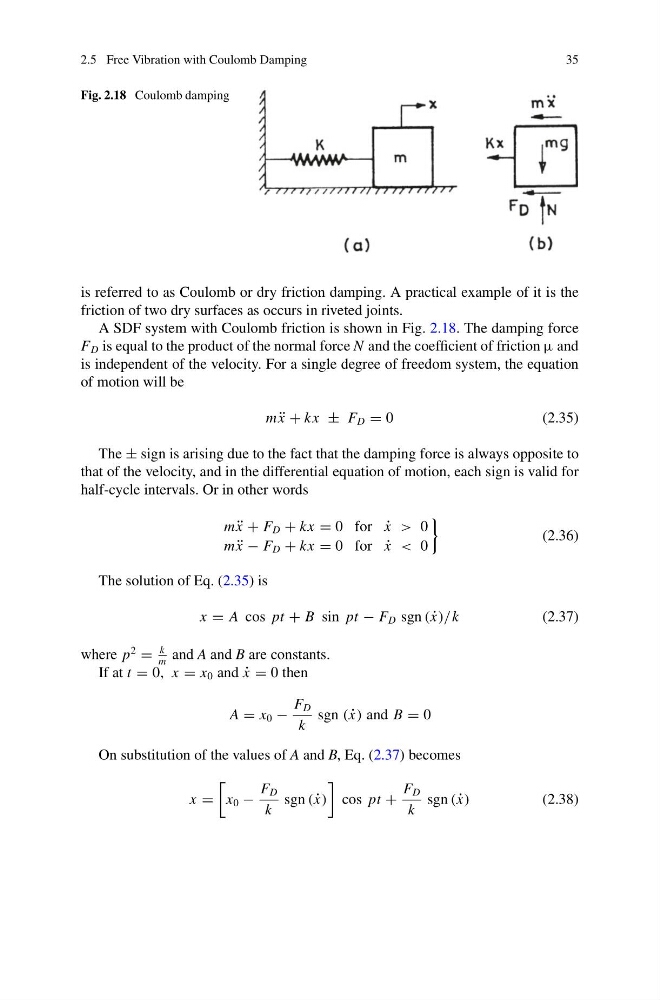
Fig. 2.18 Coulomb damping
is referred to as Coulomb or dry friction damping. A practical example of it is the
friction of two dry surfaces as occurs in riveted joints.
A SDF system with Coulomb friction is shown in Fig. 2.18. The damping force
F D is equal to the product of the normal force N and the coefficient of friction μ and
is independent of the velocity. For a single degree of freedom system, the equation
of motion will be
m ¨
x + kx ± F D = 0
(2.35)
The ± sign is arising due to the fact that the damping force is always opposite to
that of the velocity, and in the differential equation of motion, each sign is valid for
half-cycle intervals. Or in other words
m ¨
x + F D + kx = 0 for ˙
x > 0
m ¨
x − F D + kx = 0 for ˙
x < 0
(2.36)
The solution of Eq. (2.35) is
x = A cos pt + B sin pt − F D sgn ( ˙
x)/k
(2.37)
where p
2
=
k
m
and A and B are constants.
If at t = 0, x = x 0 and ˙
x = 0 then
A = x 0 −
F D
k
sgn ( ˙
x) and B = 0
On substitution of the values of A and B, Eq. (2.37) becomes
x =
x 0 −
F D
k
sgn ( ˙
x)
cos pt +
F D
k
sgn ( ˙
x)
(2.38)
35
Fig. 2.18 Coulomb damping
is referred to as Coulomb or dry friction damping. A practical example of it is the
friction of two dry surfaces as occurs in riveted joints.
A SDF system with Coulomb friction is shown in Fig. 2.18. The damping force
F D is equal to the product of the normal force N and the coefficient of friction μ and
is independent of the velocity. For a single degree of freedom system, the equation
of motion will be
m ¨
x + kx ± F D = 0
(2.35)
The ± sign is arising due to the fact that the damping force is always opposite to
that of the velocity, and in the differential equation of motion, each sign is valid for
half-cycle intervals. Or in other words
m ¨
x + F D + kx = 0 for ˙
x > 0
m ¨
x − F D + kx = 0 for ˙
x < 0
(2.36)
The solution of Eq. (2.35) is
x = A cos pt + B sin pt − F D sgn ( ˙
x)/k
(2.37)
where p
2
=
k
m
and A and B are constants.
If at t = 0, x = x 0 and ˙
x = 0 then
A = x 0 −
F D
k
sgn ( ˙
x) and B = 0
On substitution of the values of A and B, Eq. (2.37) becomes
x =
x 0 −
F D
k
sgn ( ˙
x)
cos pt +
F D
k
sgn ( ˙
x)
(2.38)