

34
2 Free Vibration of Single Degree of Freedom System
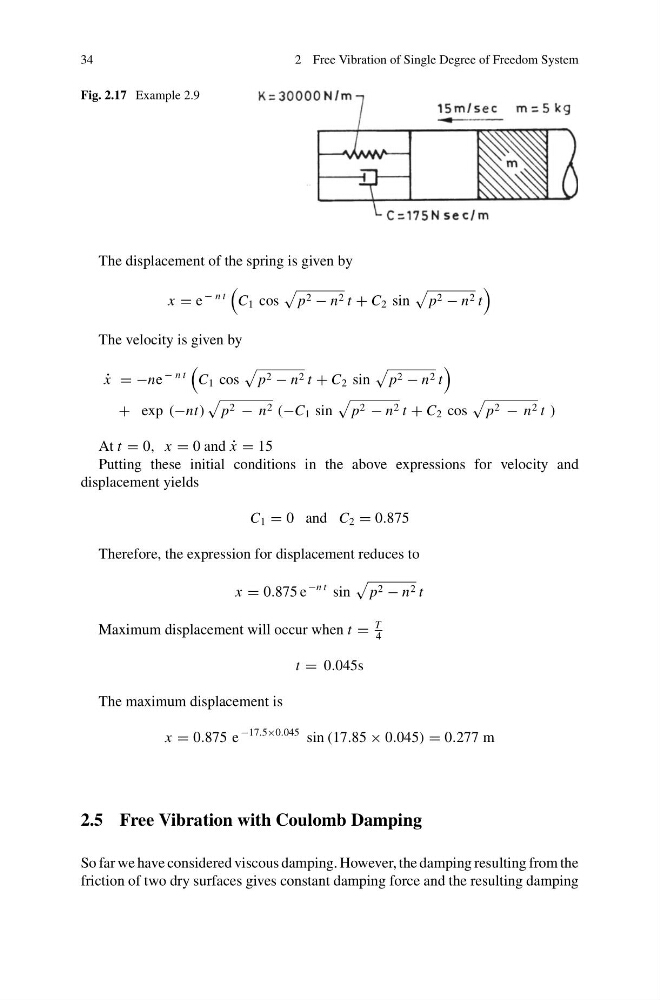
Fig. 2.17 Example 2.9
The displacement of the spring is given by
x = e
− n t
C 1 cos
p 2 − n 2 t + C 2 sin
p 2 − n 2 t
The velocity is given by
˙
x = −ne
− n t
C 1 cos
p 2 − n 2 t + C 2 sin
p 2 − n 2 t
+ exp (−nt)
p 2 − n 2 (−C 1 sin
p 2 − n 2 t + C 2 cos
p 2 − n 2 t )
At t = 0, x = 0 and ˙
x = 15
Putting these initial conditions in the above expressions for velocity and
displacement yields
C 1 = 0 and C 2 = 0.875
Therefore, the expression for displacement reduces to
x = 0.875 e
−n t sin
p 2 − n 2 t
Maximum displacement will occur when t =
T
4
t = 0.045s
The maximum displacement is
x = 0.875 e
−17.5×0.045 sin (17.85 × 0.045) = 0.277 m
2.5 Free Vibration with Coulomb Damping
So far we have considered viscous damping. However, the damping resulting from the
friction of two dry surfaces gives constant damping force and the resulting damping
2 Free Vibration of Single Degree of Freedom System
Fig. 2.17 Example 2.9
The displacement of the spring is given by
x = e
− n t
C 1 cos
p 2 − n 2 t + C 2 sin
p 2 − n 2 t
The velocity is given by
˙
x = −ne
− n t
C 1 cos
p 2 − n 2 t + C 2 sin
p 2 − n 2 t
+ exp (−nt)
p 2 − n 2 (−C 1 sin
p 2 − n 2 t + C 2 cos
p 2 − n 2 t )
At t = 0, x = 0 and ˙
x = 15
Putting these initial conditions in the above expressions for velocity and
displacement yields
C 1 = 0 and C 2 = 0.875
Therefore, the expression for displacement reduces to
x = 0.875 e
−n t sin
p 2 − n 2 t
Maximum displacement will occur when t =
T
4
t = 0.045s
The maximum displacement is
x = 0.875 e
−17.5×0.045 sin (17.85 × 0.045) = 0.277 m
2.5 Free Vibration with Coulomb Damping
So far we have considered viscous damping. However, the damping resulting from the
friction of two dry surfaces gives constant damping force and the resulting damping