

36
2 Free Vibration of Single Degree of Freedom System
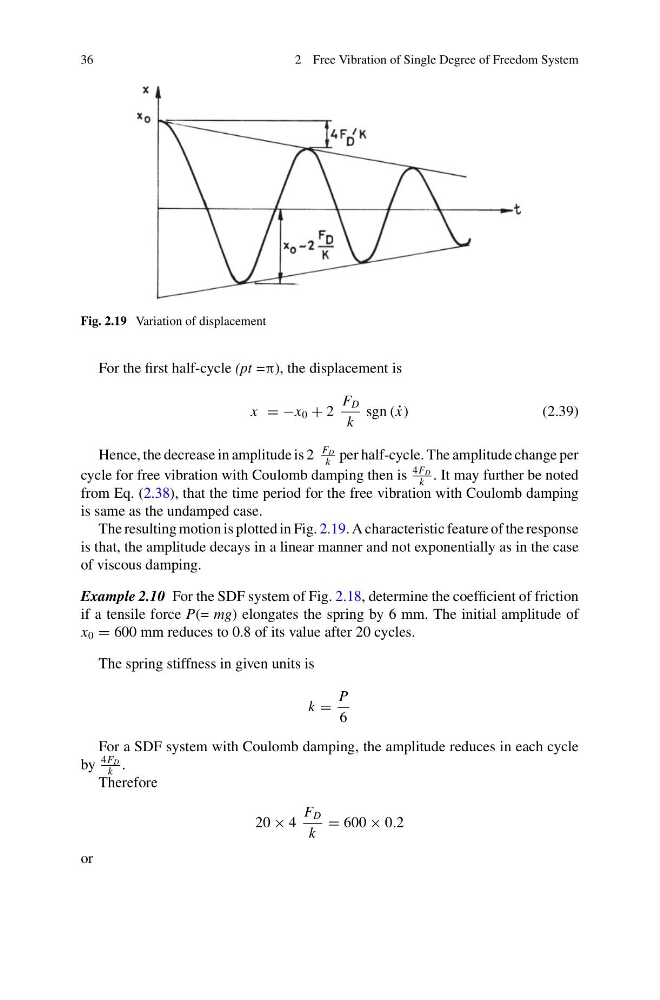
Fig. 2.19 Variation of displacement
For the first half-cycle (pt =π), the displacement is
x = −x 0 + 2
F D
k
sgn ( ˙
x)
(2.39)
Hence, the decrease in amplitude is 2
F D
k
per half-cycle. The amplitude change per
cycle for free vibration with Coulomb damping then is
4F D
k
. It may further be noted
from Eq. (2.38), that the time period for the free vibration with Coulomb damping
is same as the undamped case.
The resulting motion is plotted in Fig. 2.19. A characteristic feature of the response
is that, the amplitude decays in a linear manner and not exponentially as in the case
of viscous damping.
Example 2.10 For the SDF system of Fig. 2.18, determine the coefficient of friction
if a tensile force P(= mg) elongates the spring by 6 mm. The initial amplitude of
x 0 = 600 mm reduces to 0.8 of its value after 20 cycles.
The spring stiffness in given units is
k =
P
6
For a SDF system with Coulomb damping, the amplitude reduces in each cycle
by
4F D
k
.
Therefore
20 × 4
F D
k
= 600 × 0.2
or
2 Free Vibration of Single Degree of Freedom System
Fig. 2.19 Variation of displacement
For the first half-cycle (pt =π), the displacement is
x = −x 0 + 2
F D
k
sgn ( ˙
x)
(2.39)
Hence, the decrease in amplitude is 2
F D
k
per half-cycle. The amplitude change per
cycle for free vibration with Coulomb damping then is
4F D
k
. It may further be noted
from Eq. (2.38), that the time period for the free vibration with Coulomb damping
is same as the undamped case.
The resulting motion is plotted in Fig. 2.19. A characteristic feature of the response
is that, the amplitude decays in a linear manner and not exponentially as in the case
of viscous damping.
Example 2.10 For the SDF system of Fig. 2.18, determine the coefficient of friction
if a tensile force P(= mg) elongates the spring by 6 mm. The initial amplitude of
x 0 = 600 mm reduces to 0.8 of its value after 20 cycles.
The spring stiffness in given units is
k =
P
6
For a SDF system with Coulomb damping, the amplitude reduces in each cycle
by
4F D
k
.
Therefore
20 × 4
F D
k
= 600 × 0.2
or