

488
12 Finite Element Method in Vibration Analysis
Young’s modulus of the material of the bar E. Derive the stiffness matrix
and consistent mass matrix of the bar element.
12.2. Consider a uniform bar of length L. The bar is fixed at one end and free
at the other end. The bar is divided into two elements. The element has
two nodes, one at each end. Determine the natural frequency of the free
vibration of the bar.
12.3. Consider a shaft element subjected to torsion. The element has three nodes,
including one midside node. Find the consistent mass matrix and the
stiffness matrix for the element.
12.4. Consider a beam clamped at both ends. Treating the beam as uniform and
dividing it into two elements, determine the fundamental frequency of the
beam.
12.5. Consider a rectangular plate element subjected to inplane vibrations. Derive
the stiffness matrix and the consistent mass matrix for the plate element.
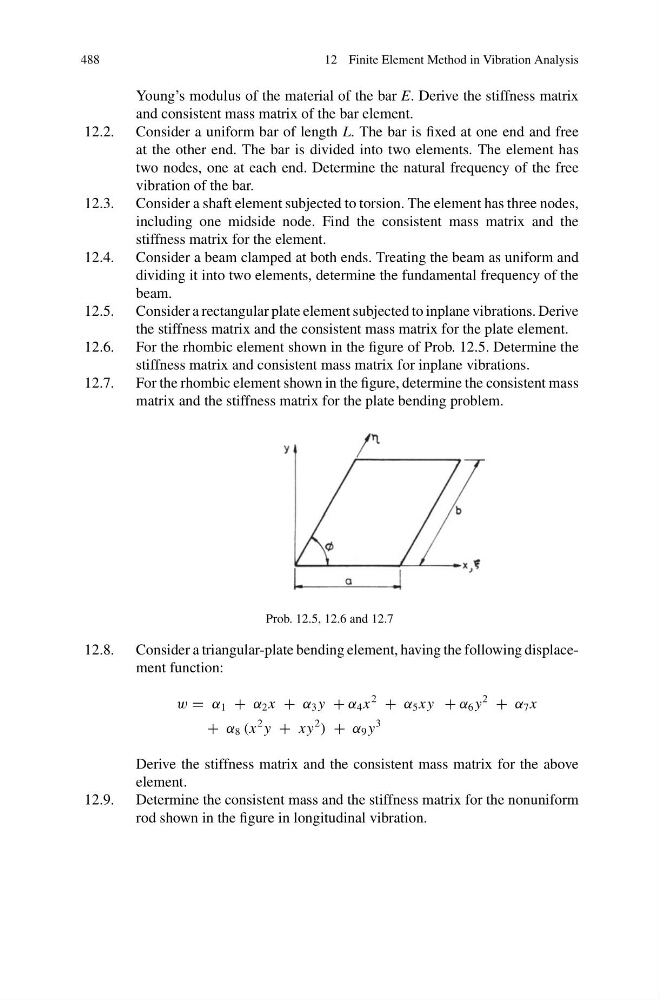
12.6. For the rhombic element shown in the figure of Prob. 12.5. Determine the
stiffness matrix and consistent mass matrix for inplane vibrations.
12.7. For the rhombic element shown in the figure, determine the consistent mass
matrix and the stiffness matrix for the plate bending problem.
Prob. 12.5, 12.6 and 12.7
12.8. Consider a triangular-plate bending element, having the following displacement function:
w = α 1 + α 2 x + α 3 y + α 4 x
2
+ α 5 x y + α 6 y
2
+ α 7 x
+ α 8 (x
2 y + x y
2
) + α 9 y
3
Derive the stiffness matrix and the consistent mass matrix for the above
element.
12.9. Determine the consistent mass and the stiffness matrix for the nonuniform
rod shown in the figure in longitudinal vibration.
12 Finite Element Method in Vibration Analysis
Young’s modulus of the material of the bar E. Derive the stiffness matrix
and consistent mass matrix of the bar element.
12.2. Consider a uniform bar of length L. The bar is fixed at one end and free
at the other end. The bar is divided into two elements. The element has
two nodes, one at each end. Determine the natural frequency of the free
vibration of the bar.
12.3. Consider a shaft element subjected to torsion. The element has three nodes,
including one midside node. Find the consistent mass matrix and the
stiffness matrix for the element.
12.4. Consider a beam clamped at both ends. Treating the beam as uniform and
dividing it into two elements, determine the fundamental frequency of the
beam.
12.5. Consider a rectangular plate element subjected to inplane vibrations. Derive
the stiffness matrix and the consistent mass matrix for the plate element.
12.6. For the rhombic element shown in the figure of Prob. 12.5. Determine the
stiffness matrix and consistent mass matrix for inplane vibrations.
12.7. For the rhombic element shown in the figure, determine the consistent mass
matrix and the stiffness matrix for the plate bending problem.
Prob. 12.5, 12.6 and 12.7
12.8. Consider a triangular-plate bending element, having the following displacement function:
w = α 1 + α 2 x + α 3 y + α 4 x
2
+ α 5 x y + α 6 y
2
+ α 7 x
+ α 8 (x
2 y + x y
2
) + α 9 y
3
Derive the stiffness matrix and the consistent mass matrix for the above
element.
12.9. Determine the consistent mass and the stiffness matrix for the nonuniform
rod shown in the figure in longitudinal vibration.