

12.9 Periodic Structures
489
Fig. Prob. 12.9
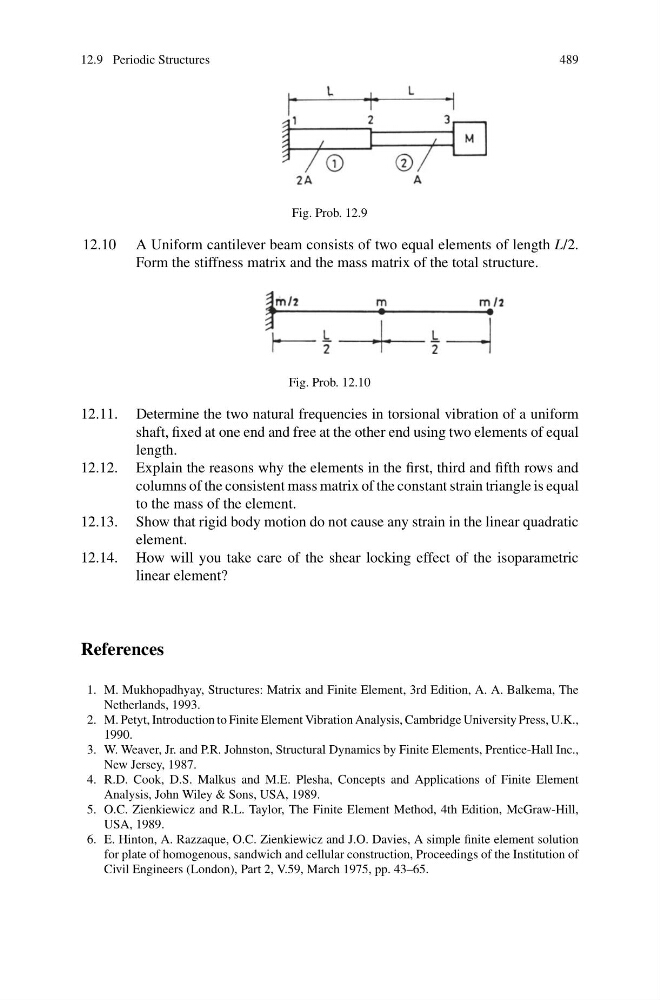
12.10 A Uniform cantilever beam consists of two equal elements of length L/2.
Form the stiffness matrix and the mass matrix of the total structure.
Fig. Prob. 12.10
12.11. Determine the two natural frequencies in torsional vibration of a uniform
shaft, fixed at one end and free at the other end using two elements of equal
length.
12.12. Explain the reasons why the elements in the first, third and fifth rows and
columns of the consistent mass matrix of the constant strain triangle is equal
to the mass of the element.
12.13. Show that rigid body motion do not cause any strain in the linear quadratic
element.
12.14. How will you take care of the shear locking effect of the isoparametric
linear element?
References
1. M. Mukhopadhyay, Structures: Matrix and Finite Element, 3rd Edition, A. A. Balkema, The
Netherlands, 1993.
2. M. Petyt, Introduction to Finite Element Vibration Analysis, Cambridge University Press, U.K.,
1990.
3. W. Weaver, Jr. and P.R. Johnston, Structural Dynamics by Finite Elements, Prentice-Hall Inc.,
New Jersey, 1987.
4. R.D. Cook, D.S. Malkus and M.E. Plesha, Concepts and Applications of Finite Element
Analysis, John Wiley & Sons, USA, 1989.
5. O.C. Zienkiewicz and R.L. Taylor, The Finite Element Method, 4th Edition, McGraw-Hill,
USA, 1989.
6. E. Hinton, A. Razzaque, O.C. Zienkiewicz and J.O. Davies, A simple finite element solution
for plate of homogenous, sandwich and cellular construction, Proceedings of the Institution of
Civil Engineers (London), Part 2, V.59, March 1975, pp. 43–65.
489
Fig. Prob. 12.9
12.10 A Uniform cantilever beam consists of two equal elements of length L/2.
Form the stiffness matrix and the mass matrix of the total structure.
Fig. Prob. 12.10
12.11. Determine the two natural frequencies in torsional vibration of a uniform
shaft, fixed at one end and free at the other end using two elements of equal
length.
12.12. Explain the reasons why the elements in the first, third and fifth rows and
columns of the consistent mass matrix of the constant strain triangle is equal
to the mass of the element.
12.13. Show that rigid body motion do not cause any strain in the linear quadratic
element.
12.14. How will you take care of the shear locking effect of the isoparametric
linear element?
References
1. M. Mukhopadhyay, Structures: Matrix and Finite Element, 3rd Edition, A. A. Balkema, The
Netherlands, 1993.
2. M. Petyt, Introduction to Finite Element Vibration Analysis, Cambridge University Press, U.K.,
1990.
3. W. Weaver, Jr. and P.R. Johnston, Structural Dynamics by Finite Elements, Prentice-Hall Inc.,
New Jersey, 1987.
4. R.D. Cook, D.S. Malkus and M.E. Plesha, Concepts and Applications of Finite Element
Analysis, John Wiley & Sons, USA, 1989.
5. O.C. Zienkiewicz and R.L. Taylor, The Finite Element Method, 4th Edition, McGraw-Hill,
USA, 1989.
6. E. Hinton, A. Razzaque, O.C. Zienkiewicz and J.O. Davies, A simple finite element solution
for plate of homogenous, sandwich and cellular construction, Proceedings of the Institution of
Civil Engineers (London), Part 2, V.59, March 1975, pp. 43–65.